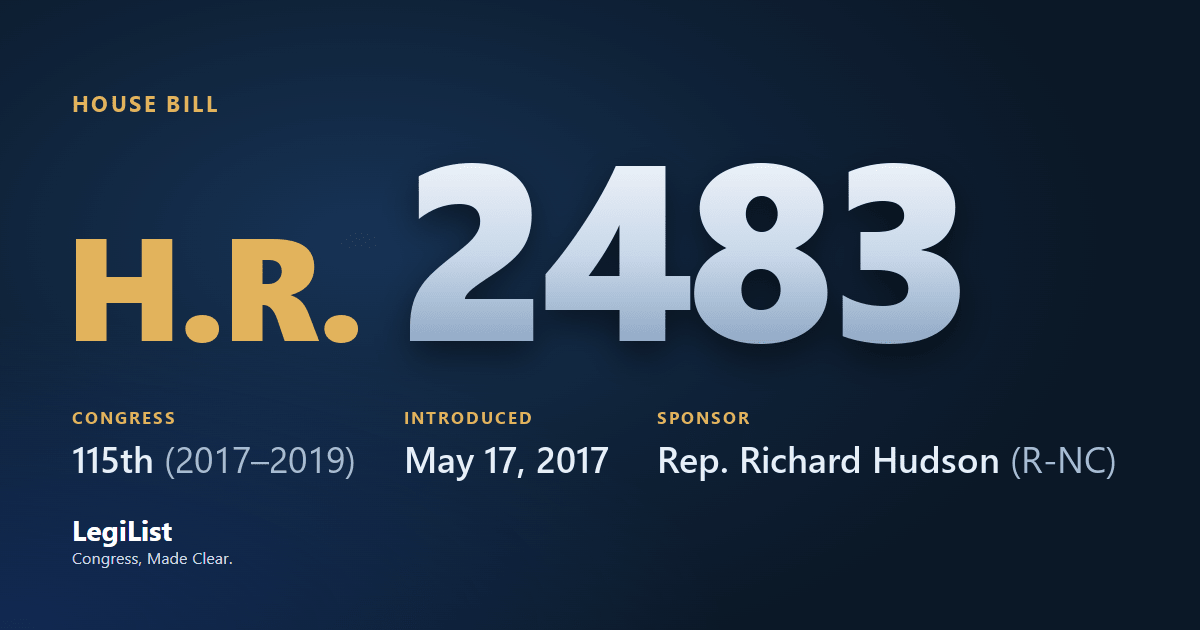
Quality Systems Certification Act of 2017
Latest action · May 19, 2017 Referred to the Subcommittee on Health.
Progress
Where this bill reached, and when. A stage with no date was not reached; one that failed a vote and later carried shows the date it carried.
- IntroducedMay 17, 2017
- Passed HouseNot reached
- Passed SenateNot reached
- To the PresidentNot reached
- Became lawNot reached
Summary
Quality Systems Certification Act of 2017
This bill amends the Federal Food, Drug, and Cosmetic Act to require the Food and Drug Administration (FDA) to establish a third-party quality system assessment program to accredit persons to assess whether a medical device manufacturer's quality system can ensure the safety and effectiveness or substantial equivalence of an approved medical device after certain changes, including changes in manufacturing or changes to enhance device safety.
Device manufacturers with quality systems that have been certified by an accredited person are allowed to make changes to a device without submitting to the FDA the premarket notification, 30-day notice, or premarket approval supplement that would otherwise be required.
An accredited person who assesses a device manufacturer's quality system must submit a summary of their assessment and, as appropriate, a certification of the quality system to the FDA within 30 days of the assessment. An assessment summary and certification is deemed accepted by the FDA 30 days after submission unless the FDA determines that additional information is needed to support certification, the assessment or certification is unwarranted, or an action other than acceptance of the certification is otherwise justified.
Device manufacturers who make changes to devices without submitting a premarket notification must describe the changes in an annual summary submitted to the FDA. Changes made without submitting a 30-day notice or a premarket approval supplement must be described in a periodic report.
Certifications accepted by the FDA remain in effect for two years.
The FDA must report on this quality system assessment program no later than January 31, 2022. The program is terminated at the end of FY2022.Cosponsors 1
Members who signed on, in the order they did. All signed on May 17, 2017.
| Seat | Cosponsor | Signed on | |
|---|---|---|---|
| R-IN | Larry Bucshon | Original | May 17, 2017 |
Committees 1
Where it was sent and what each committee and subcommittee did with it, in order.
| Chamber | Committee | What it did |
|---|---|---|
| House | Energy and Commerce Committee | Referred May 17, 2017 |
| Health Subcommittee | Referred May 19, 2017 |
Actions 3
Everything that happened, newest first.
- May 19, 2017Referred to the Subcommittee on Health.
- May 17, 2017Introduced in House
- May 17, 2017Referred to the House Committee on Energy and Commerce.
Research
What has been written about this bill: committee reports, cost estimates, the sponsor’s authority statement, printed hearings and the Congressional Research Service’s work.
Constitutional authority
The sponsor’s statement, as printed in the Congressional Record, vol. 163, no. 85, May 17, 2017, page H4311.
Related bills 1
Companion bills and other measures the record links to this one.
| Bill | Title | Relationship | Latest action |
|---|---|---|---|
| S 1183 | FDA Regulatory Efficiency Act | Related bill | May 18, 2017 |
Titles 2
Every title it has carried, official and short, at each stage.
- Official Title as Introduced
- To amend the Federal Food, Drug, and Cosmetic Act to provide for the establishment of a third-party quality system assessment program for devices, and for other purposes.
- Short Titles as Introduced
- Quality Systems Certification Act of 2017
Subjects
Assigned by the Library of Congress. Policy area: Health.
Text 1
Each version as it was printed, newest first.
- May 17, 2017Introduced in House
Support LegiList
This page is free, carries no paywall, and is built and maintained by one person. If the record here is useful to you, a few dollars keeps it going.
Everything here is as published by Congress: the summary is the Congressional Research Service's, the action wording is the clerks', and the subjects are the Library of Congress's. How far it got is read from the actions themselves, taking the most recent one of each kind, so a bill that failed a vote and later passed is shown as having passed. Records come from this bill on Congress.gov and govinfo.gov; cost estimates are the Congressional Budget Office's, and the hearings are the printed hearings GovInfo publishes, which can appear months after the hearing.