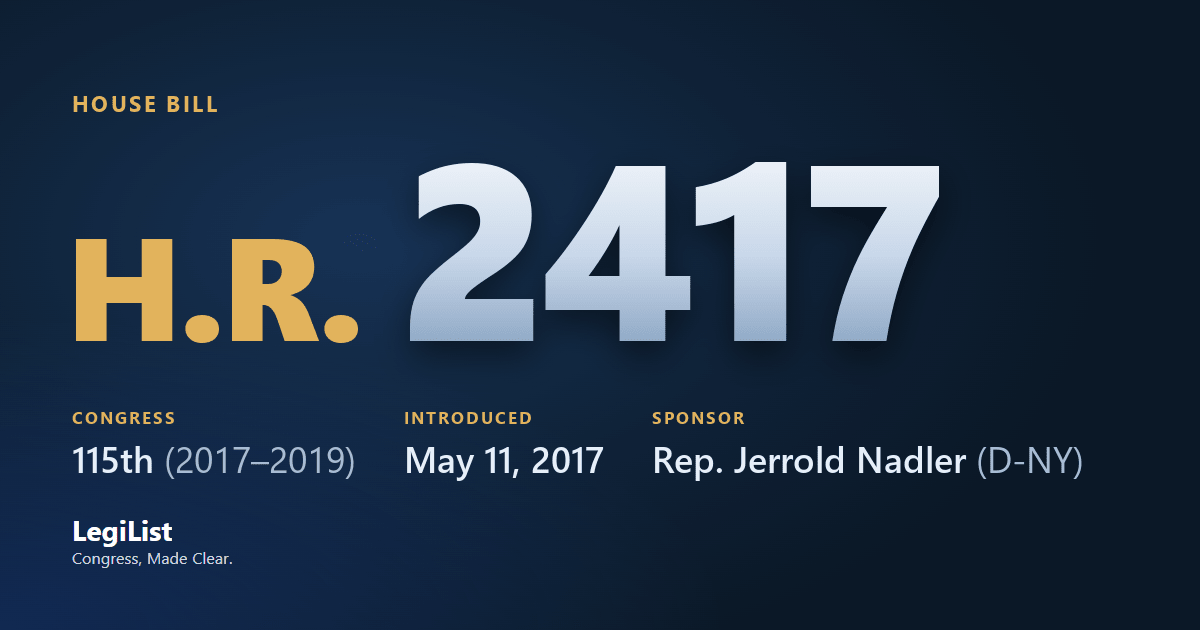
Pregnant Workers Fairness Act
Latest action · Jun 7, 2017 Referred to the Subcommittee on the Constitution and Civil Justice.
Progress
Where this bill reached, and when. A stage with no date was not reached; one that failed a vote and later carried shows the date it carried.
- IntroducedMay 11, 2017
- Passed HouseNot reached
- Passed SenateNot reached
- To the PresidentNot reached
- Became lawNot reached
Summary
Pregnant Workers Fairness Act
This bill prohibits employment practices that discriminate against making reasonable accommodations for job applicants or employees affected by pregnancy, childbirth, or related medical conditions. Specifically, the bill declares that it is an unlawful employment practice to: (1) fail to make reasonable accommodations to known limitations of such job applicants or employees, unless the accommodation would impose an undue hardship on an entity's business operation; (2) deny employment opportunities based on the need of the entity to make such reasonable accommodations; (3) require such job applicants or employees to accept an accommodation that they choose not to accept, if such accommodation is unnecessary to perform the job; (4) require such employees to take paid or unpaid leave if another reasonable accommodation can be provided to their known limitations; or (5) take adverse action in terms, conditions, or privileges of employment against an employee requesting or using such reasonable accommodations.
The bill sets forth enforcement procedures and remedies under the Civil Rights Act of 1964, the Congressional Accountability Act of 1995, the Government Employee Rights Act of 1991, and the rights and protections extended to presidential offices.
The Equal Employment Opportunity Commission must provide examples of reasonable accommodations that shall be provided to affected job applicants or employees unless the employer can demonstrate that doing so would impose an undue hardship.
The bill prohibits state immunity under the Eleventh Amendment to the Constitution from an action for a violation of this bill.
Cosponsors 131
Members who signed on, in the order they did. Signatures ran from May 11, 2017 to Nov 29, 2018; 5 are original cosponsors, there from the day it was introduced.
| Seat | Cosponsor | Signed on | |
|---|---|---|---|
| D-NY | Carolyn B. Maloney | Original | May 11, 2017 |
| D-CA | Jackie Speier | Original | May 11, 2017 |
| R-NY | John Katko | Original | May 11, 2017 |
| R-CO | Mike Coffman | Original | May 11, 2017 |
| D-VA | Robert C. "Bobby" Scott | Original | May 11, 2017 |
| D-CA | Adam B. Schiff | May 25, 2017 | |
| D-CA | Barbara Lee | May 25, 2017 | |
| D-IL | Daniel Lipinski | May 25, 2017 | |
| D-CO | Diana DeGette | May 25, 2017 | |
| D-NJ | Donald M. Payne, Jr. | May 25, 2017 | |
| D-DC | Eleanor Holmes Norton | May 25, 2017 | |
| D-MD | Elijah E. Cummings | May 25, 2017 | |
| D-NY | Eliot L. Engel | May 25, 2017 | |
| D-CT | Elizabeth H. Esty | May 25, 2017 | |
| D-FL | Frederica S. Wilson | May 25, 2017 |
Committees 4
Where it was sent and what each committee and subcommittee did with it, in order.
| Chamber | Committee | What it did |
|---|---|---|
| House | Education and Workforce Committee | Referred May 11, 2017 |
| House | Committee on House Administration | Referred May 11, 2017 |
| House | Oversight and Government Reform Committee | Referred May 11, 2017 |
| House | Judiciary Committee | Referred May 11, 2017 |
| Constitution and Limited Government Subcommittee | Referred Jun 7, 2017 |
Actions 3
Everything that happened, newest first.
- Jun 7, 2017Referred to the Subcommittee on the Constitution and Civil Justice.
- May 11, 2017Introduced in House
- May 11, 2017Referred to the Committee on Education and the Workforce, and in addition to the Committees on House Administration, Oversight and Government Reform, and the Judiciary, for a period to be subsequently determined by the Speaker, in each case for consideration of such provisions as fall within the jurisdiction of the committee concerned.
Research
What has been written about this bill: committee reports, cost estimates, the sponsor’s authority statement, printed hearings and the Congressional Research Service’s work.
Constitutional authority
The sponsor’s statement, as printed in the Congressional Record, vol. 163, no. 82, May 11, 2017, page H4190.
Related bills 3
Companion bills and other measures the record links to this one.
| Bill | Title | Relationship | Latest action |
|---|---|---|---|
| S 1101 | Pregnant Workers Fairness Act | Related bill | May 11, 2017 |
| HR 2654 | Pregnant Workers Fairness Act | Reintroduction of | Nov 16, 2015 |
| HR 2694 | Pregnant Workers Fairness Act | Reintroduced Bill | Sep 17, 2020 |
Titles 2
Every title it has carried, official and short, at each stage.
- Official Title as Introduced
- To eliminate discrimination and promote women's health and economic security by ensuring reasonable workplace accommodations for workers whose ability to perform the functions of a job are limited by pregnancy, childbirth, or a related medical condition.
- Short Titles as Introduced
- Pregnant Workers Fairness Act
Subjects
Assigned by the Library of Congress. Policy area: Labor and Employment.
- Administrative law and regulatory procedures
- Child care and development
- Civil actions and liability
- Employee hiring
- Employee leave
- Employment discrimination and employee rights
- Equal Employment Opportunity Commission (EEOC)
- Government employee pay, benefits, personnel management
- Government liability
- Labor and Employment
- Sex and reproductive health
- Sex, gender, sexual orientation discrimination
- State and local government operations
- Women's employment
- Women's health
Text 1
Each version as it was printed, newest first.
- May 11, 2017Introduced in House
Support LegiList
This page is free, carries no paywall, and is built and maintained by one person. If the record here is useful to you, a few dollars keeps it going.
Everything here is as published by Congress: the summary is the Congressional Research Service's, the action wording is the clerks', and the subjects are the Library of Congress's. How far it got is read from the actions themselves, taking the most recent one of each kind, so a bill that failed a vote and later passed is shown as having passed. Records come from this bill on Congress.gov and govinfo.gov; cost estimates are the Congressional Budget Office's, and the hearings are the printed hearings GovInfo publishes, which can appear months after the hearing.