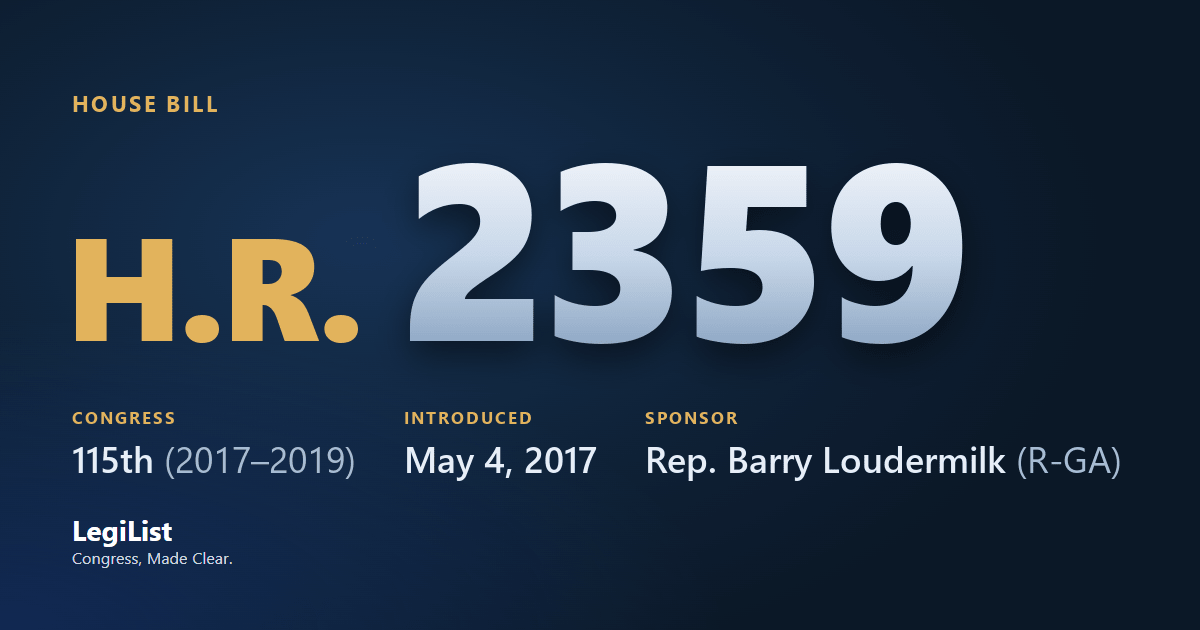
FCRA Liability Harmonization Act
Latest action · Sep 7, 2017 Hearings Held by the Subcommittee on Financial Institutions and Consumer Credit Prior to Referral.
Progress
Where this bill reached, and when. A stage with no date was not reached; one that failed a vote and later carried shows the date it carried.
- IntroducedMay 4, 2017
- Passed HouseNot reached
- Passed SenateNot reached
- To the PresidentNot reached
- Became lawNot reached
Summary
FCRA Liability Harmonization Act
This bill amends the Fair Credit Reporting Act to limit the recovery amount available in a class action lawsuit to the lesser of $500,000 or 1% of the net worth of the defendant. The bill also eliminates the awarding of punitive damages.
Cosponsors 13
Members who signed on, in the order they did. Signatures ran from May 4, 2017 to Sep 7, 2017; 4 are original cosponsors, there from the day it was introduced.
| Seat | Cosponsor | Signed on | |
|---|---|---|---|
| R-MO | Ann Wagner | Original | May 4, 2017 |
| R-CA | Edward R. Royce | Original | May 4, 2017 |
| R-NY | Peter T. King | Original | May 4, 2017 |
| R-NC | Ted Budd | Original | May 4, 2017 |
| R-CO | Scott R. Tipton | May 17, 2017 | |
| R-MI | David A. Trott | May 18, 2017 | |
| R-PA | Keith J. Rothfus | May 18, 2017 | |
| R-MN | Tom Emmer | Jun 6, 2017 | |
| R-NC | Robert Pittenger | Jun 20, 2017 | |
| R-OK | Frank D. Lucas | Jul 18, 2017 | |
| R-OH | Steve Stivers | Jul 19, 2017 | |
| R-MI | Bill Huizenga | Aug 8, 2017 | |
| R-TX | Roger Williams | Sep 7, 2017 |
Committees 2
Where it was sent and what each committee and subcommittee did with it, in order.
| Chamber | Committee | What it did |
|---|---|---|
| House | Financial Services Committee | Referred May 4, 2017 |
| Consumer Protection and Financial Institutions Subcommittee | Hearings Sep 7, 2017 | |
| House | Judiciary Committee | Referred May 4, 2017 |
| Constitution and Limited Government Subcommittee | Referred Jun 7, 2017 |
Actions 4
Everything that happened, newest first.
- Sep 7, 2017Hearings Held by the Subcommittee on Financial Institutions and Consumer Credit Prior to Referral.
- Jun 7, 2017Referred to the Subcommittee on the Constitution and Civil Justice.
- May 4, 2017Introduced in House
- May 4, 2017Referred to the Committee on Financial Services, and in addition to the Committee on the Judiciary, for a period to be subsequently determined by the Speaker, in each case for consideration of such provisions as fall within the jurisdiction of the committee concerned.
Research
What has been written about this bill: committee reports, cost estimates, the sponsor’s authority statement, printed hearings and the Congressional Research Service’s work.
Constitutional authority
The sponsor’s statement, as printed in the Congressional Record, vol. 163, no. 77, May 4, 2017, page H4179.
Printed hearings 1
Hearings whose printed record names this bill, newest first: hearings on it, and wider hearings where it came up.
| Number | Hearing | Committee | Held |
|---|---|---|---|
| Serial No. 115-38 | LEGISLATIVE PROPOSALS FOR A MORE EFFICIENT FEDERAL FINANCIAL REGULATORY REGIME209 pages | Financial Services Committee | Sep 7, 2017 |
Titles 2
Every title it has carried, official and short, at each stage.
- Official Title as Introduced
- To amend the civil liability requirements under the Fair Credit Reporting Act to include requirements relating to class actions, and for other purposes.
- Short Titles as Introduced
- FCRA Liability Harmonization Act
Subjects
Assigned by the Library of Congress. Policy area: Finance and Financial Sector.
Text 1
Each version as it was printed, newest first.
- May 4, 2017Introduced in House
Everything here is as published by Congress: the summary is the Congressional Research Service's, the action wording is the clerks', and the subjects are the Library of Congress's. How far it got is read from the actions themselves, taking the most recent one of each kind, so a bill that failed a vote and later passed is shown as having passed. Records come from this bill on Congress.gov and govinfo.gov; cost estimates are the Congressional Budget Office's, and the hearings are the printed hearings GovInfo publishes, which can appear months after the hearing.