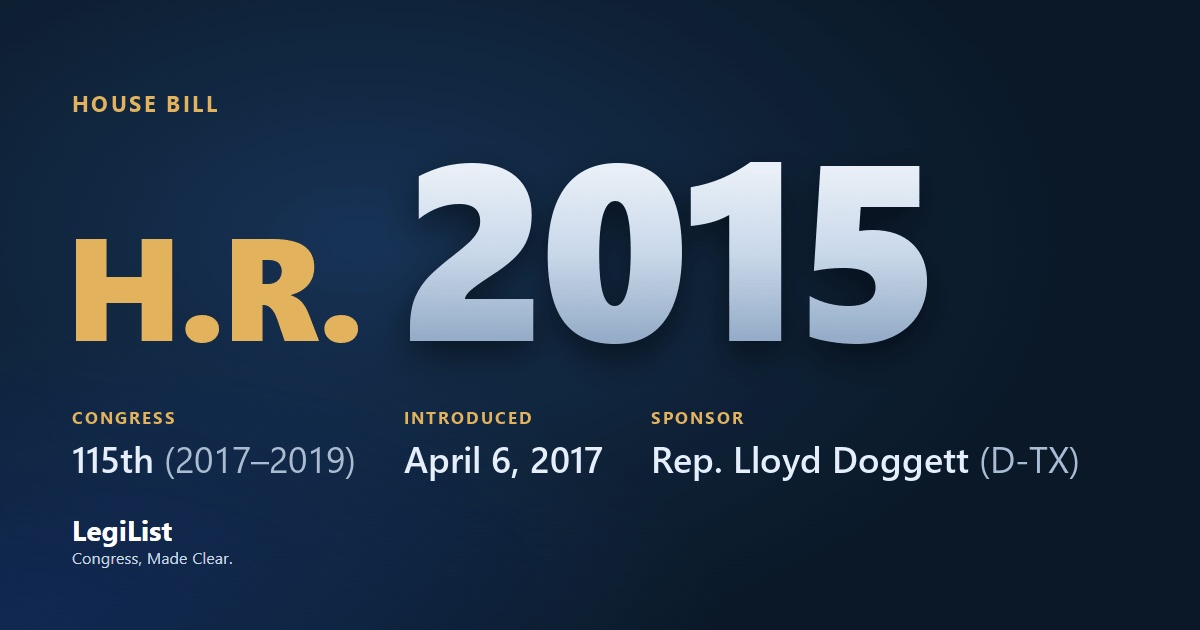
Equitable Student Aid Access Act
Latest action · Apr 6, 2017 Referred to the House Committee on Education and the Workforce.
Progress
Where this bill reached, and when. A stage with no date was not reached; one that failed a vote and later carried shows the date it carried.
- IntroducedApr 6, 2017
- Passed HouseNot reached
- Passed SenateNot reached
- To the PresidentNot reached
- Became lawNot reached
Summary
Equitable Student Aid Access Act
This bill amends the Higher Education Act of 1965 to revise requirements governing the Free Application for Federal Student Aid (FAFSA).
The bill increases the adjusted gross income threshold used to determine whether a student qualifies for an automatic zero expected family contribution (EFC) in the calculation of the student's financial need. A dependent student is eligible for an automatic zero EFC if the student's parents have adjusted gross income up to $30,000. An independent student with non-spouse dependents is eligible for a zero EFC if the student and spouse have adjusted gross income up to $30,000.
The bill requires the Department of Education (ED) to allow students to use tax information from the year before the previous one in determining their financial aid eligibility. The Internal Revenue Service and ED must share available data pursuant to taxpayer consent.
The bill requires the FAFSA application to be available to students by October 1, which is three months earlier than is currently required.
Cosponsors 100
Members who signed on, in the order they did. Signatures ran from Apr 6, 2017 to Oct 19, 2018; 61 are original cosponsors, there from the day it was introduced.
| Seat | Cosponsor | Signed on | |
|---|---|---|---|
| D-TX | Al Green | Original | Apr 6, 2017 |
| D-FL | Alcee L. Hastings | Original | Apr 6, 2017 |
| D-NC | Alma S. Adams | Original | Apr 6, 2017 |
| D-IN | André Carson | Original | Apr 6, 2017 |
| D-NM | Ben Ray Luján | Original | Apr 6, 2017 |
| D-TX | Beto O'Rourke | Original | Apr 6, 2017 |
| D-NY | Brian Higgins | Original | Apr 6, 2017 |
| D-MD | C. A. Dutch Ruppersberger | Original | Apr 6, 2017 |
| D-IL | Cheri Bustos | Original | Apr 6, 2017 |
| D-MI | Daniel T. Kildee | Original | Apr 6, 2017 |
| D-FL | Darren Soto | Original | Apr 6, 2017 |
| D-NC | David E. Price | Original | Apr 6, 2017 |
| D-RI | David N. Cicilline | Original | Apr 6, 2017 |
| D-GA | David Scott | Original | Apr 6, 2017 |
| D-NV | Dina Titus | Original | Apr 6, 2017 |
Withdrew 1 Joe Wilson R-SC Apr 27, 2017
Committees 1
Where it was sent and what each committee and subcommittee did with it, in order.
| Chamber | Committee | What it did |
|---|---|---|
| House | Education and Workforce Committee | Referred Apr 6, 2017 |
Actions 2
Everything that happened, newest first.
- Apr 6, 2017Introduced in House
- Apr 6, 2017Referred to the House Committee on Education and the Workforce.
Research
What has been written about this bill: committee reports, cost estimates, the sponsor’s authority statement, printed hearings and the Congressional Research Service’s work.
Constitutional authority
The sponsor’s statement, as printed in the Congressional Record, vol. 163, no. 60, April 6, 2017, page H2791.
Printed hearings 1
Hearings whose printed record names this bill, newest first: hearings on it, and wider hearings where it came up.
| Number | Hearing | Committee | Held |
|---|---|---|---|
| — | PROCEEDINGS OF THE FULL COMMITTEE MARKUP ON H.R. 1224, NIST CYBERSECURITY FRAMEWORK, ASSESSMENT, AND AUDITING ACT OF 2017942 pages | Science, Space, and Technology Committee | Jan 10, 2017–Nov 15, 2017 |
Titles 2
Every title it has carried, official and short, at each stage.
- Official Title as Introduced
- To amend the Higher Education Act of 1965 to simplify the financial aid application process, and for other purposes.
- Short Titles as Introduced
- Equitable Student Aid Access Act
Subjects
Assigned by the Library of Congress. Policy area: Education.
Text 1
Each version as it was printed, newest first.
- Apr 6, 2017Introduced in House
Everything here is as published by Congress: the summary is the Congressional Research Service's, the action wording is the clerks', and the subjects are the Library of Congress's. How far it got is read from the actions themselves, taking the most recent one of each kind, so a bill that failed a vote and later passed is shown as having passed. Records come from this bill on Congress.gov and govinfo.gov; cost estimates are the Congressional Budget Office's, and the hearings are the printed hearings GovInfo publishes, which can appear months after the hearing.