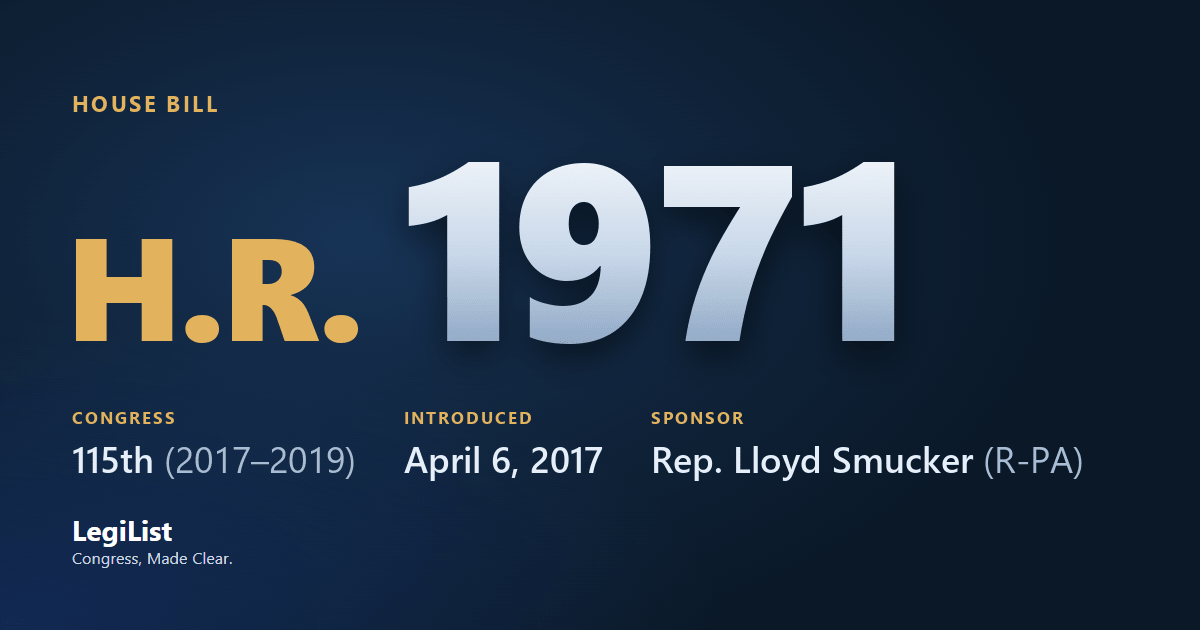
Water Infrastructure Flexibility Act
Latest action · Apr 7, 2017 Referred to the Subcommittee on Water Resources and Environment.
Progress
Where this bill reached, and when. A stage with no date was not reached; one that failed a vote and later carried shows the date it carried.
- IntroducedApr 6, 2017
- Passed HouseNot reached
- Passed SenateNot reached
- To the PresidentNot reached
- Became lawNot reached
Summary
Water Infrastructure Flexibility Act
This bill amends the Federal Water Pollution Control Act (commonly known as the Clean Water Act) to allow municipalities to develop a plan that integrates wastewater and stormwater management.
A permit for a municipal discharge under the national pollutant discharge elimination system that incorporates an integrated plan may integrate all requirements under the Act addressed in the plan. Those permits may include a schedule of compliance that allows actions for meeting water quality-based effluent limitations to be implemented over more than one permit term if the compliance schedules are authorized by state water quality standards. Those actions may include implementing green infrastructure as part of a water quality-based effluent limitation. (Green infrastructure includes measures that mimic natural processes to store, reuse, or reduce stormwater.)
The bill establishes an Office of the Municipal Ombudsman in the Environmental Protection Agency (EPA) to provide: (1) technical assistance to municipalities seeking to comply with the Clean Water Act and the Safe Drinking Water Act, and (2) information to the EPA to ensure that agency policies are implemented by all EPA offices.
The EPA must ensure that specified EPA offices promote the integration of green infrastructure into permitting programs, planning efforts, research, technical assistance, and funding guidance.
The bill establishes requirements for revising the EPA's 1997 guidance about combined sewer overflows, including by setting forth criteria for determining the ability of households to pay utility bills. (Combined sewer systems collect rainwater, sewage, and industrial wastewater into one pipe. During storms, the combined wastewater sometimes exceeds the capacity of the treatment plant. When this occurs, combined sewer overflows discharge directly into water bodies.)
Cosponsors 1
Members who signed on, in the order they did. All signed on Apr 26, 2017.
| Seat | Cosponsor | Signed on | |
|---|---|---|---|
| R-OH | Robert E. Latta | Apr 26, 2017 |
Committees 2
Where it was sent and what each committee and subcommittee did with it, in order.
| Chamber | Committee | What it did |
|---|---|---|
| House | Transportation and Infrastructure Committee | Referred Apr 6, 2017 |
| Water Resources and Environment Subcommittee | Referred Apr 7, 2017 | |
| House | Energy and Commerce Committee | Referred Apr 6, 2017 |
| Environment Subcommittee | Referred Apr 7, 2017 |
Actions 4
Everything that happened, newest first.
- Apr 7, 2017Referred to the Subcommittee on Environment.
- Apr 7, 2017Referred to the Subcommittee on Water Resources and Environment.
- Apr 6, 2017Introduced in House
- Apr 6, 2017Referred to the Committee on Transportation and Infrastructure, and in addition to the Committee on Energy and Commerce, for a period to be subsequently determined by the Speaker, in each case for consideration of such provisions as fall within the jurisdiction of the committee concerned.
Research
What has been written about this bill: committee reports, cost estimates, the sponsor’s authority statement, printed hearings and the Congressional Research Service’s work.
Constitutional authority
The sponsor’s statement, as printed in the Congressional Record, vol. 163, no. 60, April 6, 2017, page H2789.
Printed hearings 1
Hearings whose printed record names this bill, newest first: hearings on it, and wider hearings where it came up.
| Number | Hearing | Committee | Held |
|---|---|---|---|
| Serial No. 115-16 | BUILDING A 21ST-CENTURY INFRASTRUCTURE FOR AMERICA: IMPROVING WATER QUALITY THROUGH INTEGRATED PLANNING155 pages | Transportation and Infrastructure Committee | May 18, 2017 |
CRS reports 1
Congressional Research Service work that CRS links to this bill or the law it became, newest first.
Cite it 1
Products on other subjects that cite it, usually among other measures.
| Product | Title | Kind | Published |
|---|---|---|---|
| R44963 | Wastewater Infrastructure: Overview, Funding, and Legislative Developments Archived | Report | May 22, 2018 |
Related bills 4
Companion bills and other measures the record links to this one.
| Bill | Title | Relationship | Latest action |
|---|---|---|---|
| S 692 | Water Infrastructure Flexibility Act | Identical bill | Oct 13, 2017 |
| HR 2355 | Water Infrastructure Flexibility Act | Related bill | May 5, 2017 |
| S 2800 | America's Water Infrastructure Act of 2018 | Related bill | Jul 10, 2018 |
| HR 7279 | Water Infrastructure Improvement Act | Related bill | Jan 14, 2019 |
Titles 2
Every title it has carried, official and short, at each stage.
- Official Title as Introduced
- To provide for integrated plan permits, to establish an Office of the Municipal Ombudsman, to promote green infrastructure, and to require the revision of financial capability guidance.
- Short Titles as Introduced
- Water Infrastructure Flexibility Act
Subjects
Assigned by the Library of Congress. Policy area: Environmental Protection.
- Congressional oversight
- Environmental Protection
- Environmental Protection Agency (EPA)
- Executive agency funding and structure
- Infrastructure development
- Intergovernmental relations
- Licensing and registrations
- Public utilities and utility rates
- State and local government operations
- Water quality
- Water use and supply
Text 1
Each version as it was printed, newest first.
- Apr 6, 2017Introduced in House
Everything here is as published by Congress: the summary is the Congressional Research Service's, the action wording is the clerks', and the subjects are the Library of Congress's. How far it got is read from the actions themselves, taking the most recent one of each kind, so a bill that failed a vote and later passed is shown as having passed. Records come from this bill on Congress.gov and govinfo.gov; cost estimates are the Congressional Budget Office's, and the hearings are the printed hearings GovInfo publishes, which can appear months after the hearing.