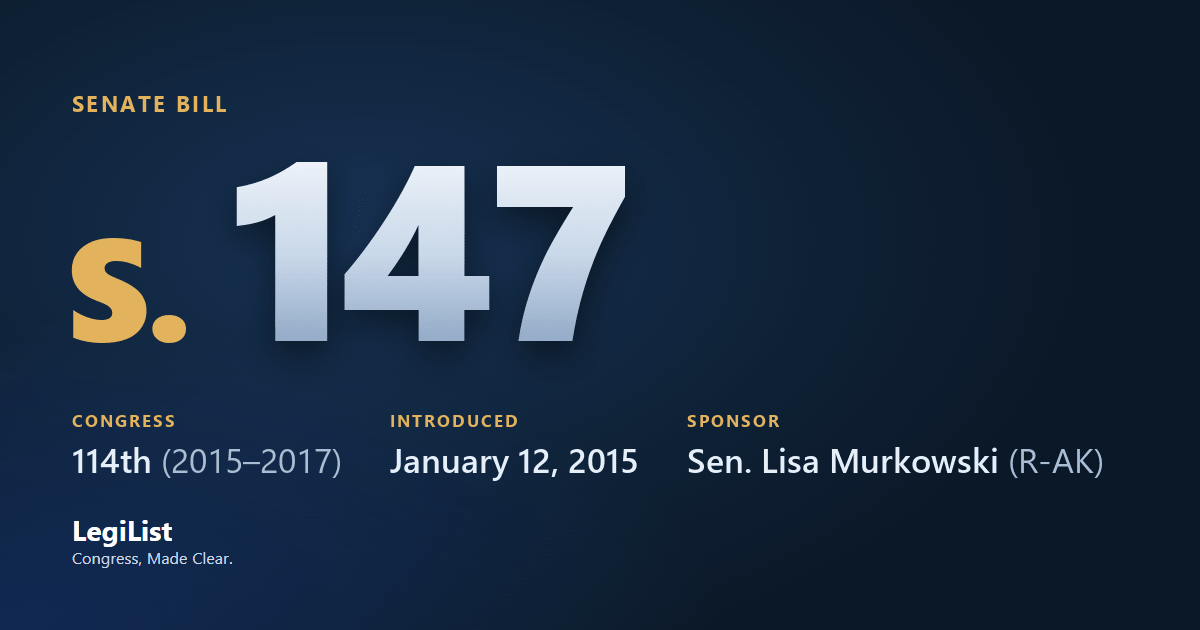
Keystone XL Pipeline Approval Act
Latest action · Jan 12, 2015 Placed on Senate Legislative Calendar under General Orders. Calendar No. 2.
Progress
Where this bill reached, and when. A stage with no date was not reached; one that failed a vote and later carried shows the date it carried.
- IntroducedJan 12, 2015
- Passed SenateNot reached
- Passed HouseNot reached
- To the PresidentNot reached
- Became lawNot reached
Summary
(This measure has not been amended since it was introduced. The summary has been expanded because action occurred on the measure.)
Keystone XL Pipeline Approval Act
(Sec. 2) Authorizes TransCanada Keystone Pipeline, L.P. to construct, connect, operate, and maintain the pipeline and cross-border facilities specified in an application filed by TransCanada Corporation to the Department of State on May 4, 2012.
Deems the Final Supplemental Environmental Impact Statement regarding the pipeline issued by the Secretary of State in January 2014 to fully satisfy the National Environmental Policy Act of 1969 and any law that requires federal agency consultation or review, including the Endangered Species Act of 1973.
Maintains in effect any applicable federal permit or authorization issued before enactment of this Act.
Grants original and exclusive jurisdiction, except for review in the Supreme Court, to the U.S. Court of Appeals for the District of Columbia Circuit over any civil action for the review of a federal agency action regarding the pipeline and related facilities.
Declares that this Act does not alter any federal, state, or local process or condition in effect on the date of enactment of this Act that is necessary to secure access from an owner of private property to construct the pipeline and cross-border facilities.
Cosponsors
Members who signed on, in the order they did.
Committees 1
Where it was sent and what each committee and subcommittee did with it, in order.
| Chamber | Committee | What it did |
|---|---|---|
| Senate | Energy and Natural Resources Committee | Reported as an original measure Jan 12, 2015 |
Actions 3
Everything that happened, newest first.
- Jan 12, 2015Introduced in Senate
- Jan 12, 2015Committee on Energy and Natural Resources. Original measure reported to Senate by Senator Murkowski. With written report No. 114-1. Minority views filed.
- Jan 12, 2015Placed on Senate Legislative Calendar under General Orders. Calendar No. 2.
Research
What has been written about this bill: committee reports, cost estimates, the sponsor’s authority statement, printed hearings and the Congressional Research Service’s work.
Committee report
Congressional Budget Office cost estimate
- Jan 20, 2015Keystone XL Pipeline Approval ActAs ordered reported by the Senate Committee on Energy and Natural Resources on January 8, 2015
CRS reports 2
Congressional Research Service work that CRS links to this bill or the law it became, newest first.
Cite it 2
Products on other subjects that cite it, usually among other measures.
| Product | Title | Kind | Published |
|---|---|---|---|
| R44140 | Presidential Permit Review for Cross-Border Pipelines and Electric Transmission | Report | Apr 19, 2017 |
| R43787 | Keystone XL Pipeline: Overview and Recent Developments Archived | Report | Apr 1, 2015 |
Related bills 2
Companion bills and other measures the record links to this one.
| Bill | Title | Relationship | Latest action |
|---|---|---|---|
| S 1 | Keystone XL Pipeline Approval Act | Related bill | Mar 4, 2015 |
| HR 3 | Keystone XL Pipeline Act | Related bill | Jan 12, 2015 |
Titles 3
Every title it has carried, official and short, at each stage.
- Official Title as Introduced
- An original bill to approve the Keystone XL Pipeline.
- Short Titles as Introduced
- Keystone XL Pipeline Approval Act
- Short Titles as Reported to Senate
- Keystone XL Pipeline Approval Act
Subjects
Assigned by the Library of Congress. Policy area: Energy.
Text 1
Each version as it was printed, newest first.
- Jan 12, 2015Placed on Calendar Senate
Everything here is as published by Congress: the summary is the Congressional Research Service's, the action wording is the clerks', and the subjects are the Library of Congress's. How far it got is read from the actions themselves, taking the most recent one of each kind, so a bill that failed a vote and later passed is shown as having passed. Records come from this bill on Congress.gov and govinfo.gov; cost estimates are the Congressional Budget Office's, and the hearings are the printed hearings GovInfo publishes, which can appear months after the hearing.