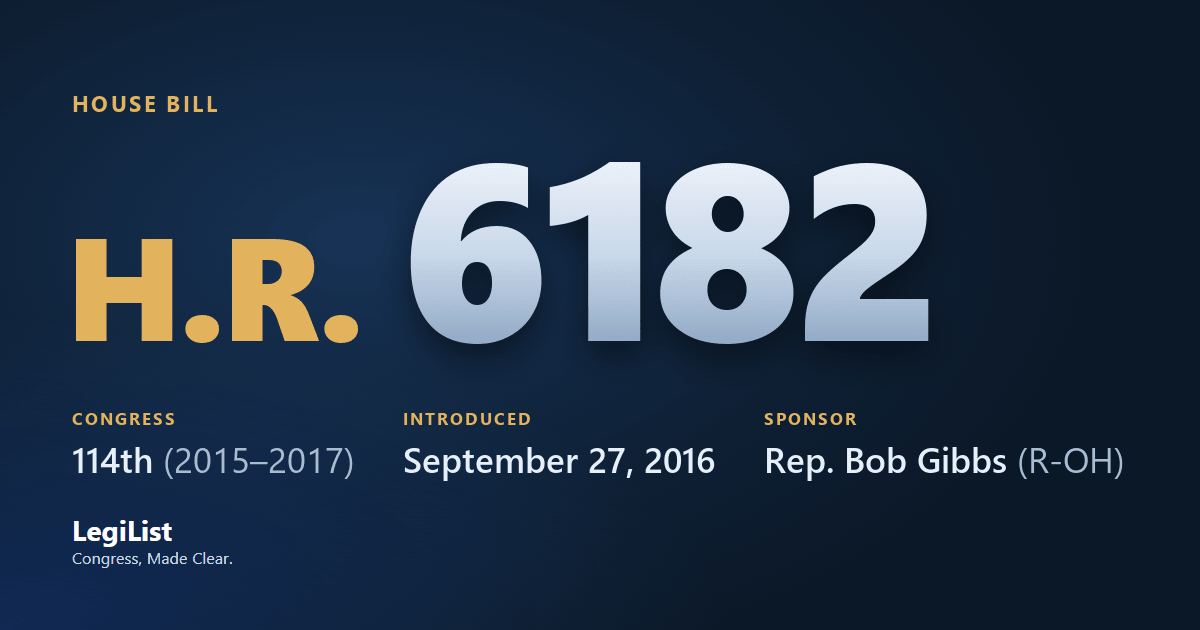
Water Quality Improvement Act of 2016
Latest action · Sep 27, 2016 Referred to the House Committee on Transportation and Infrastructure.
Progress
Where this bill reached, and when. A stage with no date was not reached; one that failed a vote and later carried shows the date it carried.
- IntroducedSep 27, 2016
- Passed HouseNot reached
- Passed SenateNot reached
- To the PresidentNot reached
- Became lawNot reached
Summary
Water Quality Improvement Act of 2016
This bill amends the Federal Water Pollution Control Act (commonly known as the Clean Water Act) by requiring the Environmental Protection Agency (EPA) to establish an integrated planning and permitting process for municipal wastewater and stormwater management that:
- enables municipalities to identify the most cost-effective and protective approaches to comply with the Act's requirements;
- helps them prioritize their investments in addressing the requirements; and
- is comprehensive and flexible.
The EPA must provide technical assistance to the municipalities or states for developing an integrated plan upon request.
The EPA must: (1) update its financial capability assessment guidance entitled, "Combined Sewer Overflows--Guidance for Financial Capability Assessment and Schedule Development," and dated February 1997; and (2) ensure that the guidance may be used for assessing the financial capability of municipalities to implement effluent limitations and other pollution control measures.
During the next 5 years, the EPA must work with at least 15 municipalities to develop and implement integrated plans and permits to meet the requirements of the national pollutant discharge elimination system.
Cosponsors
Members who signed on, in the order they did.
Committees 1
Where it was sent and what each committee and subcommittee did with it, in order.
| Chamber | Committee | What it did |
|---|---|---|
| House | Transportation and Infrastructure Committee | Referred Sep 27, 2016 |
Actions 2
Everything that happened, newest first.
- Sep 27, 2016Introduced in House
- Sep 27, 2016Referred to the House Committee on Transportation and Infrastructure.
Research
What has been written about this bill: committee reports, cost estimates, the sponsor’s authority statement, printed hearings and the Congressional Research Service’s work.
Constitutional authority
The sponsor’s statement, as printed in the Congressional Record, vol. 162, no. 146, September 27, 2016, page H6001.
Related bills 1
Companion bills and other measures the record links to this one.
| Bill | Title | Relationship | Latest action |
|---|---|---|---|
| HR 465 | Water Quality Improvement Act of 2017 | Reintroduced Bill | Jan 13, 2017 |
Titles 2
Every title it has carried, official and short, at each stage.
- Official Title as Introduced
- To amend the Federal Water Pollution Control Act to provide for an integrated planning and permitting process, and for other purposes.
- Short Titles as Introduced
- Water Quality Improvement Act of 2016
Subjects
Assigned by the Library of Congress. Policy area: Environmental Protection.
Text 1
Each version as it was printed, newest first.
- Sep 27, 2016Introduced in House
Support LegiList
This page is free, carries no paywall, and is built and maintained by one person. If the record here is useful to you, a few dollars keeps it going.
Everything here is as published by Congress: the summary is the Congressional Research Service's, the action wording is the clerks', and the subjects are the Library of Congress's. How far it got is read from the actions themselves, taking the most recent one of each kind, so a bill that failed a vote and later passed is shown as having passed. Records come from this bill on Congress.gov and govinfo.gov; cost estimates are the Congressional Budget Office's, and the hearings are the printed hearings GovInfo publishes, which can appear months after the hearing.