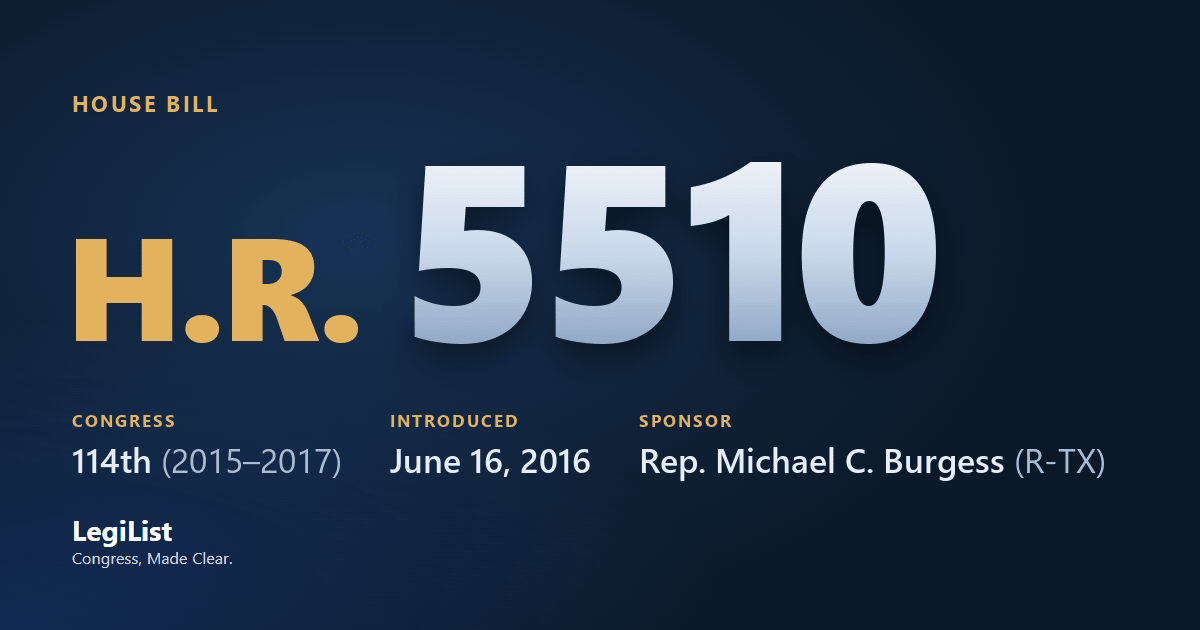
FTC Process and Transparency Reform Act of 2016
Latest action · Dec 13, 2016 Placed on the Union Calendar, Calendar No. 685.
Progress
Where this bill reached, and when. A stage with no date was not reached; one that failed a vote and later carried shows the date it carried.
- IntroducedJun 16, 2016
- Passed HouseNot reached
- Passed SenateNot reached
- To the PresidentNot reached
- Became lawNot reached
Summary
FTC Process and Transparency Reform Act of 2016
(Sec. 2) This bill amends the Federal Trade Commission Act to provide additional factors for the Federal Trade Commission (FTC) to consider before it may declare acts or practices to be unlawful on the ground that they are unfair and likely to cause substantial injury to consumers. Trivial or merely speculative injury or harm must be considered unlikely to cause substantial injury. But the FTC may consider substantial: (1) an injury that does small harm to a large number of people, or (2) a significant risk of concrete harm.
In determining the likelihood of substantial injury to consumers, the FTC must consider: (1) monetary harm, (2) unwarranted health or safety risks, or (3) only emotional or other more subjective harm.
The FTC must find an act or practice to be injurious in its net effects before it may be considered unfair. In determining the net effects, the FTC must consider: (1) remedy costs; and (2) burdens on society in general, such as increased paperwork or regulatory burdens or reduced incentives for innovation and capital formation. The FTC may not second-guess consumer decisions, but may consider whether an act or practice unreasonably creates or takes advantage of an obstacle to the free exercise of consumer decisionmaking.
(Sec. 3) A consent order entered into by the FTC to enforce against alleged unfair or deceptive acts or practices must include a termination clause providing for the order to expire within eight years after it is entered into, unless it relates to alleged fraud or requires a longer time limit. A consent order longer than five years that is unrelated to alleged fraud must provide for the FTC to: (1) review the order five years after it is entered into, and (2) terminate the order if it has achieved its initial purposes.
In determining the time limit, the FTC must consider: (1) the impact of technological progress on the order's continuing relevance; and (2) whether the person, partnership, or corporation would continue to engage in violations without the consent order.
The bill also allows persons, partnerships, or corporations subject to a consent order that is unrelated to alleged fraud and has been effective for at least five years to petition the FTC to terminate the order.
(Sec. 4) The FTC must report annually on investigations the FTC has commenced, concluded with official agency action, or closed with no official agency action. With the consent of persons, partnerships, or corporations that were a subject of a closed investigation, the FTC must describe the legal analysis supporting its decisions not to continue with investigations and the industry sectors of those that were the subject of such closed investigations. The bill prohibits the FTC from including the identity of a person, partnership, or corporation that is a subject of an investigation in its description of an investigation that closed with no official agency action.
(Sec. 5) The FTC is prohibited from recommending a legislative or regulatory action unless it publishes any economic analysis or advice prepared by the FTC's Bureau of Economics or indicates that no such analysis or advice was given. These requirements do not apply to recommendations made: (1) in an appearance by a commissioner before Congress, (2) to state or local governments, (3) in response to a request by a Member or committee of Congress, (4) to another federal agency in response to a notice of proposed rulemaking, or (5) to the United Kingdom or the European Union.
(Sec. 6) The bill prohibits the FTC's guidelines or general statements of policy from: (1) conferring rights upon any person, state, or locality; or (2) binding the FTC or any person, state, or locality to a recommended approach. In enforcement actions, the FTC must prove a violation of FTC-enforced law.
The FTC's enforcement actions or consent orders may not be based solely on allegations that acts or practices are inconsistent with guidelines or general policy statements unless the acts or practices violate FTC-enforced law.
Compliance with guidelines or general statements of policy may be used as evidence of compliance with a law under which the guidelines or statements were issued.
(Sec. 7) Certain FTC investigations involving civil investigative demands must terminate six months after the FTC sends a verifiable written communication to notify the subject of the investigation. But an investigation may continue beyond that six-month period if the FTC: (1) sends an additional verifiable written communication, or votes to extend the investigation, before the period expires; or (2) votes within 30 days after the expiration of such period that it did not send a written communication because of excusable neglect or a circumstance beyond the FTC's control that rendered notification during such period impossible.
A bipartisan majority of FTC commissioners may hold a nonpublic meeting to discuss official business if: (1) no votes or actions are taken, (2) each person at the meeting is an FTC commissioner or employee, and (3) an attorney from the FTC's Office of General Counsel is present. "Bipartisan majority" means a group of at least two commissioners that includes, for each political party of which any commissioner is a member, at least one commissioner who is a member of such political party and, if any commissioner has no political party affiliation, at least one unaffiliated commissioner.
Within two business days after such a nonpublic meeting, the FTC must disclose on its website: (1) a list of persons who attended such meeting; and (2) a summary of discussed matters, except for matters that are classified or otherwise exempt from disclosure.
(Sec. 9) The FTC must publish and submit to Congress annually: (1) the FTC's plan describing its projected activities and timelines for the next calendar year, and (2) a report on FTC enforcement actions to address unfair or deceptive acts or practices that may have targeted or significantly affected individuals who are 65 or older during the previous year.
Cosponsors
Members who signed on, in the order they did.
Committees 2
Where it was sent and what each committee and subcommittee did with it, in order.
| Chamber | Committee | What it did |
|---|---|---|
| House | Energy and Commerce Committee | Referred Jun 16, 2016Reported Dec 13, 2016 |
| House | Judiciary Committee | Referred Jun 16, 2016Discharged Dec 13, 2016 |
| Administrative State, Regulatory Reform, and Antitrust Subcommittee | Referred Jun 23, 2016 |
Actions 6
Everything that happened, newest first.
- Dec 13, 2016Reported (Amended) by the Committee on Energy and Commerce. H. Rept. 114-875, Part I.
- Dec 13, 2016Committee on the Judiciary discharged.
- Dec 13, 2016Placed on the Union Calendar, Calendar No. 685.
- Jun 23, 2016Referred to the Subcommittee on Regulatory Reform, Commercial And Antitrust Law.
- Jun 16, 2016Introduced in House
In the Congressional Record 1
Days the Record’s own index lists this bill, newest first, with the pages and the members it names. Pages starting H are the House, S the Senate, E Extensions of Remarks.
| Where | In the Record | Members | Date |
|---|---|---|---|
| House | Debate and remarks H5293 | Janice D. Schakowsky D-IL, Michael C. Burgess R-TX | Sep 12, 2016 |
Research
What has been written about this bill: committee reports, cost estimates, the sponsor’s authority statement, printed hearings and the Congressional Research Service’s work.
Committee report
Congressional Budget Office cost estimate
- Sep 9, 2016H.R. 5510, FTC Process and Transparency Reform Act of 2016As ordered reported by the House Committee on Energy and Commerce on July 14, 2016
Constitutional authority
The sponsor’s statement, as printed in the Congressional Record, vol. 162, no. 96, June 16, 2016, page H3968.
Related bills 9
Companion bills and other measures the record links to this one.
| Bill | Title | Relationship | Latest action |
|---|---|---|---|
| HR 5093 | TIME Act | Related bill | Apr 29, 2016 |
| HR 5097 | STALL Act | Related bill | Apr 29, 2016 |
| HR 5098 | FTC REPORTS Act | Related bill | Apr 29, 2016 |
| HR 5109 | CLEAR Act | Related bill | Apr 29, 2016 |
| HR 5115 | SURE Act | Related bill | Apr 29, 2016 |
| HR 5116 | FREE Act | Related bill | Apr 29, 2016 |
| HR 5118 | SHIELD Act | Related bill | Apr 29, 2016 |
| HR 5315 | CLEAR Act of 2016 | Related bill | May 24, 2016 |
| HR 5318 | SHIELD Act of 2016 | Related bill | May 24, 2016 |
Titles 3
Every title it has carried, official and short, at each stage.
- Official Title as Introduced
- To amend the Federal Trade Commission Act to establish new requirements relating to investigations, consent orders, and reporting requirements, and for other purposes.
- Short Titles as Introduced
- FTC Process and Transparency Reform Act of 2016
- Short Titles as Reported to House
- FTC Process and Transparency Reform Act of 2016
Subjects
Assigned by the Library of Congress. Policy area: Commerce.
- Administrative law and regulatory procedures
- Administrative remedies
- Aging
- Business investment and capital
- Civil actions and liability
- Commerce
- Competition and antitrust
- Congressional oversight
- Consumer affairs
- Evidence and witnesses
- Federal Trade Commission (FTC)
- Fraud offenses and financial crimes
- Government information and archives
- Government studies and investigations
- Intergovernmental relations
- Public participation and lobbying
- State and local government operations
Text 2
Each version as it was printed, newest first.
- Dec 13, 2016Reported in House
- Jun 16, 2016Introduced in House
Support LegiList
This page is free, carries no paywall, and is built and maintained by one person. If the record here is useful to you, a few dollars keeps it going.
Everything here is as published by Congress: the summary is the Congressional Research Service's, the action wording is the clerks', and the subjects are the Library of Congress's. How far it got is read from the actions themselves, taking the most recent one of each kind, so a bill that failed a vote and later passed is shown as having passed. Records come from this bill on Congress.gov and govinfo.gov; cost estimates are the Congressional Budget Office's, and the hearings are the printed hearings GovInfo publishes, which can appear months after the hearing.