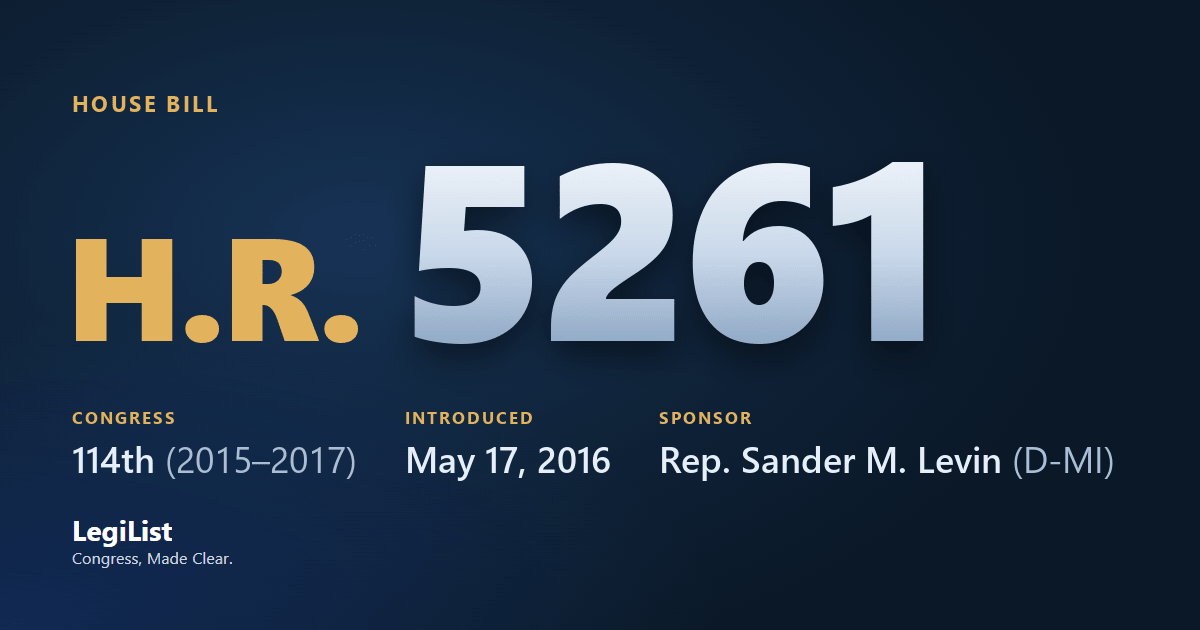
Protecting the U.S. Corporate Tax Base Act of 2016
Latest action · May 17, 2016 Referred to the House Committee on Ways and Means.
Progress
Where this bill reached, and when. A stage with no date was not reached; one that failed a vote and later carried shows the date it carried.
- IntroducedMay 17, 2016
- Passed HouseNot reached
- Passed SenateNot reached
- To the PresidentNot reached
- Became lawNot reached
Summary
Protecting the U.S. Corporate Tax Base Act of 2016
This bill amends the Internal Revenue Code to revise the rules for taxing the earnings and determining the stock ownership of certain controlled foreign corporations (CFCs).
The bill provides that, in the case of certain CFCs, subpart F income (income of a CFC earned outside the United States that is not tax deferred) includes a U.S. shareholder's pro rata share of any increase in the CFC's investment of earnings in certain foreign property.
The bill also revises the rules for determining stock ownership to prohibit a CFC from transferring stock to a foreign affiliate to reduce the portion of stock owned by U.S. shareholders below the level required to be considered a CFC.
Cosponsors 6
Members who signed on, in the order they did. All signed on May 17, 2016.
| Seat | Cosponsor | Signed on | |
|---|---|---|---|
| D-NJ | Bill Pascrell, Jr. | Original | May 17, 2016 |
| D-NY | Charles B. Rangel | Original | May 17, 2016 |
| D-MD | Chris Van Hollen | Original | May 17, 2016 |
| D-IL | Danny K. Davis | Original | May 17, 2016 |
| D-WA | Jim McDermott | Original | May 17, 2016 |
| D-CA | Mike Thompson | Original | May 17, 2016 |
Actions 2
Everything that happened, newest first.
- May 17, 2016Introduced in House
- May 17, 2016Referred to the House Committee on Ways and Means.
Subjects
Assigned by the Library of Congress. Policy area: Taxation.
Text 1
Each version as it was printed, newest first.
- May 17, 2016Introduced in House
Everything here is as published by Congress: the summary is the Congressional Research Service's, the action wording is the clerks', and the subjects are the Library of Congress's. How far it got is read from the actions themselves, taking the most recent one of each kind, so a bill that failed a vote and later passed is shown as having passed. Records come from this bill on Congress.gov and govinfo.gov.