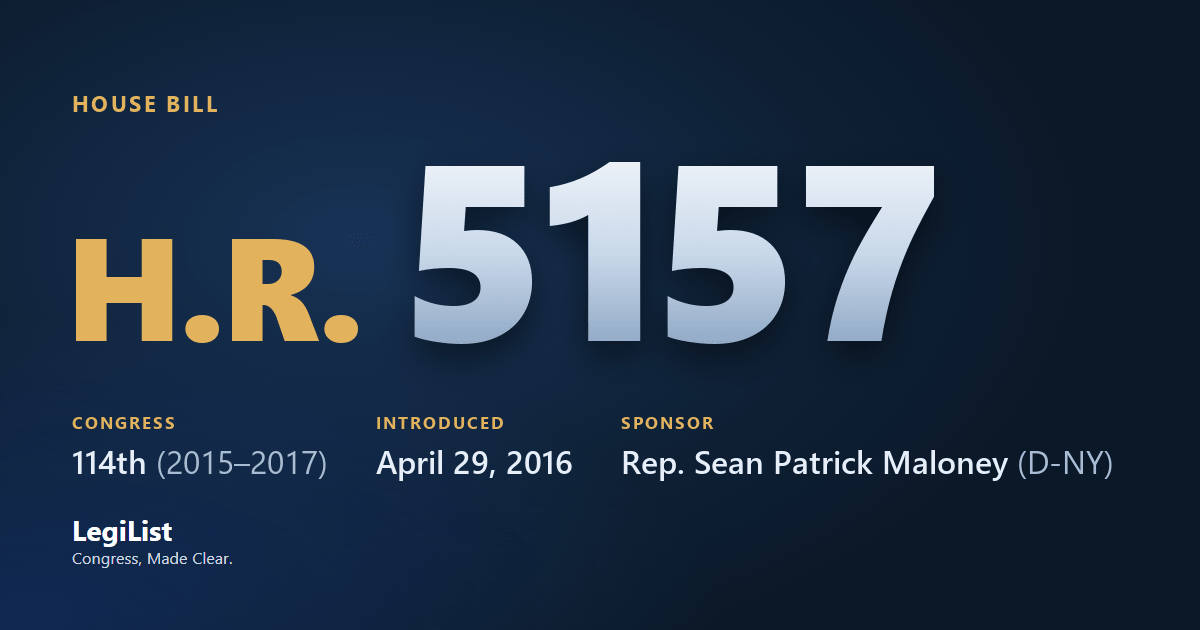
SMART Jobs Act
Latest action · Sep 19, 2016 Referred to the Subcommittee on Early Childhood, Elementary, and Secondary Education.
Progress
Where this bill reached, and when. A stage with no date was not reached; one that failed a vote and later carried shows the date it carried.
- IntroducedApr 29, 2016
- Passed HouseNot reached
- Passed SenateNot reached
- To the PresidentNot reached
- Became lawNot reached
Summary
School Modernization and Revitalization Through Jobs Act, the SMART Jobs Act, or the 21st Century Green High-Performing Public School Facilities Act
This bill requires the Department of Education (ED) to make grants to states for the modernization, renovation, or repair of public schools, including early learning facilities and charter schools. The bill allocates grant funds among states on the basis of the relative portion of school improvement funds provided to local educational agencies (LEAs) in each state under the Elementary and Secondary Education Act of 1965. States shall reallocate the grant funds to LEAs on the basis of each LEA's share of school improvement funds received by LEAs in the state for the previous fiscal year.
In addition, ED shall make grants to LEAs that serve specified disaster areas for the construction, modernization, renovation, or repair of public schools, including early learning facilities and charter schools. The bill allocates grant funds among LEAs on the basis of each LEA's share of infrastructure damage inflicted on public school facilities in such areas.
With specified exceptions, only U.S.-produced iron, steel, and manufactured goods shall be used in projects funded under the bill.
Cosponsors 5
Members who signed on, in the order they did. Signatures ran from Apr 29, 2016 to Jul 14, 2016; 2 are original cosponsors, there from the day it was introduced.
| Seat | Cosponsor | Signed on | |
|---|---|---|---|
| D-MD | Elijah E. Cummings | Original | Apr 29, 2016 |
| D-CO | Jared Polis | Original | Apr 29, 2016 |
| D-WA | Jim McDermott | May 23, 2016 | |
| D-NY | Paul Tonko | May 23, 2016 | |
| D-PA | Matt Cartwright | Jul 14, 2016 |
Committees 1
Where it was sent and what each committee and subcommittee did with it, in order.
| Chamber | Committee | What it did |
|---|---|---|
| House | Education and Workforce Committee | Referred Apr 29, 2016 |
| Early Childhood, Elementary, and Secondary Education Subcommittee | Referred Sep 19, 2016 |
Actions 3
Everything that happened, newest first.
- Sep 19, 2016Referred to the Subcommittee on Early Childhood, Elementary, and Secondary Education.
- Apr 29, 2016Introduced in House
- Apr 29, 2016Referred to the House Committee on Education and the Workforce.
Research
What has been written about this bill: committee reports, cost estimates, the sponsor’s authority statement, printed hearings and the Congressional Research Service’s work.
Constitutional authority
The sponsor’s statement, as printed in the Congressional Record, vol. 162, no. 67, April 29, 2016, page H2151.
Titles 5
Every title it has carried, official and short, at each stage.
- Official Title as Introduced
- To direct the Secretary of Education to make grants to State educational agencies for the modernization, renovation, or repair of public school facilities, and for other purposes.
- Short Titles as Introduced
- 21st Century Green High-Performing Public School Facilities Act
- SMART Jobs Act
- School Modernization and Revitalization Through Jobs Act
- Override Display Title
- SMART Jobs Act
Subjects
Assigned by the Library of Congress. Policy area: Education.
- Air quality
- Building construction
- Buy American requirements
- Child health
- Child safety and welfare
- Disability and paralysis
- Education
- Education of the disadvantaged
- Education programs funding
- Educational facilities and institutions
- Educational technology and distance education
- Elementary and secondary education
- Employment and training programs
- Energy efficiency and conservation
- Environmental technology
- Hazardous wastes and toxic substances
- Indian social and development programs
- Metals
- Natural disasters
- Noise pollution
- Preschool education
- Public contracts and procurement
- Vocational and technical education
- Youth employment and child labor
Text 1
Each version as it was printed, newest first.
- Apr 29, 2016Introduced in House
Support LegiList
This page is free, carries no paywall, and is built and maintained by one person. If the record here is useful to you, a few dollars keeps it going.
Everything here is as published by Congress: the summary is the Congressional Research Service's, the action wording is the clerks', and the subjects are the Library of Congress's. How far it got is read from the actions themselves, taking the most recent one of each kind, so a bill that failed a vote and later passed is shown as having passed. Records come from this bill on Congress.gov and govinfo.gov; cost estimates are the Congressional Budget Office's, and the hearings are the printed hearings GovInfo publishes, which can appear months after the hearing.