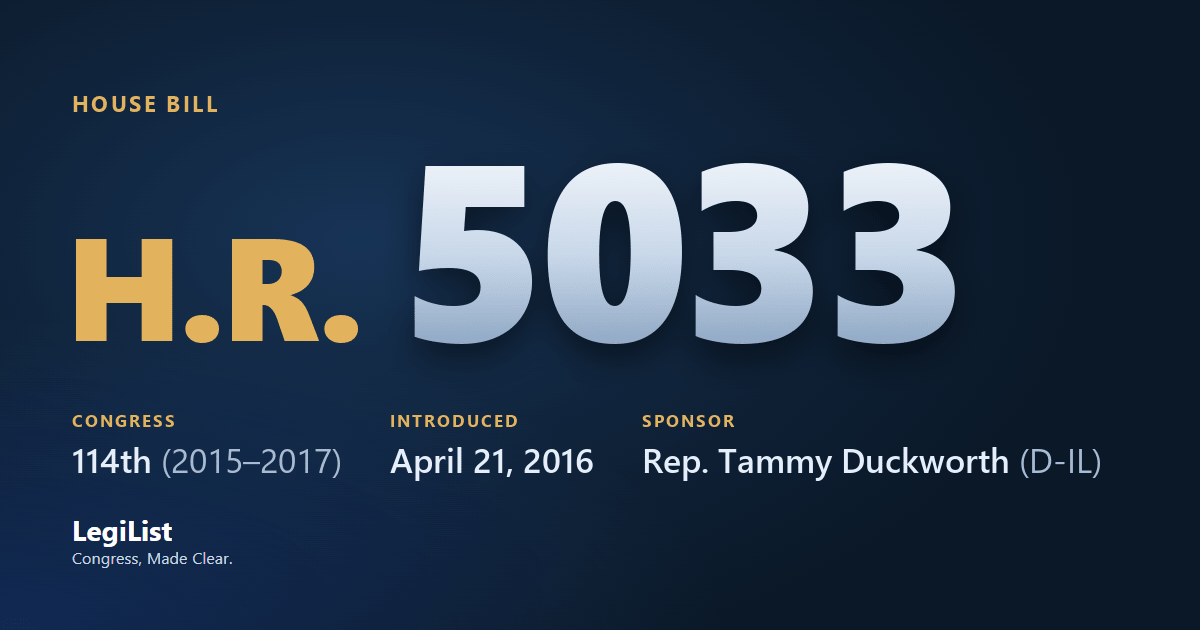
Getting Results through Enhanced Accountability and Transparency Act of 2016
Latest action · Dec 8, 2016 Placed on the Union Calendar, Calendar No. 666.
Progress
Where this bill reached, and when. A stage with no date was not reached; one that failed a vote and later carried shows the date it carried.
- IntroducedApr 21, 2016
- Passed HouseNot reached
- Passed SenateNot reached
- To the PresidentNot reached
- Became lawNot reached
Summary
Getting Results through Enhanced Accountability and Transparency Act of 2016
(Sec. 3) This bill requires that the Government Accountability Office's (GAO's) annual report on its routine investigations to identify programs, agencies, offices, and initiatives with unnecessarily duplicative goals and activities aggregate separately estimates of related costs for instances of actual and potential unnecessary duplication and other potential cost savings and revenue collection.
(Sec. 4) When executive agencies (with certain exceptions) conduct their systemic review of operations on a continuing basis, the purpose of their reviews must include: (1) improving agency performance toward their mission, (2) informing learning and decision-making processes, (3) assessing opportunities to improve coordination within the agency and with other agencies, and (4) identifying employees who cause their units to be outstanding toward achieving the agency's mission.
Chief operating officers' responsibilities are expanded to include: (1) improving evaluation and risk management; (2) addressing crosscutting program and management issues, including opportunities to improve coordination and address unnecessary duplication, using an enterprise risk management approach; (3) overseeing agency-specific efforts to improve management of mission-oriented components and units; and (4) coordinating with mission-related components, units, and support functions at their agency and the major components of their agency.
The Office of Management and Budget's (OMB's) federal government performance plan submitted with each budget must provide plans to address management challenges concerning unnecessary duplication. Agency performance plans for each program activity set forth in the budget must include planned actions and performance goals for resolving such challenges.
The OMB's federal government priority goals must include mission support for financial, human capital, information technology, procurement, and real estate management. The OMB must consider GAO recommendations when developing or adjusting such goals. Performance improvement officers must collaborate with the heads of agency components and mission support functions when they advise on strategic planning. Their advice must include performance evaluation and risk management.
The Performance Improvement Council's (PIC's) functions are expanded to include: (1) resolving government-wide issues relating to coordination and unnecessary duplication; (2) facilitating the exchange of performance improvement practices with state and local governments and other nonfederal stakeholders; and (3) coordinating with interagency mission support councils. PIC must also publish annual reports describing its structure, budgets, funding, staffing, and activities.
The chief operating officers of agencies must publish all of the plans and reports produced for Congress with citations to the relevant statutory requirements.
Agencies must submit to Congress statements regarding the actions they have taken in response to recommendations in the GAO's: (1) annual report on unnecessarily duplicative goals and activities; and (2) High Risk list of fraud, waste, abuse, and mismanagement.
Cosponsors 4
Members who signed on, in the order they did. Signatures ran from Apr 21, 2016 to Apr 28, 2016; 1 is an original cosponsor, there from the day it was introduced.
| Seat | Cosponsor | Signed on | |
|---|---|---|---|
| R-OK | Steve Russell | Original | Apr 21, 2016 |
| D-VA | Gerald E. Connolly | Apr 28, 2016 | |
| D-CA | Mark DeSaulnier | Apr 28, 2016 | |
| D-IL | Robin L. Kelly | Apr 28, 2016 |
Committees 1
Where it was sent and what each committee and subcommittee did with it, in order.
| Chamber | Committee | What it did |
|---|---|---|
| House | Oversight and Government Reform Committee | Referred Apr 21, 2016Markup Jul 12, 2016Reported Dec 8, 2016 |
Actions 6
Everything that happened, newest first.
- Dec 8, 2016Reported (Amended) by the Committee on Oversight and Government Reform. H. Rept. 114-853.
- Dec 8, 2016Placed on the Union Calendar, Calendar No. 666.
- Jul 12, 2016Committee Consideration and Mark-up Session Held.
- Jul 12, 2016Ordered to be Reported (Amended) by Voice Vote.
- Apr 21, 2016Introduced in House
- Apr 21, 2016Referred to the House Committee on Oversight and Government Reform.
Research
What has been written about this bill: committee reports, cost estimates, the sponsor’s authority statement, printed hearings and the Congressional Research Service’s work.
Committee report
Constitutional authority
The sponsor’s statement, as printed in the Congressional Record, vol. 162, no. 62, April 21, 2016, page H1924.
Related bills 2
Companion bills and other measures the record links to this one.
| Bill | Title | Relationship | Latest action |
|---|---|---|---|
| S 2834 | Getting Results through Enhanced Accountability and Transparency Act of 2016 | Identical bill | Dec 9, 2016 |
| S 3011 | Bolster Accountability to Drive Government Efficiency and Reform Washington Act of 2016 | Related bill | Jun 6, 2016 |
Titles 3
Every title it has carried, official and short, at each stage.
- Official Title as Introduced
- To improve the Governmentwide management of unnecessarily duplicative Government programs and for other purposes.
- Short Titles as Introduced
- Getting Results through Enhanced Accountability and Transparency Act of 2016
- Short Titles as Reported to House
- Getting Results through Enhanced Accountability and Transparency Act of 2016
Subjects
Assigned by the Library of Congress. Policy area: Government Operations and Politics.
- Accounting and auditing
- Computers and information technology
- Congressional oversight
- Executive agency funding and structure
- Government employee pay, benefits, personnel management
- Government information and archives
- Government Operations and Politics
- Performance measurement
- Public contracts and procurement
Text 2
Each version as it was printed, newest first.
- Dec 8, 2016Reported in House
- Apr 21, 2016Introduced in House
Support LegiList
This page is free, carries no paywall, and is built and maintained by one person. If the record here is useful to you, a few dollars keeps it going.
Everything here is as published by Congress: the summary is the Congressional Research Service's, the action wording is the clerks', and the subjects are the Library of Congress's. How far it got is read from the actions themselves, taking the most recent one of each kind, so a bill that failed a vote and later passed is shown as having passed. Records come from this bill on Congress.gov and govinfo.gov; cost estimates are the Congressional Budget Office's, and the hearings are the printed hearings GovInfo publishes, which can appear months after the hearing.