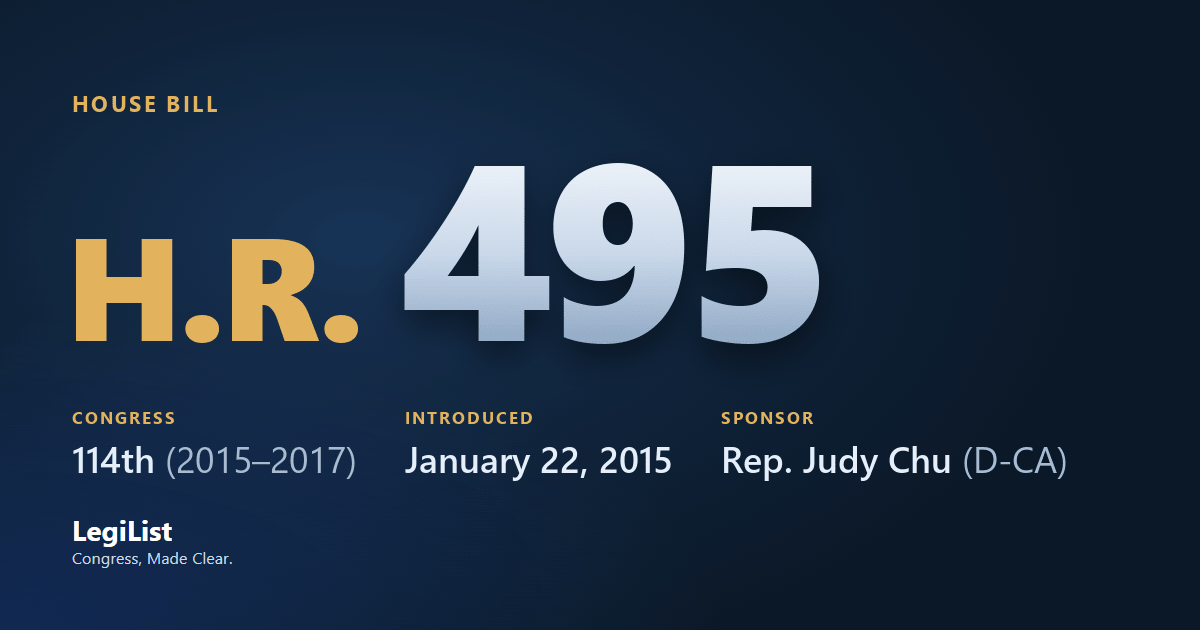
DIPLOMA Act
Latest action · Apr 29, 2015 Referred to the Subcommittee on Early Childhood, Elementary, and Secondary Education.
Progress
Where this bill reached, and when. A stage with no date was not reached; one that failed a vote and later carried shows the date it carried.
- IntroducedJan 22, 2015
- Passed HouseNot reached
- Passed SenateNot reached
- To the PresidentNot reached
- Became lawNot reached
Summary
Developing Innovative Partnerships and Learning Opportunities that Motivate Achievement Act or the DIPLOMA Act
Authorizes the Secretary of Education to award renewable five-year grants to states and, through them, subgrants to local consortia that include a local educational agency and other community partners to: (1) ensure the academic, physical, social, emotional, and civic development of disadvantaged youth; and (2) strengthen their families and communities.
Requires each state grantee to develop and implement a state child and youth strategy that assesses children's needs and the assets within the state that can be mobilized, coordinated, and integrated to achieve quantifiable progress toward goals that include ensuring that:
- children are ready for school;
- students are engaged and achieving in school;
- students are physically, mentally, socially, and emotionally healthy;
- schools and neighborhoods are safe and provide a positive climate for learning;
- families and communities are supportive and engaged in their children's education as equal partners;
- students are ready for postsecondary education and 21st Century careers;
- students are contributing to their communities; and
- students are not chronically absent.
Directs the consortia to develop and implement a local child and youth strategy that integrates multiple private and public services into a comprehensive, coordinated continuum of services directed toward achieving quantifiable progress toward such goals.
Requires the Secretary to award competitive grants directly to local consortia if appropriated funds fall below a specified amount.
Cosponsors 17
Members who signed on, in the order they did. Signatures ran from Jan 22, 2015 to Oct 23, 2015, with 9 there on the day it was introduced.
| Seat | Cosponsor | Signed on | |
|---|---|---|---|
| D-CA | Barbara Lee | Original | Jan 22, 2015 |
| D-IA | David Loebsack | Original | Jan 22, 2015 |
| D-DC | Eleanor Holmes Norton | Original | Jan 22, 2015 |
| D-NY | Grace Meng | Original | Jan 22, 2015 |
| D-CA | Juan Vargas | Original | Jan 22, 2015 |
| D-MN | Keith Ellison | Original | Jan 22, 2015 |
| D-CA | Michael M. Honda | Original | Jan 22, 2015 |
| D-MA | Niki Tsongas | Original | Jan 22, 2015 |
| D-TX | Ruben Hinojosa | Original | Jan 22, 2015 |
| D-PA | Matt Cartwright | Feb 5, 2015 | |
| D-CA | Lucille Roybal-Allard | Feb 10, 2015 | |
| D-AZ | Raúl M. Grijalva | Feb 10, 2015 | |
| D-CO | Jared Polis | Feb 12, 2015 | |
| D-CA | Ted Lieu | Feb 24, 2015 | |
| D-CA | Mark DeSaulnier | Mar 10, 2015 |
Actions 4
Everything that happened, newest first.
- Apr 29, 2015Referred to the Subcommittee on Early Childhood, Elementary, and Secondary Education.
- Jan 23, 2015Referred to the Subcommittee on Health.
- Jan 22, 2015Introduced in House
- Jan 22, 2015Referred to the Committee on Education and the Workforce, and in addition to the Committee on Energy and Commerce, for a period to be subsequently determined by the Speaker, in each case for consideration of such provisions as fall within the jurisdiction of the committee concerned.
Subjects
Assigned by the Library of Congress. Policy area: Education.
Text 1
Each version as it was printed, newest first.
- Jan 22, 2015Introduced in House
Everything here is as published by Congress: the summary is the Congressional Research Service's, the action wording is the clerks', and the subjects are the Library of Congress's. How far it got is read from the actions themselves, taking the most recent one of each kind, so a bill that failed a vote and later passed is shown as having passed. Records come from this bill on Congress.gov and govinfo.gov.