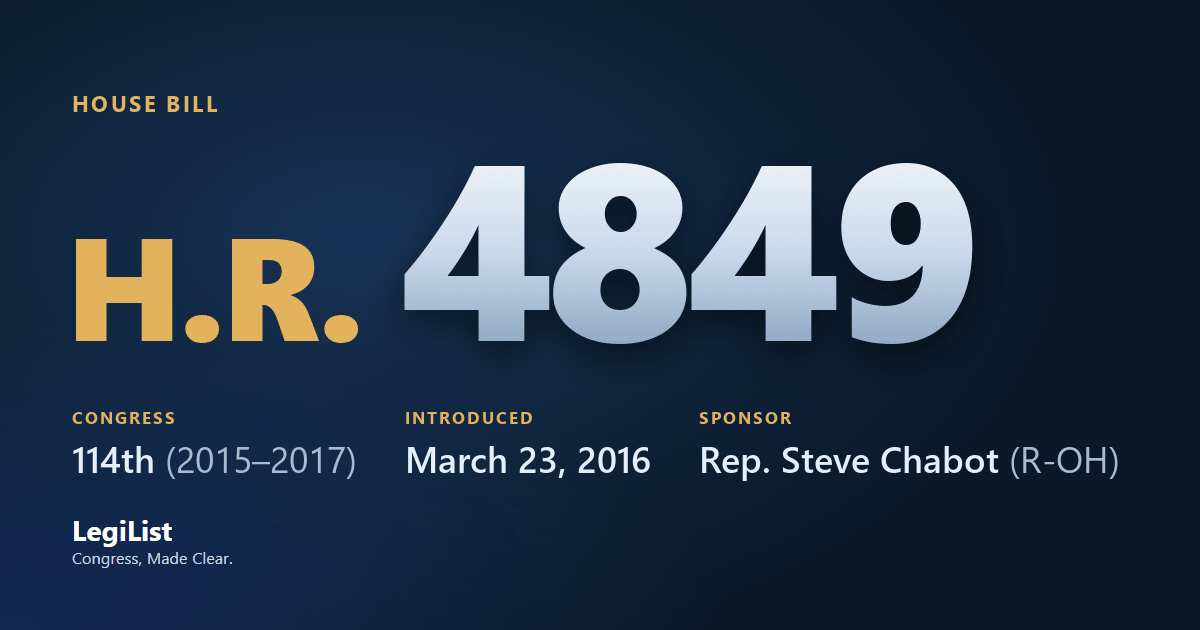
Food and Nutrition Reform, Responsibility, and Accountability Act of 2016
Latest action · Mar 31, 2016 Referred to the Subcommittee on Nutrition.
Progress
Where this bill reached, and when. A stage with no date was not reached; one that failed a vote and later carried shows the date it carried.
- IntroducedMar 23, 2016
- Passed HouseNot reached
- Passed SenateNot reached
- To the PresidentNot reached
- Became lawNot reached
Summary
Food and Nutrition Reform, Responsibility, and Accountability Act of 2016
This bill amends the Food and Nutrition Act of 2008 to change the work requirements for the Department of Agriculture's (USDA's) Supplemental Nutrition Assistance Program (SNAP, formerly known as the food stamp program).
The bill reduces, from three months to one month, the time period for which able-bodied adults without dependents may receive SNAP benefits over a three-year period without meeting work requirements.
The bill modifies the exemption from work requirements for individuals who are under 18 or over 50 years of age to apply the exemption to those who are:
- under 18,
- over 50 in a household that includes an individual that is under 18, or
- over 63.
The bill eliminates USDA's authority to waive work requirements for individuals in areas with an unemployment rate above 10% or an insufficient number of jobs.
States may provide exemptions from the work requirements for up to 5% (currently 15%) of the covered individuals who either receive SNAP benefits or were denied benefits due to work requirements.
States must expunge benefits from a SNAP electronic benefit transfer account if: (1) the benefits are not used within 90 days of being posted to the account, or (2) the account has not been accessed for a 3-month period.
State workfare programs for SNAP participants must require at least six hours of work per week.
Cosponsors 2
Members who signed on, in the order they did. Signatures ran from May 13, 2016 to May 31, 2016.
| Seat | Cosponsor | Signed on | |
|---|---|---|---|
| R-CA | Tom McClintock | May 13, 2016 | |
| R-OH | Bob Gibbs | May 31, 2016 |
Committees 1
Where it was sent and what each committee and subcommittee did with it, in order.
| Chamber | Committee | What it did |
|---|---|---|
| House | Agriculture Committee | Referred Mar 23, 2016 |
| Nutrition and Foreign Agriculture Subcommittee | Referred Mar 31, 2016 |
Actions 3
Everything that happened, newest first.
- Mar 31, 2016Referred to the Subcommittee on Nutrition.
- Mar 23, 2016Introduced in House
- Mar 23, 2016Referred to the House Committee on Agriculture.
In the Congressional Record 2
Days the Record’s own index lists this bill, newest first, with the pages and the members it names. Pages starting H are the House, S the Senate, E Extensions of Remarks.
| Where | In the Record | Members | Date |
|---|---|---|---|
| House | Debate and remarks H3757 | — | Jun 14, 2016 |
| House | Debate and remarks H1880 | Steve Chabot R-OH | Apr 20, 2016 |
Research
What has been written about this bill: committee reports, cost estimates, the sponsor’s authority statement, printed hearings and the Congressional Research Service’s work.
Constitutional authority
The sponsor’s statement, as printed in the Congressional Record, vol. 162, no. 46, March 23, 2016, page H1584.
Titles 2
Every title it has carried, official and short, at each stage.
- Official Title as Introduced
- To amend the Food and Nutrition Act of 2008 to reform the work requirements for able-bodied adults without dependents; and for other purposes.
- Short Titles as Introduced
- Food and Nutrition Reform, Responsibility, and Accountability Act of 2016
Subjects
Assigned by the Library of Congress. Policy area: Agriculture and Food.
Text 1
Each version as it was printed, newest first.
- Mar 23, 2016Introduced in House
Support LegiList
This page is free, carries no paywall, and is built and maintained by one person. If the record here is useful to you, a few dollars keeps it going.
Everything here is as published by Congress: the summary is the Congressional Research Service's, the action wording is the clerks', and the subjects are the Library of Congress's. How far it got is read from the actions themselves, taking the most recent one of each kind, so a bill that failed a vote and later passed is shown as having passed. Records come from this bill on Congress.gov and govinfo.gov; cost estimates are the Congressional Budget Office's, and the hearings are the printed hearings GovInfo publishes, which can appear months after the hearing.