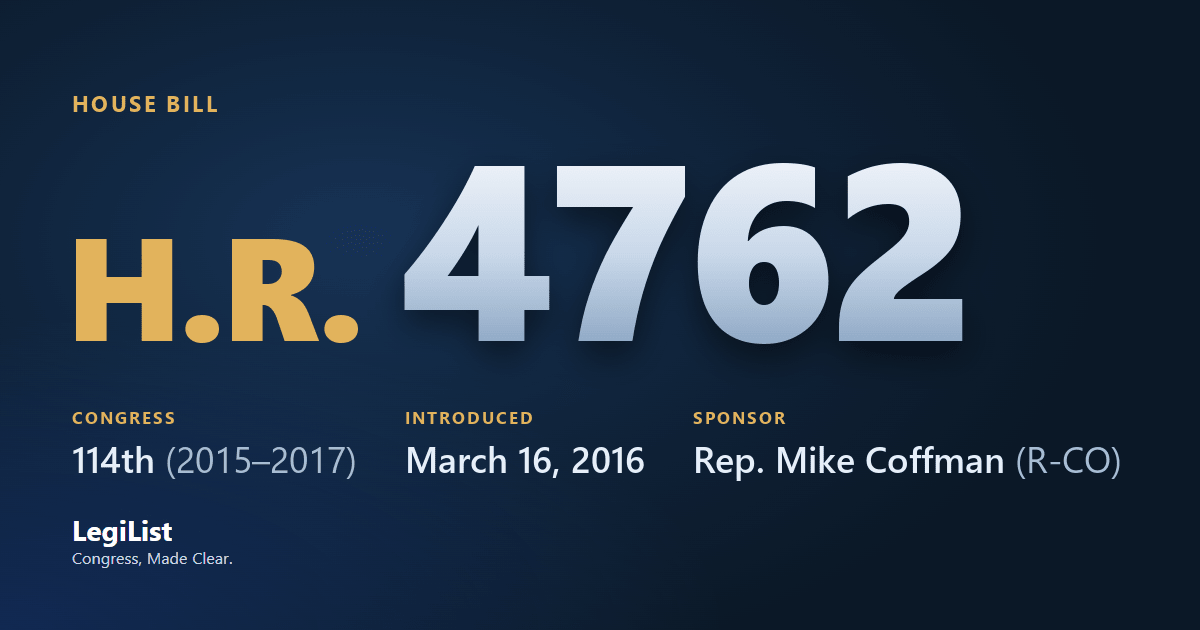
REGROW Act
Latest action · Mar 18, 2016 Referred to the Subcommittee on Health.
Progress
Where this bill reached, and when. A stage with no date was not reached; one that failed a vote and later carried shows the date it carried.
- IntroducedMar 16, 2016
- Passed HouseNot reached
- Passed SenateNot reached
- To the PresidentNot reached
- Became lawNot reached
Summary
Reliable and Effective Growth for Regenerative Health Options that Improve Wellness or the REGROW Act
This bill amends the Public Health Service Act to require the Food and Drug Administration (FDA) to conditionally approve certain cellular therapeutic products without initiation of large-scale clinical trials. A conditionally approved cellular therapy may be marketed if certain conditions are met, including conditions on the source, processing, and function of the cells in the product.
The sponsor of a conditionally approved cellular therapy must apply for approval of the product as a biological product within five years. Unless the FDA has decided not to approve the product, the product may be marketed during this five-year period and the FDA may permit continued marketing while the application is being reviewed.
An individual administering a conditionally approved cellular therapy must inform the recipient regarding conditional approval.
The premarket report for a medical device used for cellular therapy must include specified information regarding the preparation or delivery of the cellular therapy.
The approval of a medical device that is a cellular therapy must be based on laboratory performance testing and not clinical trials.
A medical device used for cellular therapy is subject to medical device classification. The FDA must not limit the use of these devices to only specific cell types unless unique to the use of the device.
The Center for Biologics Evaluation and Research has primary jurisdiction for premarket review of combination products that act primarily through cellular components.
The Department of Health and Human Services must work with stakeholders to promote the development of standards for regenerative medicine products.Cosponsors 4
Members who signed on, in the order they did. Signatures ran from Mar 16, 2016 to Jul 12, 2016; 2 are original cosponsors, there from the day it was introduced.
| Seat | Cosponsor | Signed on | |
|---|---|---|---|
| R-VA | H. Morgan Griffith | Original | Mar 16, 2016 |
| D-HI | Mark Takai | Original | Mar 16, 2016 |
| R-CA | Dana Rohrabacher | Apr 18, 2016 | |
| R-WI | F. James Sensenbrenner, Jr. | Jul 12, 2016 |
Committees 1
Where it was sent and what each committee and subcommittee did with it, in order.
| Chamber | Committee | What it did |
|---|---|---|
| House | Energy and Commerce Committee | Referred Mar 16, 2016 |
| Health Subcommittee | Referred Mar 18, 2016 |
Actions 3
Everything that happened, newest first.
- Mar 18, 2016Referred to the Subcommittee on Health.
- Mar 16, 2016Introduced in House
- Mar 16, 2016Referred to the House Committee on Energy and Commerce.
Research
What has been written about this bill: committee reports, cost estimates, the sponsor’s authority statement, printed hearings and the Congressional Research Service’s work.
Constitutional authority
The sponsor’s statement, as printed in the Congressional Record, vol. 162, no. 42, March 16, 2016, page H1419.
Related bills 1
Companion bills and other measures the record links to this one.
| Bill | Title | Relationship | Latest action |
|---|---|---|---|
| S 2689 | REGROW Act | Identical bill | Mar 16, 2016 |
Titles 3
Every title it has carried, official and short, at each stage.
- Official Title as Introduced
- To amend the Federal Food, Drug, and Cosmetic Act with respect to cellular therapies.
- Short Titles as Introduced
- REGROW Act
- Reliable and Effective Growth for Regenerative Health Options that Improve Wellness
Subjects
Assigned by the Library of Congress. Policy area: Health.
Text 1
Each version as it was printed, newest first.
- Mar 16, 2016Introduced in House
Support LegiList
This page is free, carries no paywall, and is built and maintained by one person. If the record here is useful to you, a few dollars keeps it going.
Everything here is as published by Congress: the summary is the Congressional Research Service's, the action wording is the clerks', and the subjects are the Library of Congress's. How far it got is read from the actions themselves, taking the most recent one of each kind, so a bill that failed a vote and later passed is shown as having passed. Records come from this bill on Congress.gov and govinfo.gov; cost estimates are the Congressional Budget Office's, and the hearings are the printed hearings GovInfo publishes, which can appear months after the hearing.