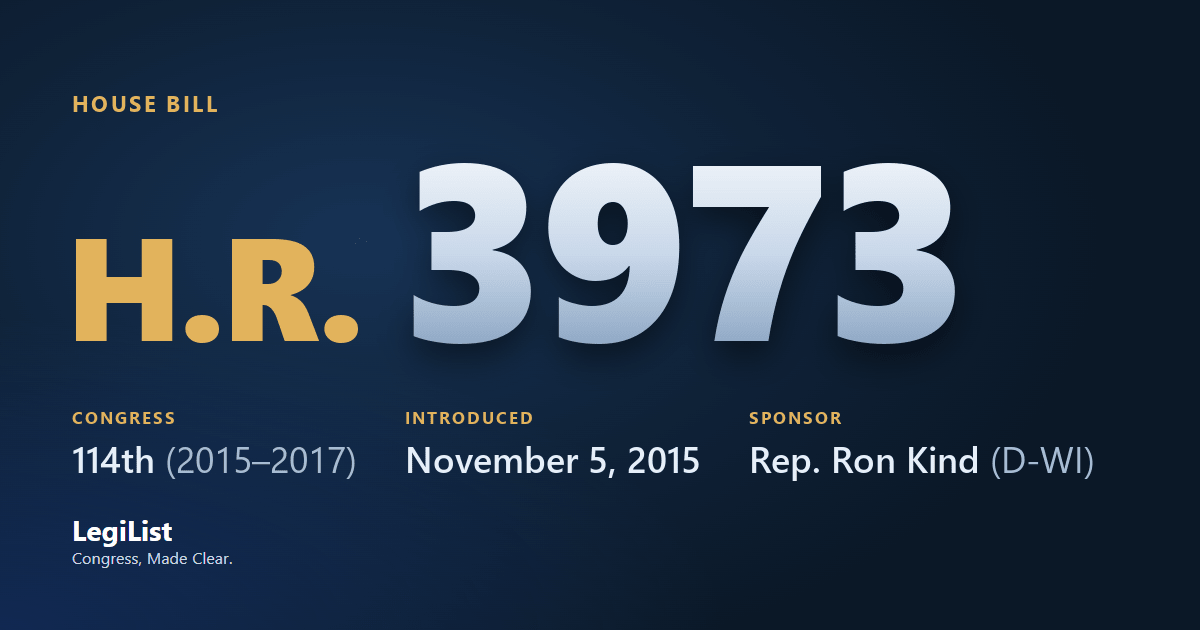
AFFIRM Act
Latest action · Dec 1, 2015 Referred to the Subcommittee on General Farm Commodities and Risk Management.
Progress
Where this bill reached, and when. A stage with no date was not reached; one that failed a vote and later carried shows the date it carried.
- IntroducedNov 5, 2015
- Passed HouseNot reached
- Passed SenateNot reached
- To the PresidentNot reached
- Became lawNot reached
Summary
Assisting Family Farmers through Insurance Reform Measures Act or the AFFIRM Act
This bill amends the Federal Crop Insurance Act to require the Department of Agriculture (USDA) to reduce federal crop insurance payments and disclose details regarding subsidies.
The bill prohibits premium subsidies: (1) for additional coverage for any person or legal entity that has an average adjusted gross income that exceeds $250,000, (2) that exceed $40,000 per year for any person or legal entity, or (3) for policies that are based on the actual market price of an agricultural commodity at the time of harvest.
The bill establishes an annual cap on total reimbursements for administrative and operating costs of crop insurance providers that begins at $900 million for 2015 and is adjusted for inflation in each subsequent year. The overall rate of return for insurance providers is capped at 8.9%.
The bill eliminates a requirement that any renegotiated Standard Insurance Agreement (SRA) be budget-neutral. (The SRA is an agreement between USDA and the private companies that administer the federal crop insurance program that specifies details such as administrative and operating expense reimbursements and risk sharing. Eliminating the budget neutrality requirement permits USDA to use the renegotiation of the SRA to achieve savings.)
USDA must annually disclose to the public specified details regarding the recipients and amounts of federal crop insurance subsidies.
Cosponsors 3
Members who signed on, in the order they did. Signatures ran from Nov 5, 2015 to Nov 18, 2015; 1 is an original cosponsor, there from the day it was introduced.
| Seat | Cosponsor | Signed on | |
|---|---|---|---|
| R-WI | F. James Sensenbrenner, Jr. | Original | Nov 5, 2015 |
| D-CT | Rosa L. DeLauro | Nov 16, 2015 | |
| D-OR | Earl Blumenauer | Nov 18, 2015 |
Committees 1
Where it was sent and what each committee and subcommittee did with it, in order.
| Chamber | Committee | What it did |
|---|---|---|
| House | Agriculture Committee | Referred Nov 5, 2015 |
| General Farm Commodities, Risk Management, and Credit Subcommittee | Referred Dec 1, 2015 |
Actions 3
Everything that happened, newest first.
- Dec 1, 2015Referred to the Subcommittee on General Farm Commodities and Risk Management.
- Nov 5, 2015Introduced in House
- Nov 5, 2015Referred to the House Committee on Agriculture.
Research
What has been written about this bill: committee reports, cost estimates, the sponsor’s authority statement, printed hearings and the Congressional Research Service’s work.
Constitutional authority
The sponsor’s statement, as printed in the Congressional Record, vol. 161, no. 165, November 5, 2015, page H8154.
Related bills 1
Companion bills and other measures the record links to this one.
| Bill | Title | Relationship | Latest action |
|---|---|---|---|
| S 2244 | AFFIRM Act | Related bill | Nov 5, 2015 |
Titles 3
Every title it has carried, official and short, at each stage.
- Official Title as Introduced
- To reform the Federal Crop Insurance Act and reduce Federal spending on crop insurance.
- Short Titles as Introduced
- AFFIRM Act
- Assisting Family Farmers through Insurance Reform Measures Act
Subjects
Assigned by the Library of Congress. Policy area: Agriculture and Food.
Text 1
Each version as it was printed, newest first.
- Nov 5, 2015Introduced in House
Support LegiList
This page is free, carries no paywall, and is built and maintained by one person. If the record here is useful to you, a few dollars keeps it going.
Everything here is as published by Congress: the summary is the Congressional Research Service's, the action wording is the clerks', and the subjects are the Library of Congress's. How far it got is read from the actions themselves, taking the most recent one of each kind, so a bill that failed a vote and later passed is shown as having passed. Records come from this bill on Congress.gov and govinfo.gov; cost estimates are the Congressional Budget Office's, and the hearings are the printed hearings GovInfo publishes, which can appear months after the hearing.