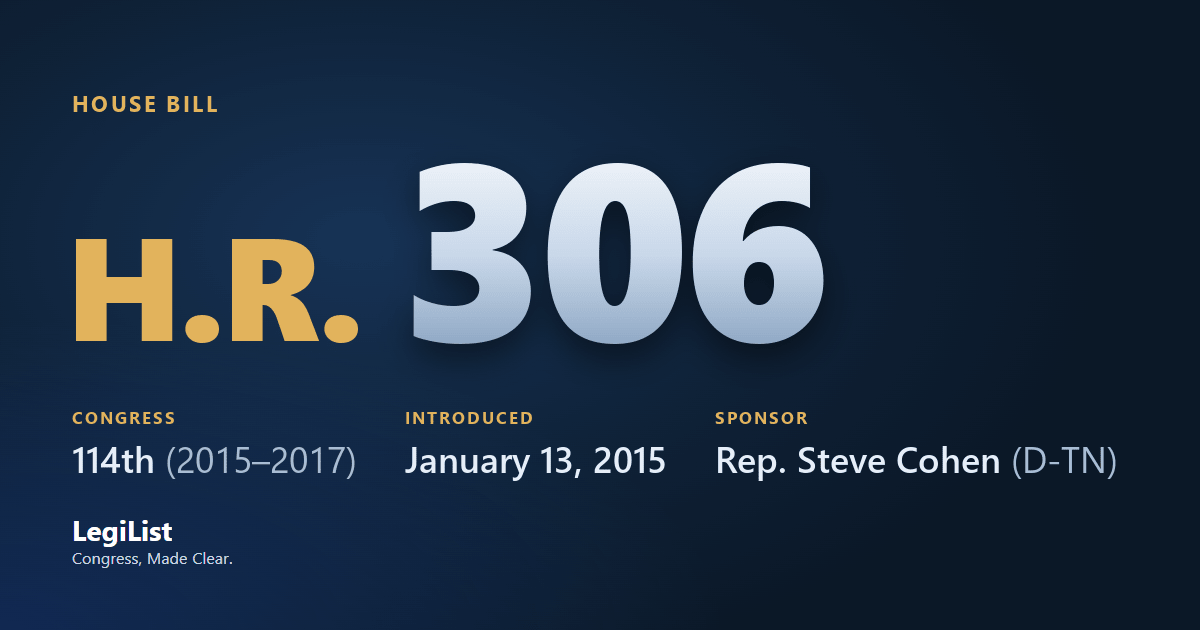
National Statistics on Deadly Force Transparency Act of 2015
Latest action · Feb 5, 2015 Referred to the Subcommittee on Crime, Terrorism, Homeland Security, and Investigations.
Progress
Where this bill reached, and when. A stage with no date was not reached; one that failed a vote and later carried shows the date it carried.
- IntroducedJan 13, 2015
- Passed HouseNot reached
- Passed SenateNot reached
- To the PresidentNot reached
- Became lawNot reached
Summary
National Statistics on Deadly Force Transparency Act of 2015
Requires the Attorney General to issue regulations for the collection and compilation of data pertaining to the use of deadly force by law enforcement officers, which shall require:
- the collection of data on all instances wherein deadly force was used;
- the data to include information on the characteristics of the officer and the person who was the target of deadly force (excluding personally identifiable information), the alleged criminal activity of such person, when and where the deadly force occurred, the nature of the deadly force used, the law enforcement agency's explanation of why deadly force was used, any deadly force guidelines of the law enforcement agency in effect at the time, and any non-lethal efforts employed to apprehend or subdue the person before deadly force was used;
- a standardized form be made available to law enforcement agencies for the submission of data collected to the Department of Justice Bureau of Justice Statistics; and
- law enforcement agencies to maintain all data collected for not less than four years.
Requires the Bureau to provide the data to Congress and make it available to the public. Restricts the disclosure of the name or identifying information of a law enforcement officer, a person who was the target of deadly force, or any other individual involved in any activity for which such data is collected.
Directs the Attorney General to reduce by 10% the amount that would otherwise be awarded under the Edward Byrne Memorial Justice Assistance Grant Program to a state or local government that fails to comply with the requirements of this Act.
Cosponsors 20
Members who signed on, in the order they did. Signatures ran from Jan 30, 2015 to Sep 16, 2015.
| Seat | Cosponsor | Signed on | |
|---|---|---|---|
| D-RI | David N. Cicilline | Jan 30, 2015 | |
| D-MD | Elijah E. Cummings | Jan 30, 2015 | |
| D-NY | Gregory W. Meeks | Jan 30, 2015 | |
| D-CA | Juan Vargas | Jan 30, 2015 | |
| D-MA | Katherine M. Clark | Jan 30, 2015 | |
| D-IL | Luis V. Gutierrez | Jan 30, 2015 | |
| D-AZ | Raúl M. Grijalva | Jan 30, 2015 | |
| D-CA | Mark Takano | Feb 10, 2015 | |
| D-CA | Judy Chu | Feb 27, 2015 | |
| D-CA | Barbara Lee | Mar 13, 2015 | |
| D-IL | Bobby L. Rush | Apr 13, 2015 | |
| D-MI | Brenda L. Lawrence | Apr 13, 2015 | |
| D-NY | Charles B. Rangel | Apr 13, 2015 | |
| D-DC | Eleanor Holmes Norton | Apr 13, 2015 | |
| D-GA | Henry C. "Hank" Johnson, Jr. | Apr 13, 2015 |
Committees 1
Where it was sent and what each committee and subcommittee did with it, in order.
| Chamber | Committee | What it did |
|---|---|---|
| House | Judiciary Committee | Referred Jan 13, 2015 |
| Crime and Federal Government Surveillance Subcommittee | Referred Feb 5, 2015 |
Actions 3
Everything that happened, newest first.
- Feb 5, 2015Referred to the Subcommittee on Crime, Terrorism, Homeland Security, and Investigations.
- Jan 13, 2015Introduced in House
- Jan 13, 2015Referred to the House Committee on the Judiciary.
In the Congressional Record 1
Days the Record’s own index lists this bill, newest first, with the pages and the members it names. Pages starting H are the House, S the Senate, E Extensions of Remarks.
| Where | In the Record | Members | Date |
|---|---|---|---|
| Extensions | Debate and remarks E698 | Steve Cohen D-TN | May 13, 2015 |
Research
What has been written about this bill: committee reports, cost estimates, the sponsor’s authority statement, printed hearings and the Congressional Research Service’s work.
Constitutional authority
The sponsor’s statement, as printed in the Congressional Record, vol. 161, no. 6, January 13, 2015, page H359.
CRS reports 1
Congressional Research Service work that CRS links to this bill or the law it became, newest first.
Cite it 1
Products on other subjects that cite it, usually among other measures.
| Product | Title | Kind | Published |
|---|---|---|---|
| R44256 | Police Use of Force: Rules, Remedies, and Reforms Archived | Report | Oct 30, 2015 |
Related bills 1
Companion bills and other measures the record links to this one.
| Bill | Title | Relationship | Latest action |
|---|---|---|---|
| HR 630 | National Statistics on Deadly Force Transparency Act of 2017 | Reintroduced Bill | Jan 24, 2017 |
Titles 2
Every title it has carried, official and short, at each stage.
- Official Title as Introduced
- To require the Attorney General to issue rules pertaining to the collection and compilation of data on the use of deadly force by law enforcement officers.
- Short Titles as Introduced
- National Statistics on Deadly Force Transparency Act of 2015
Subjects
Assigned by the Library of Congress. Policy area: Crime and Law Enforcement.
- Administrative law and regulatory procedures
- Census and government statistics
- Crime and Law Enforcement
- Criminal justice information and records
- Department of Justice
- Law enforcement administration and funding
- Law enforcement officers
- Racial and ethnic relations
- Sex, gender, sexual orientation discrimination
Text 1
Each version as it was printed, newest first.
- Jan 13, 2015Introduced in House
Everything here is as published by Congress: the summary is the Congressional Research Service's, the action wording is the clerks', and the subjects are the Library of Congress's. How far it got is read from the actions themselves, taking the most recent one of each kind, so a bill that failed a vote and later passed is shown as having passed. Records come from this bill on Congress.gov and govinfo.gov; cost estimates are the Congressional Budget Office's, and the hearings are the printed hearings GovInfo publishes, which can appear months after the hearing.