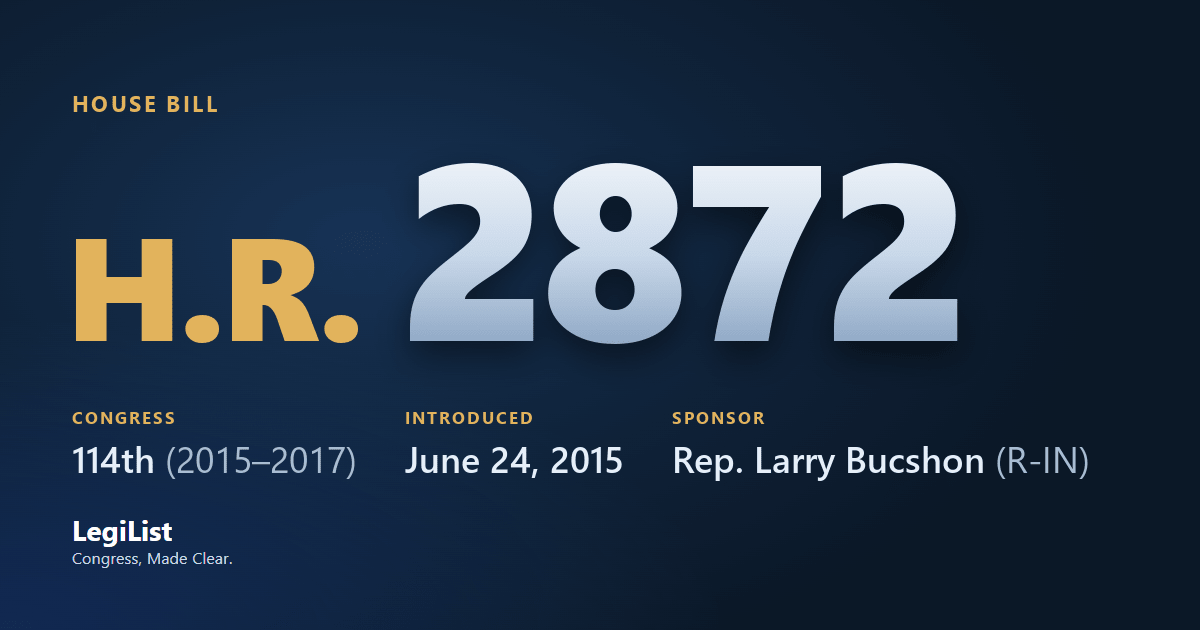
Opioid Addiction Treatment Modernization Act
Latest action · Jul 9, 2015 Referred to the Subcommittee on Crime, Terrorism, Homeland Security, and Investigations.
Progress
Where this bill reached, and when. A stage with no date was not reached; one that failed a vote and later carried shows the date it carried.
- IntroducedJun 24, 2015
- Passed HouseNot reached
- Passed SenateNot reached
- To the PresidentNot reached
- Became lawNot reached
Summary
Opioid Addiction Treatment Modernization Act
This bill amends the Controlled Substances Act to require a practitioner who administers or dispenses narcotic drugs for maintenance or detoxification treatment in an opioid treatment program to complete training every two years.
The legislation revises the waiver requirements for a physician who wants to administer, dispense, or prescribe narcotic drugs for maintenance or detoxification treatment in an office-based opioid treatment program. Currently, such physician must notify the Department of Health and Human Services (HHS) and certify that he or she is a qualifying physician, has the capacity to refer patients for appropriate counseling and ancillary services, and will comply with a patient limit. This bill requires a physician to also certify that he or she maintains a diversion control plan and has the capacity to provide directly or by referral all drugs approved by the Food and Drug Administration for the treatment of opioid addiction.
The bill modifies the definition of a "qualifying physician." Currently, a qualifying physician must be licensed in a state and have expertise (such as relevant certification, training, or experience). This legislation requires a qualifying physician to also complete training every two years and obtain written consent from each patient regarding available treatment options.
It permits HHS or the Department of Justice to inspect registered practitioners who dispense narcotics to ensure compliance with the requirements of this Act.
All practitioners who are permitted to dispense narcotic drugs to individuals for maintenance treatment or detoxification treatment must submit to HHS a certification of compliance with the requirements of this Act.
The Government Accountability Office must review opioid addition treatment services in the United States and report findings to Congress every five years.
Cosponsors 5
Members who signed on, in the order they did. Signatures ran from Jun 24, 2015 to Apr 13, 2016; 1 is an original cosponsor, there from the day it was introduced.
| Seat | Cosponsor | Signed on | |
|---|---|---|---|
| R-AR | Steve Womack | Original | Jun 24, 2015 |
| R-OH | Steve Chabot | Jul 29, 2015 | |
| R-OH | Steve Stivers | Oct 6, 2015 | |
| R-FL | Daniel Webster | Dec 10, 2015 | |
| D-NH | Ann M. Kuster | Apr 13, 2016 |
Committees 2
Where it was sent and what each committee and subcommittee did with it, in order.
| Chamber | Committee | What it did |
|---|---|---|
| House | Energy and Commerce Committee | Referred Jun 24, 2015 |
| Health Subcommittee | Referred Jun 26, 2015 | |
| House | Judiciary Committee | Referred Jun 24, 2015 |
| Crime and Federal Government Surveillance Subcommittee | Referred Jul 9, 2015 |
Actions 4
Everything that happened, newest first.
- Jul 9, 2015Referred to the Subcommittee on Crime, Terrorism, Homeland Security, and Investigations.
- Jun 26, 2015Referred to the Subcommittee on Health.
- Jun 24, 2015Introduced in House
- Jun 24, 2015Referred to the Committee on Energy and Commerce, and in addition to the Committee on the Judiciary, for a period to be subsequently determined by the Speaker, in each case for consideration of such provisions as fall within the jurisdiction of the committee concerned.
In the Congressional Record 1
Days the Record’s own index lists this bill, newest first, with the pages and the members it names. Pages starting H are the House, S the Senate, E Extensions of Remarks.
| Where | In the Record | Members | Date |
|---|---|---|---|
| House | Debate and remarks H2202 | Sheila Jackson Lee D-TX | May 10, 2016 |
Research
What has been written about this bill: committee reports, cost estimates, the sponsor’s authority statement, printed hearings and the Congressional Research Service’s work.
Constitutional authority
The sponsor’s statement, as printed in the Congressional Record, vol. 161, no. 102, June 24, 2015, page H4651.
Printed hearings 1
Hearings whose printed record names this bill, newest first: hearings on it, and wider hearings where it came up.
| Number | Hearing | Committee | Held |
|---|---|---|---|
| Serial No. 114-86 | EXAMINING LEGISLATIVE PROPOSALS TO COMBAT OUR NATION'S DRUG ABUSE CRISIS249 pages | Energy and Commerce Committee | Oct 8, 2015–Oct 20, 2015 |
Titles 2
Every title it has carried, official and short, at each stage.
- Official Title as Introduced
- To amend the Controlled Substances Act to modernize the treatment of opioid addiction, and for other purposes.
- Short Titles as Introduced
- Opioid Addiction Treatment Modernization Act
Subjects
Assigned by the Library of Congress. Policy area: Health.
Text 1
Each version as it was printed, newest first.
- Jun 24, 2015Introduced in House
Support LegiList
This page is free, carries no paywall, and is built and maintained by one person. If the record here is useful to you, a few dollars keeps it going.
Everything here is as published by Congress: the summary is the Congressional Research Service's, the action wording is the clerks', and the subjects are the Library of Congress's. How far it got is read from the actions themselves, taking the most recent one of each kind, so a bill that failed a vote and later passed is shown as having passed. Records come from this bill on Congress.gov and govinfo.gov; cost estimates are the Congressional Budget Office's, and the hearings are the printed hearings GovInfo publishes, which can appear months after the hearing.