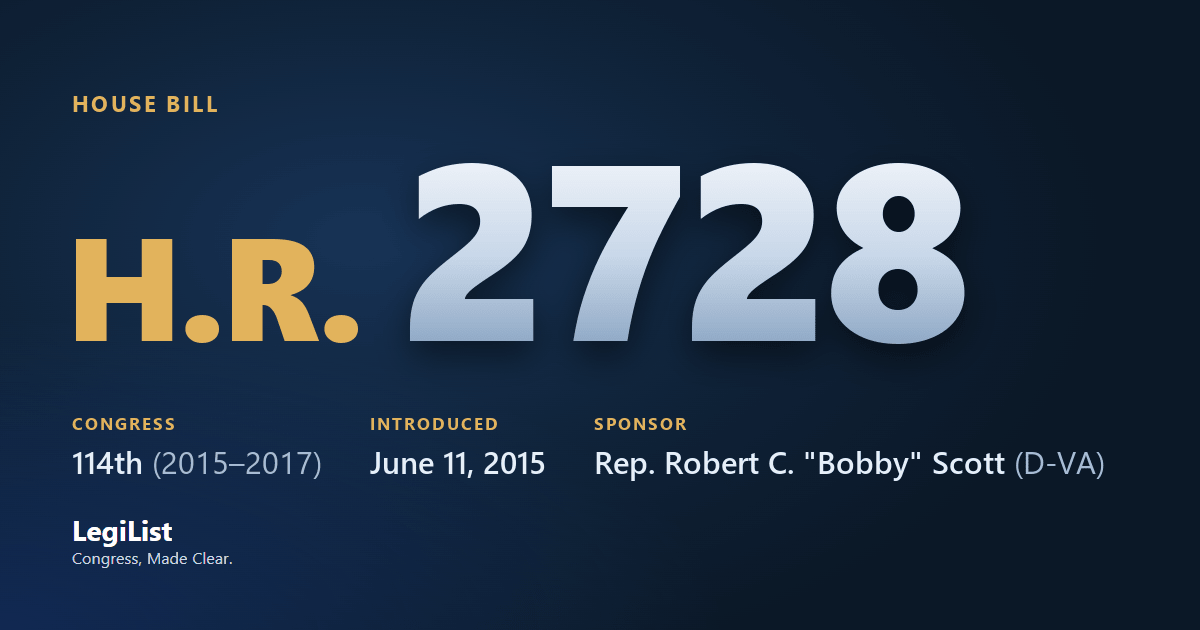
Youth Justice Act of 2015
Latest action · Nov 16, 2015 Referred to the Subcommittee on Early Childhood, Elementary, and Secondary Education.
Progress
Where this bill reached, and when. A stage with no date was not reached; one that failed a vote and later carried shows the date it carried.
- IntroducedJun 11, 2015
- Passed HouseNot reached
- Passed SenateNot reached
- To the PresidentNot reached
- Became lawNot reached
Summary
Youth Justice Act of 2015
Amends the Juvenile Justice and Delinquency Prevention Act of 1974 (JJDPA) to:
- increase funding for such Act in each of FY2016-FY2020 and authorize appropriations at the FY2020 level for each succeeding fiscal year;
- include as one of the purposes of such Act the support of a trauma-informed continuum of programs (including delinquency prevention, intervention, mental health, behavioral health, substance abuse treatment, and aftercare) to address the needs of at-risk youth and youth who come into contact with the justice system;
- require the Office of Juvenile Justice and Delinquency Prevention (Office) to develop a long-term plan to improve the juvenile justice system, taking into account scientific knowledge regarding adolescent development and behavior;
- include the Administrator of the Substance Abuse and Mental Health Services Administration, the Secretary of Defense, and the Secretary of Agriculture on the Coordinating Council on Juvenile Justice and Delinquency Prevention;
- expand the annual reporting requirement of the Office to include information on the use of restraints and isolation upon juveniles held in custody;
- require states to implement plans to ensure fairness and reduce racial and ethnic disparities in the detention of juveniles;
- enhance requirements for separating juveniles from sight or sound contact with adult lock-ups;
- terminate, three years after the enactment of this Act, the authority of a court to issue an order detaining juveniles in adult lockups who have not been charged with adult criminal offenses (status offenders);
- require the Office to report annually on policies and procedures to eliminate dangerous practices and unreasonable use of restraints in the detention of juveniles;
- expand requirements for state plans for juvenile justice and delinquency prevention to include community-based alternatives to the detention of juveniles in correctional facilities;
- provide technical assistance to states and local governments for achieving compliance with the requirements of this Act; and
- authorize the Office to make incentive grants to states and local governments to increase the use of evidence-based or promising prevention and intervention programs for juveniles who enter the criminal justice system and for the recruitment and training of professional personnel.
Amends the Incentive Grants for Local Delinquency Prevention Programs Act of 2002 to include mentoring programs in delinquency prevention grant programs.
Requires the Government Accountability Office to conduct: (1) a comprehensive evaluation of the performance of the Office of Juvenile Justice and Delinquency Prevention; and (2) a comprehensive audit and evaluation of selected grant recipients, including a review of internal controls to prevent fraud, waste, and abuse.
Requires audits of all JJDPA grants awarded by the Department of Justice (DOJ). Prohibits: (1) the award of a JJDPA grant to a tax-exempt nonprofit organization that holds money in offshore accounts for the purpose of avoiding the tax on unrelated business income; (2) the hosting or supporting of DOJ conferences that use more than $20,000 of DOJ funds without prior written authorization; and (3) lobbying of representatives of DOJ or of a federal, state, local, or tribal government regarding the award of grant funding.
Amends the Omnibus Crime Control and Safe Streets Act of 1968 to require states, as a condition of receiving juvenile accountability block grants, to provide assurances of compliance with the core requirement of JJDPA applicable to the detention and confinement of juveniles.
Cosponsors 10
Members who signed on, in the order they did. Signatures ran from Jun 11, 2015 to Apr 26, 2016; 4 are original cosponsors, there from the day it was introduced.
| Seat | Cosponsor | Signed on | |
|---|---|---|---|
| D-LA | Cedric L. Richmond | Original | Jun 11, 2015 |
| D-CA | Karen Bass | Original | Jun 11, 2015 |
| D-TX | Sheila Jackson Lee | Original | Jun 11, 2015 |
| D-CA | Tony Cárdenas | Original | Jun 11, 2015 |
| D-CA | Eric Swalwell | Jul 29, 2015 | |
| D-MN | Timothy J. Walz | Jul 29, 2015 | |
| D-TN | Steve Cohen | Sep 22, 2015 | |
| D-CA | Zoe Lofgren | Sep 25, 2015 | |
| D-WA | Suzan K. DelBene | Oct 6, 2015 | |
| D-NY | Sean Patrick Maloney | Apr 26, 2016 |
Committees 2
Where it was sent and what each committee and subcommittee did with it, in order.
| Chamber | Committee | What it did |
|---|---|---|
| House | Education and Workforce Committee | Referred Jun 11, 2015 |
| Early Childhood, Elementary, and Secondary Education Subcommittee | Referred Nov 16, 2015 | |
| House | Judiciary Committee | Referred Jun 11, 2015 |
| Crime and Federal Government Surveillance Subcommittee | Referred Jul 1, 2015 |
Actions 4
Everything that happened, newest first.
- Nov 16, 2015Referred to the Subcommittee on Early Childhood, Elementary, and Secondary Education.
- Jul 1, 2015Referred to the Subcommittee on Crime, Terrorism, Homeland Security, and Investigations.
- Jun 11, 2015Introduced in House
- Jun 11, 2015Referred to the Committee on Education and the Workforce, and in addition to the Committee on the Judiciary, for a period to be subsequently determined by the Speaker, in each case for consideration of such provisions as fall within the jurisdiction of the committee concerned.
In the Congressional Record 1
Days the Record’s own index lists this bill, newest first, with the pages and the members it names. Pages starting H are the House, S the Senate, E Extensions of Remarks.
| Where | In the Record | Members | Date |
|---|---|---|---|
| House | Lists H4242H.R. 2728–2744 | — | Jun 11, 2015 |
Research
What has been written about this bill: committee reports, cost estimates, the sponsor’s authority statement, printed hearings and the Congressional Research Service’s work.
Constitutional authority
The sponsor’s statement, as printed in the Congressional Record, vol. 161, no. 93, June 11, 2015, page H4242.
Related bills 1
Companion bills and other measures the record links to this one.
| Bill | Title | Relationship | Latest action |
|---|---|---|---|
| S 1169 | Juvenile Justice and Delinquency Prevention Reauthorization Act of 2015 | Related bill | Dec 15, 2015 |
Titles 2
Every title it has carried, official and short, at each stage.
- Official Title as Introduced
- To reauthorize and improve the Juvenile Justice and Delinquency Prevention Act of 1974, and for other purposes.
- Short Titles as Introduced
- Youth Justice Act of 2015
Subjects
Assigned by the Library of Congress. Policy area: Crime and Law Enforcement.
- Accounting and auditing
- Child health
- Child safety and welfare
- Congressional oversight
- Correctional facilities and imprisonment
- Crime and Law Enforcement
- Crime prevention
- Department of Justice
- Detention of persons
- Executive agency funding and structure
- Government studies and investigations
- Juvenile crime and gang violence
- Law enforcement administration and funding
- Mental health
- Performance measurement
- Public participation and lobbying
- Racial and ethnic relations
- Tax-exempt organizations
- Taxation of foreign income
Text 1
Each version as it was printed, newest first.
- Jun 11, 2015Introduced in House
Support LegiList
This page is free, carries no paywall, and is built and maintained by one person. If the record here is useful to you, a few dollars keeps it going.
Everything here is as published by Congress: the summary is the Congressional Research Service's, the action wording is the clerks', and the subjects are the Library of Congress's. How far it got is read from the actions themselves, taking the most recent one of each kind, so a bill that failed a vote and later passed is shown as having passed. Records come from this bill on Congress.gov and govinfo.gov; cost estimates are the Congressional Budget Office's, and the hearings are the printed hearings GovInfo publishes, which can appear months after the hearing.