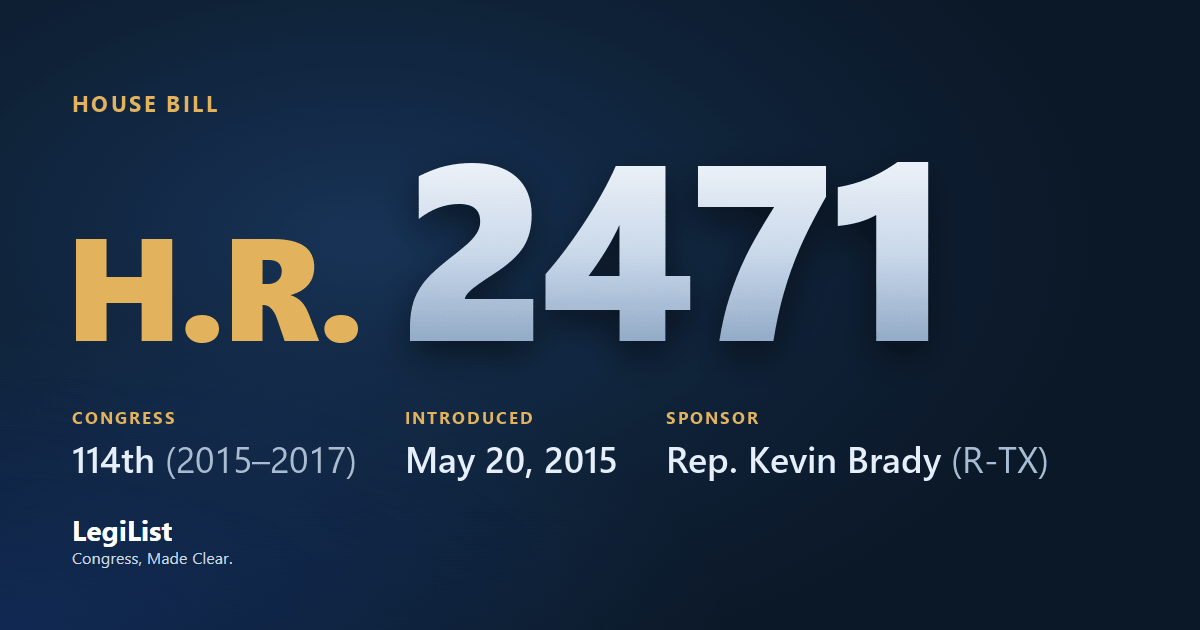
Maximizing America's Prosperity Act of 2015
Latest action · May 20, 2015 Referred to the Committee on the Budget, and in addition to the Committee on Rules, for a period to be subsequently determined by the Speaker, in each case for consideration of such provisions as fall within the jurisdiction of the committee concerned.
Progress
Where this bill reached, and when. A stage with no date was not reached; one that failed a vote and later carried shows the date it carried.
- IntroducedMay 20, 2015
- Passed HouseNot reached
- Passed SenateNot reached
- To the PresidentNot reached
- Became lawNot reached
Summary
Maximizing America's Prosperity Act of 2015
This bill amends the Balanced Budget and Emergency Deficit Control Act of 1985 and the Congressional Budget and Impoundment Control Act of 1974 to limit total noninterest federal spending to a specified percentage of potential gross domestic product (GDP).
The cap begins at 19% of potential GDP for FY2016 and decreases each fiscal year until it reaches 16% of potential GDP for FY2024 and subsequent fiscal years. The total cap for each year fiscal year must be reduced by an amount equal to the unfunded direct costs of federal mandates for the year.
The bill revises the existing sequestration process to establish a new process to enforce the limits established by this bill. To enforce the caps, the bill's sequestration process would impose automatic cuts to discretionary spending. No discretionary budget account is permitted to be reduced by more than 5% of its budgetary resources.
The bill eliminates adjustments to spending limits that are currently permitted for emergency spending. The President's budget must include an allowance for emergency spending that is no less than 1% of discretionary spending for the year. The appropriations committees must set aside for emergencies 1% of the funding allocation provided to the committees by the budget resolution.
Cosponsors
Members who signed on, in the order they did.
Committees 2
Where it was sent and what each committee and subcommittee did with it, in order.
| Chamber | Committee | What it did |
|---|---|---|
| House | Budget Committee | Referred May 20, 2015 |
| House | Rules Committee | Referred May 20, 2015 |
Actions 2
Everything that happened, newest first.
- May 20, 2015Introduced in House
- May 20, 2015Referred to the Committee on the Budget, and in addition to the Committee on Rules, for a period to be subsequently determined by the Speaker, in each case for consideration of such provisions as fall within the jurisdiction of the committee concerned.
Research
What has been written about this bill: committee reports, cost estimates, the sponsor’s authority statement, printed hearings and the Congressional Research Service’s work.
Constitutional authority
The sponsor’s statement, as printed in the Congressional Record, vol. 161, no. 78, May 20, 2015, page H3507.
Titles 2
Every title it has carried, official and short, at each stage.
- Official Title as Introduced
- To cap noninterest Federal Spending as a percentage of potential GDP to right-size the government, grow the economy, and balance the budget.
- Short Titles as Introduced
- Maximizing America's Prosperity Act of 2015
Subjects
Assigned by the Library of Congress. Policy area: Economics and Public Finance.
Text 1
Each version as it was printed, newest first.
- May 20, 2015Introduced in House
Everything here is as published by Congress: the summary is the Congressional Research Service's, the action wording is the clerks', and the subjects are the Library of Congress's. How far it got is read from the actions themselves, taking the most recent one of each kind, so a bill that failed a vote and later passed is shown as having passed. Records come from this bill on Congress.gov and govinfo.gov; cost estimates are the Congressional Budget Office's, and the hearings are the printed hearings GovInfo publishes, which can appear months after the hearing.