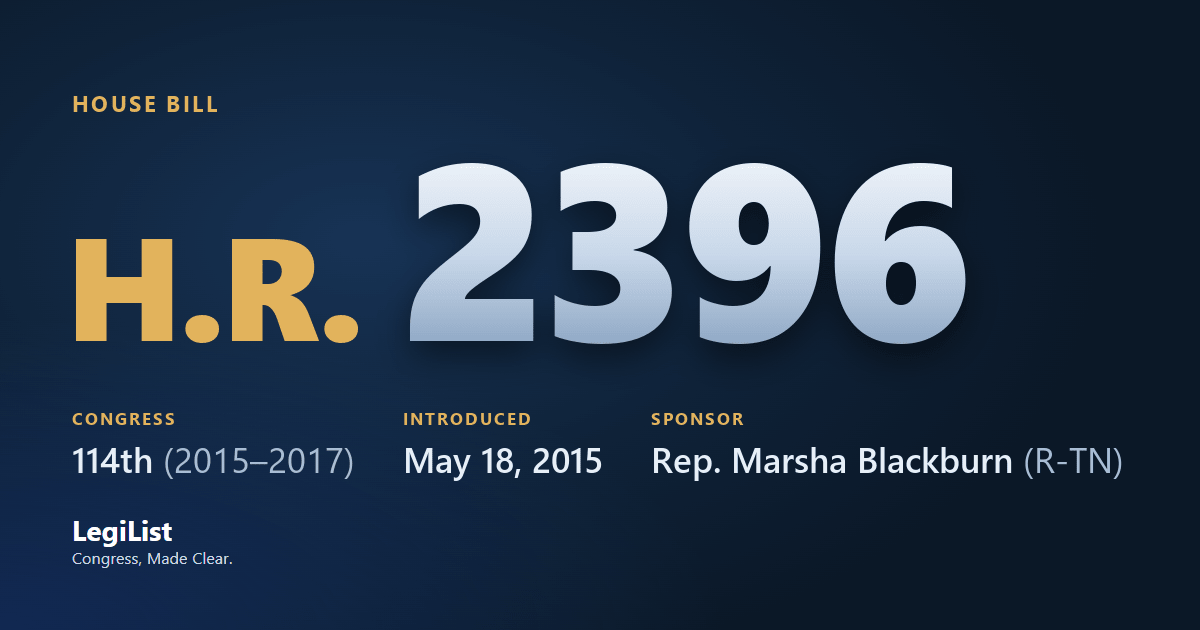
SOFTWARE Act
Latest action · May 22, 2015 Referred to the Subcommittee on Health.
Progress
Where this bill reached, and when. A stage with no date was not reached; one that failed a vote and later carried shows the date it carried.
- IntroducedMay 18, 2015
- Passed HouseNot reached
- Passed SenateNot reached
- To the PresidentNot reached
- Became lawNot reached
Summary
Sensible Oversight for Technology which Advances Regulatory Efficiency Act or the SOFTWARE Act
This bill amends the Federal Food, Drug, and Cosmetic Act to define health software as software that does not acquire, process, or analyze data from an in vitro diagnostic device or signal acquisition system, is not an accessory or part of a medical device, is not used to prevent disease in the transfusion of blood and blood components, and is for:
- administrative or operational support or the processing and maintenance of financial records;
- use in clinical, laboratory, or administrative workflow and recordkeeping;
- managing data but not for active patient monitoring or controlling the functions of a connected medical device;
- organizing and presenting information for health or wellness education or maintaining a healthy lifestyle; or
- analyzing information to provide general health information or patient-specific recommendations.
The FDA must classify an accessory of a medical device independently from the medical device with which it is used.
Health software is exempted from regulation by the FDA (including as a medical device), except for software that provides patient-specific recommendations and poses a significant risk to patient safety.
The FDA must review existing regulations and guidance regarding the regulation of health software.Cosponsors 1
Members who signed on, in the order they did. All signed on May 18, 2015.
| Seat | Cosponsor | Signed on | |
|---|---|---|---|
| D-TX | Gene Green | Original | May 18, 2015 |
Committees 1
Where it was sent and what each committee and subcommittee did with it, in order.
| Chamber | Committee | What it did |
|---|---|---|
| House | Energy and Commerce Committee | Referred May 18, 2015 |
| Health Subcommittee | Referred May 22, 2015 |
Actions 3
Everything that happened, newest first.
- May 22, 2015Referred to the Subcommittee on Health.
- May 18, 2015Introduced in House
- May 18, 2015Referred to the House Committee on Energy and Commerce.
Research
What has been written about this bill: committee reports, cost estimates, the sponsor’s authority statement, printed hearings and the Congressional Research Service’s work.
Constitutional authority
The sponsor’s statement, as printed in the Congressional Record, vol. 161, no. 76, May 18, 2015, page H3309.
Related bills 1
Companion bills and other measures the record links to this one.
| Bill | Title | Relationship | Latest action |
|---|---|---|---|
| HR 6 | 21st Century Cures Act | Related bill | Jul 13, 2015 |
Titles 3
Every title it has carried, official and short, at each stage.
- Official Title as Introduced
- To amend the Federal Food, Drug, and Cosmetic Act with respect to the regulation of health software, and for other purposes.
- Short Titles as Introduced
- Sensible Oversight for Technology which Advances Regulatory Efficiency Act
- SOFTWARE Act
Subjects
Assigned by the Library of Congress. Policy area: Health.
Text 1
Each version as it was printed, newest first.
- May 18, 2015Introduced in House
Everything here is as published by Congress: the summary is the Congressional Research Service's, the action wording is the clerks', and the subjects are the Library of Congress's. How far it got is read from the actions themselves, taking the most recent one of each kind, so a bill that failed a vote and later passed is shown as having passed. Records come from this bill on Congress.gov and govinfo.gov; cost estimates are the Congressional Budget Office's, and the hearings are the printed hearings GovInfo publishes, which can appear months after the hearing.