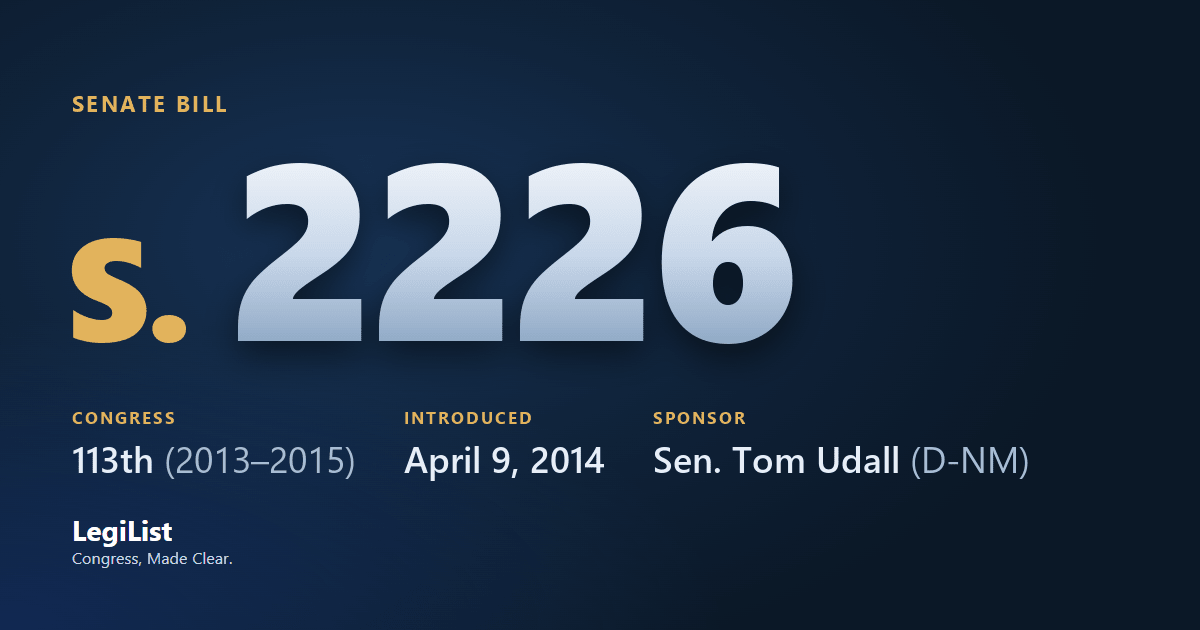
WaterSense Efficiency, Conservation, and Adaptation Act of 2014
Latest action · Apr 9, 2014 Read twice and referred to the Committee on Environment and Public Works.
Progress
Where this bill reached, and when. A stage with no date was not reached; one that failed a vote and later carried shows the date it carried.
- IntroducedApr 9, 2014
- Passed SenateNot reached
- Passed HouseNot reached
- To the PresidentNot reached
- Became lawNot reached
Summary
WaterSense Efficiency, Conservation, and Adaptation Act of 2014 - Establishes within the Environmental Protection Agency (EPA) a WaterSense program to identify and promote water efficient products, buildings, landscapes, facilities, processes, and services so as to:
- reduce water use;
- reduce the strain on water, wastewater, and stormwater infrastructure;
- conserve energy used to pump, heat, transport, and treat water; and
- preserve water resources through the voluntary labeling of, or other forms of communications about, products, buildings, landscapes, facilities, processes, and services that meet the highest water efficiency and performance criteria.
Requires the Administrator of EPA to identify other voluntary approaches to encourage recycling and reuse technologies to improve water efficiency or lower water use and to implement those approaches, if appropriate.
Establishes a State Residential Water Efficiency and Conservation Incentives Program to provide financial incentives for consumers to purchase and install products, buildings, landscapes, facilities, processes, and services labeled under the WaterSense program.
Requires the Administrator to make grants to owners or operators of water systems to address, mitigate, and adapt to address any ongoing or forecasted impact of climate change on the water quality or quantity of a U.S. region.
Cosponsors 2
Members who signed on, in the order they did. Signatures ran from Apr 9, 2014 to May 7, 2014; 1 is an original cosponsor, there from the day it was introduced.
| Seat | Cosponsor | Signed on | |
|---|---|---|---|
| D-CA | Barbara Boxer | Original | Apr 9, 2014 |
| D-MD | Benjamin L. Cardin | May 7, 2014 |
Committees 1
Where it was sent and what each committee and subcommittee did with it, in order.
| Chamber | Committee | What it did |
|---|---|---|
| Senate | Environment and Public Works Committee | Referred Apr 9, 2014 |
Actions 2
Everything that happened, newest first.
- Apr 9, 2014Introduced in Senate
- Apr 9, 2014Read twice and referred to the Committee on Environment and Public Works.
Research
What has been written about this bill: committee reports, cost estimates, the sponsor’s authority statement, printed hearings and the Congressional Research Service’s work.
CRS reports 1
Congressional Research Service work that CRS links to this bill or the law it became, newest first.
Cite it 1
Products on other subjects that cite it, usually among other measures.
| Product | Title | Kind | Published |
|---|---|---|---|
| R43915 | Climate Change Adaptation by Federal Agencies: An Analysis of Plans and Issues for Congress Archived | Report | Feb 23, 2015 |
Related bills 3
Companion bills and other measures the record links to this one.
| Bill | Title | Relationship | Latest action |
|---|---|---|---|
| S 2771 | W21 | Related bill | Jul 31, 2014 |
| HR 5150 | WaterSense Efficiency, Conservation, and Adaptation Act of 2014 | Identical bill | Jul 23, 2014 |
| HR 5363 | W21 | Related bill | Sep 12, 2014 |
Titles 2
Every title it has carried, official and short, at each stage.
- Official Title as Introduced
- A bill to establish a WaterSense program within the Environmental Protection Agency.
- Short Titles as Introduced
- WaterSense Efficiency, Conservation, and Adaptation Act of 2014
Subjects
Assigned by the Library of Congress. Policy area: Environmental Protection.
- Climate change and greenhouse gases
- Consumer affairs
- Energy efficiency and conservation
- Environmental assessment, monitoring, research
- Environmental Protection
- Environmental technology
- Housing industry and standards
- Residential rehabilitation and home repair
- Solid waste and recycling
- Water quality
- Water resources funding
- Water use and supply
Text 1
Each version as it was printed, newest first.
- Apr 9, 2014Introduced in Senate
Support LegiList
This page is free, carries no paywall, and is built and maintained by one person. If the record here is useful to you, a few dollars keeps it going.
Everything here is as published by Congress: the summary is the Congressional Research Service's, the action wording is the clerks', and the subjects are the Library of Congress's. How far it got is read from the actions themselves, taking the most recent one of each kind, so a bill that failed a vote and later passed is shown as having passed. Records come from this bill on Congress.gov and govinfo.gov; cost estimates are the Congressional Budget Office's, and the hearings are the printed hearings GovInfo publishes, which can appear months after the hearing.