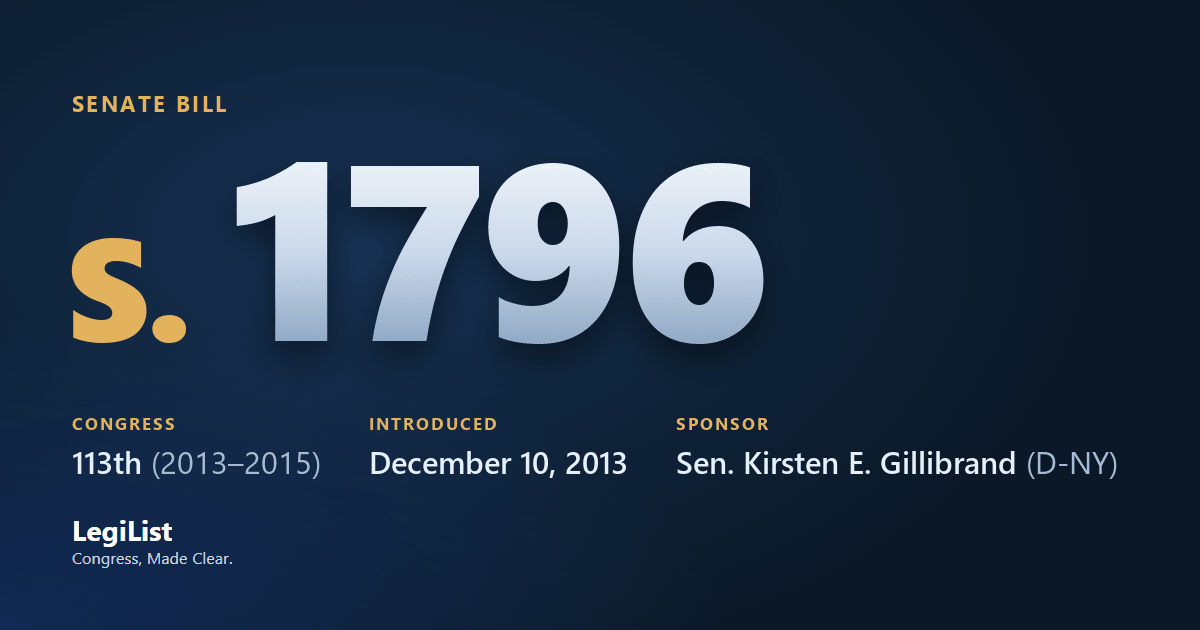
STEM Gateways Act
Latest action · Dec 10, 2013 Read twice and referred to the Committee on Health, Education, Labor, and Pensions.
Progress
Where this bill reached, and when. A stage with no date was not reached; one that failed a vote and later carried shows the date it carried.
- IntroducedDec 10, 2013
- Passed SenateNot reached
- Passed HouseNot reached
- To the PresidentNot reached
- Became lawNot reached
Summary
STEM Gateways Act - Directs the Secretary of Education to award competitive grants to eligible entities for science, technology, engineering, and mathematics (STEM) elementary and secondary school programs for women and girls, underrepresented minorities, and individuals from all economic backgrounds.
Requires those programs to be directed toward at least one of the following goals:
- encouraging the interest of elementary and secondary school students in the STEM fields;
- motivating the engagement of those students in the STEM fields by providing them with relevant hands-on learning opportunities;
- supporting classroom success in the STEM disciplines by elementary and secondary school students;
- supporting STEM workforce training and career preparation for secondary school students; and
- improving the access of secondary school students to STEM career and continuing education opportunities.
Defines an "eligible entity" as: (1) a local educational agency (LEA); (2) an educational service agency serving more than one LEA; (3) a consortium of LEAs; (4) a nonprofit organization that works with elementary schools, secondary schools, or institutions of higher education and has shown a commitment to achieving the goals listed above; or (5) a community college working in partnership with secondary schools to create dual enrollment, credit transfer, or accelerated postsecondary credentialing opportunities.
Cosponsors 1
Members who signed on, in the order they did. All signed on Jan 7, 2014.
| Seat | Cosponsor | Signed on | |
|---|---|---|---|
| D-MN | Al Franken | Jan 7, 2014 |
Committees 1
Where it was sent and what each committee and subcommittee did with it, in order.
| Chamber | Committee | What it did |
|---|---|---|
| Senate | Health, Education, Labor, and Pensions Committee | Referred Dec 10, 2013 |
Actions 2
Everything that happened, newest first.
- Dec 10, 2013Introduced in Senate
- Dec 10, 2013Read twice and referred to the Committee on Health, Education, Labor, and Pensions.
Research
What has been written about this bill: committee reports, cost estimates, the sponsor’s authority statement, printed hearings and the Congressional Research Service’s work.
Printed hearings 1
Hearings whose printed record names this bill, newest first: hearings on it, and wider hearings where it came up.
| Number | Hearing | Committee | Held |
|---|---|---|---|
| S. Hrg. 113-500 | DELIVERING BETTER HEALTH CARE VALUE TO CONSUMERS: THE FIRST THREE YEARS OF THE MEDICAL LOSS RATIO73 pages | Commerce, Science, and Transportation Committee | May 21, 2014 |
Related bills 1
Companion bills and other measures the record links to this one.
| Bill | Title | Relationship | Latest action |
|---|---|---|---|
| HR 3690 | STEM Gateways Act | Related bill | Jan 22, 2014 |
Titles 2
Every title it has carried, official and short, at each stage.
- Official Title as Introduced
- A bill to increase the participation of women, girls, and underrepresented minorities in STEM fields, to encourage and support students from all economic backgrounds to pursue STEM career opportunities, and for other purposes.
- Short Titles as Introduced
- STEM Gateways Act
Subjects
Assigned by the Library of Congress. Policy area: Education.
Text 1
Each version as it was printed, newest first.
- Dec 10, 2013Introduced in Senate
Everything here is as published by Congress: the summary is the Congressional Research Service's, the action wording is the clerks', and the subjects are the Library of Congress's. How far it got is read from the actions themselves, taking the most recent one of each kind, so a bill that failed a vote and later passed is shown as having passed. Records come from this bill on Congress.gov and govinfo.gov; cost estimates are the Congressional Budget Office's, and the hearings are the printed hearings GovInfo publishes, which can appear months after the hearing.