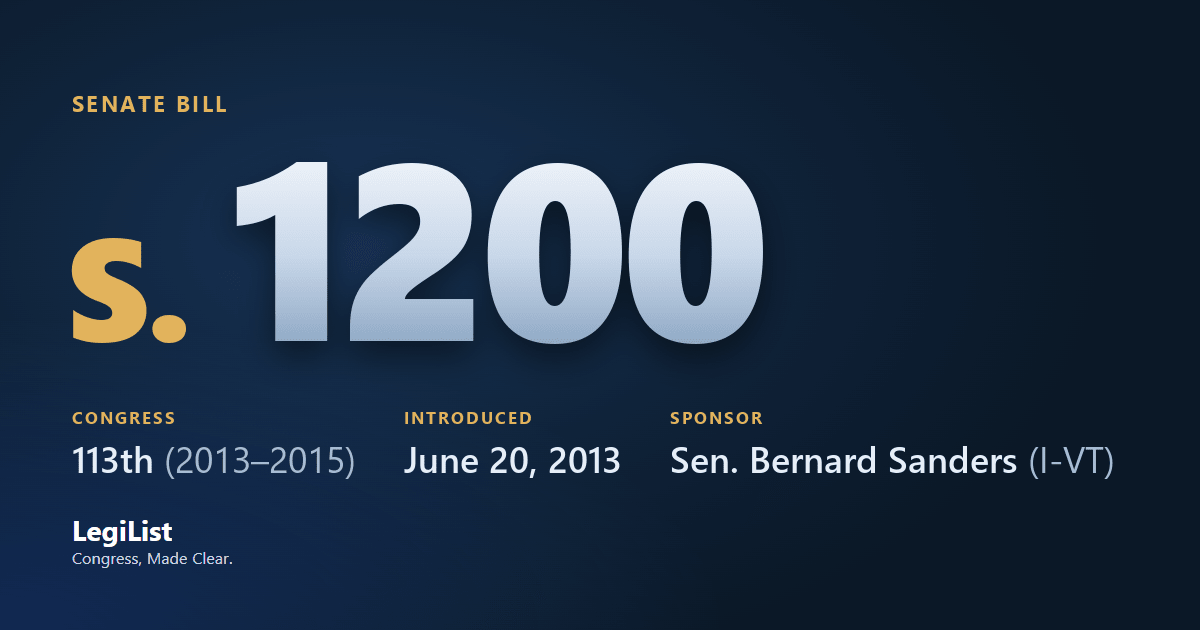
Residential Energy Savings Act of 2013
Latest action · Jun 25, 2013 Committee on Energy and Natural Resources Subcommittee on Energy. Hearings held. With printed Hearing: S.Hrg. 113-70.
Progress
Where this bill reached, and when. A stage with no date was not reached; one that failed a vote and later carried shows the date it carried.
- IntroducedJun 20, 2013
- Passed SenateNot reached
- Passed HouseNot reached
- To the PresidentNot reached
- Became lawNot reached
Summary
Residential Energy Savings Act of 2013 - Amends the Energy Policy and Conservation Act to require the Secretary of Energy (DOE) to establish a voluntary loan program to provide support to states, U.S. territories, and Indian tribal governments (eligible entities) in establishing or expanding programs that provide to residential property owners or tenants financing for energy efficiency upgrades of residential buildings.
Authorizes assistance provided by eligible entities to be in the form of a: (1) revolving loan fund; (2) credit enhancement structure designed to mitigate the effects of default; or (3) program that adopts other approaches for providing financing for upgrades producing significant energy efficiency gains, produces a high-leverage ratio of non-federal funds, and incorporates measures for making the loan repayment system for recipients of financing consumer-friendly.
Requires the Secretary to establish a performance incentive providing a repayment discount in an amount equal to no more than the value of the interest accrued on the loan provided, based on performance as evaluated in accordance with specified factors.
Makes an authorization of appropriations under this Act effective for a fiscal year only to the extent and in the amounts provided in advance in appropriations Acts.
Cosponsors 1
Members who signed on, in the order they did. All signed on Jun 20, 2013.
| Seat | Cosponsor | Signed on | |
|---|---|---|---|
| D-OR | Ron Wyden | Original | Jun 20, 2013 |
Committees 1
Where it was sent and what each committee and subcommittee did with it, in order.
| Chamber | Committee | What it did |
|---|---|---|
| Senate | Energy and Natural Resources Committee | Referred Jun 20, 2013 |
| Energy Subcommittee | Hearings Jun 25, 2013 |
Actions 3
Everything that happened, newest first.
- Jun 25, 2013Committee on Energy and Natural Resources Subcommittee on Energy. Hearings held. With printed Hearing: S.Hrg. 113-70.
- Jun 20, 2013Introduced in Senate
- Jun 20, 2013Read twice and referred to the Committee on Energy and Natural Resources.
Research
What has been written about this bill: committee reports, cost estimates, the sponsor’s authority statement, printed hearings and the Congressional Research Service’s work.
Printed hearings 2
Hearings whose printed record names this bill, newest first: hearings on it, and wider hearings where it came up.
| Number | Hearing | Committee | Held |
|---|---|---|---|
| S. Hrg. 113-222 | STATE EFFICIENCY AND RENEWABLE PROGRAMS66 pages | Energy and Natural Resources Committee | Feb 12, 2014 |
| S. Hrg. 113-70 | ENERGY EFFICIENCY BILLS94 pages | Energy and Natural Resources Committee | Jun 25, 2013 |
Titles 2
Every title it has carried, official and short, at each stage.
- Official Title as Introduced
- A bill to amend the Energy Policy and Conservation Act to promote energy efficiency and energy savings in residential buildings.
- Short Titles as Introduced
- Residential Energy Savings Act of 2013
Subjects
Assigned by the Library of Congress. Policy area: Energy.
Text 1
Each version as it was printed, newest first.
- Jun 20, 2013Introduced in Senate
Everything here is as published by Congress: the summary is the Congressional Research Service's, the action wording is the clerks', and the subjects are the Library of Congress's. How far it got is read from the actions themselves, taking the most recent one of each kind, so a bill that failed a vote and later passed is shown as having passed. Records come from this bill on Congress.gov and govinfo.gov; cost estimates are the Congressional Budget Office's, and the hearings are the printed hearings GovInfo publishes, which can appear months after the hearing.