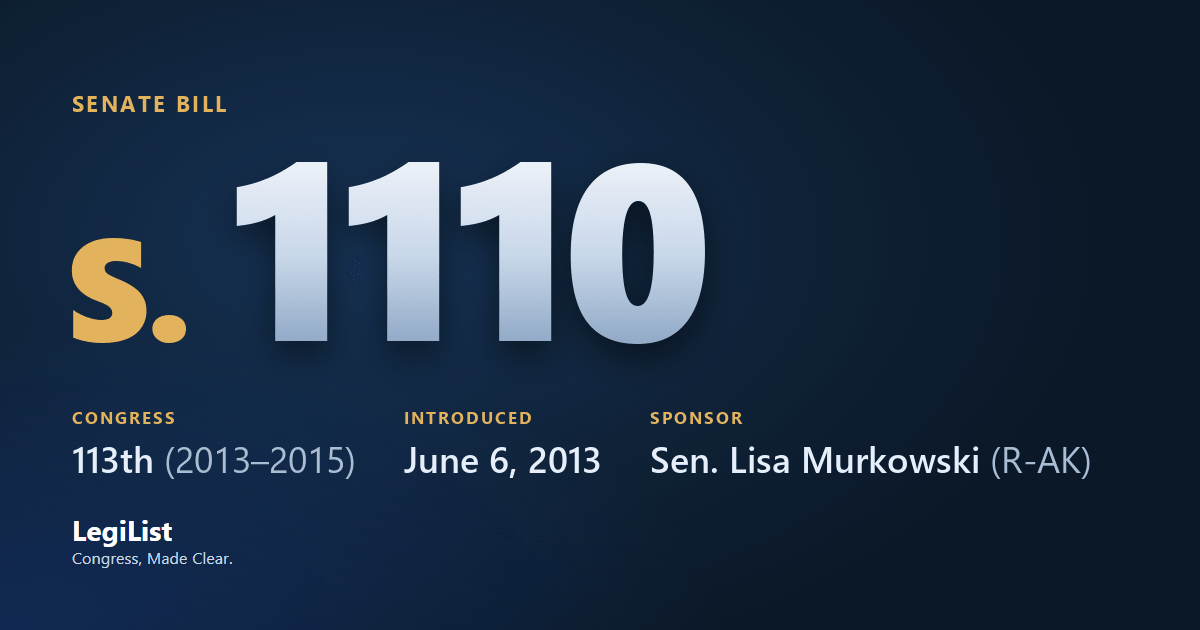
Educational Accountability and State Flexibility Act of 2013
Latest action · Jun 13, 2013 Sponsor introductory remarks on measure. (CR S4401-4402)
Progress
Where this bill reached, and when. A stage with no date was not reached; one that failed a vote and later carried shows the date it carried.
- IntroducedJun 6, 2013
- Passed SenateNot reached
- Passed HouseNot reached
- To the PresidentNot reached
- Became lawNot reached
Summary
Educational Accountability and State Flexibility Act of 2013 - Revises and reauthorizes programs under title I (Improving the Academic Achievement of the Disadvantaged) of the Elementary and Secondary Education Act of 1965 (ESEA).
Amends the school improvement program under part A of title I of the ESEA to eliminate the requirement that local educational agencies (LEAs) and schools make adequate yearly progress toward state academic content and achievement standards.
Requires states to adopt challenging academic content and achievement standards for mathematics, reading or language arts, and science that ensure that their high school graduates who are deemed proficient are fully prepared to succeed in higher education, job training, or work.
Requires states to implement a set of high-quality assessments of student progress toward those standards that: (1) involve multiple measures of student achievement; (2) measure the overall performance of students in each public school and the performance of their poor, minority, disabled, and limited English proficient student subgroups; and (3) are used as the primary means of determining the yearly performance of each of their schools.
Allows states to adopt alternative assessments for students with significant cognitive disabilities.
Requires each state to establish a multi-tiered accountability system that places each public school in a tier that reflects, at a minimum, the state's annual assessment of the extent to which each student at the school is: (1) proficient on state standards or is making satisfactory progress in attaining such proficiency, and (2) on track to graduate from high school on time. (Replaces the current system of assessing schools as needing improvement, corrective action, or restructuring due to their failure to make adequate yearly progress for a specified number of years.)
Requires, at a minimum, distinct tiers for schools that: (1) have met the state standards, (2) have not met those standards for up to two student subgroups but that are making satisfactory progress in doing so, (3) have not met those standards for a significant number of student subgroups and are not showing satisfactory progress in meeting the standards or improving the subgroups' graduation rates within the time frame required by the state plan, and (4) have not met the state standards for a significant number of subgroups and are showing little or no improvement.
Lists the minimum consequences for schools placed into each of these tiers, ranging from requiring states to recognize successful schools to requiring LEAs to implement alternative school governance models or school improvement strategies based on a specified system of support model.
Requires students in the lowest tiered schools who did not meet or exceed the proficient level on the most recent state assessment in mathematics or in reading or language arts to be provided with supplemental educational services. Allows the LEAs serving such schools to provide those students with the option to transfer to a higher-performing school served by the LEA, if that option is not prohibited by state law.
Denies the Secretary of Education any authority to approve or disapprove a state's multi-tiered accountability system.
Allows states that received a waiver of statutory or regulatory requirements under the ESEA before this Act's enactment to implement the school improvement program set forth in the waiver or implement a school improvement program that meets this Act's requirements.
Requires states and LEAs to consult with representatives of Indian tribes and Native organizations within their jurisdiction in implementing their school improvement programs.
Includes American Indian, Alaska Native, and Native Hawaiian children as children eligible for services under targeted assistance programs that direct school improvement funds toward the children in a school who are failing or most at risk of failing.
Requires each school and LEA receiving school improvement funds to establish mechanisms to overcome barriers to effective Indian, Alaska Native, and Native Hawaiian parental involvement in their children's education.
Eliminates the requirement that teachers be highly qualified, requiring instead that they be deemed highly effective in accordance with state standards. Requires teachers and paraprofessionals to meet state standards for certification or licensure, knowledge of the subject matter being taught, and competency in assisting students to meet or make satisfactory progress toward meeting state academic achievement standards.
Repeals the definition of "highly qualified" teachers.
Repeals the programs under subparts 1 (Reading First), 2 (Early Reading First), and 3 (William F. Goodling Even Start Family Literacy Programs) of part B (Student Reading Skills Improvement Grants) of the ESEA.
Cosponsors
Members who signed on, in the order they did.
Committees 1
Where it was sent and what each committee and subcommittee did with it, in order.
| Chamber | Committee | What it did |
|---|---|---|
| Senate | Health, Education, Labor, and Pensions Committee | Referred Jun 6, 2013 |
Actions 3
Everything that happened, newest first.
- Jun 13, 2013Sponsor introductory remarks on measure. (CR S4401-4402)
- Jun 6, 2013Introduced in Senate
- Jun 6, 2013Read twice and referred to the Committee on Health, Education, Labor, and Pensions.
In the Congressional Record 1
Days the Record’s own index lists this bill, newest first, with the pages and the members it names. Pages starting H are the House, S the Senate, E Extensions of Remarks.
| Where | In the Record | Members | Date |
|---|---|---|---|
| Senate | Debate and remarks S4401 | Lisa Murkowski R-AK | Jun 12, 2013 |
Titles 2
Every title it has carried, official and short, at each stage.
- Official Title as Introduced
- A bill to amend part A of title I of the Elementary and Secondary Education Act of 1965.
- Short Titles as Introduced
- Educational Accountability and State Flexibility Act of 2013
Subjects
Assigned by the Library of Congress. Policy area: Education.
- Academic performance and assessments
- Alaska
- Alaska Natives and Hawaiians
- Education
- Education of the disadvantaged
- Education programs funding
- Elementary and secondary education
- Foreign language and bilingual programs
- Hawaii
- Homelessness and emergency shelter
- Indian social and development programs
- Language arts
- Libraries and archives
- Minority education
- Preschool education
- School administration
- Science and engineering education
- Teaching, teachers, curricula
Text 1
Each version as it was printed, newest first.
- Jun 6, 2013Introduced in Senate
Everything here is as published by Congress: the summary is the Congressional Research Service's, the action wording is the clerks', and the subjects are the Library of Congress's. How far it got is read from the actions themselves, taking the most recent one of each kind, so a bill that failed a vote and later passed is shown as having passed. Records come from this bill on Congress.gov and govinfo.gov; cost estimates are the Congressional Budget Office's, and the hearings are the printed hearings GovInfo publishes, which can appear months after the hearing.