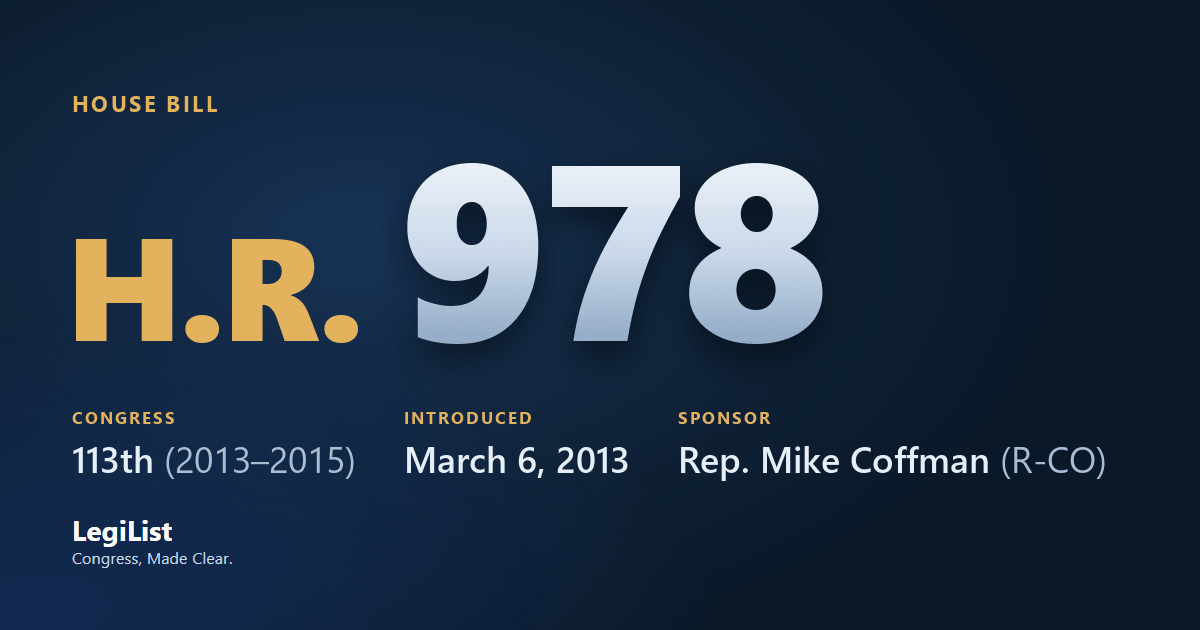
National Emergency Selective Service Act
Latest action · Mar 14, 2013 Referred to the Subcommittee on Military Personnel.
Progress
Where this bill reached, and when. A stage with no date was not reached; one that failed a vote and later carried shows the date it carried.
- IntroducedMar 6, 2013
- Passed HouseNot reached
- Passed SenateNot reached
- To the PresidentNot reached
- Became lawNot reached
Summary
National Emergency Selective Service Act - Deauthorizes the Military Selective Service Act (requiring registration under the Selective Service System [System] for possible military induction) except during a period of national emergency declared by the President.
Provides for the suspension of local military selection boards, appeal boards, and other selective service system agencies and activities during non-emergency periods. Requires the Secretary of Defense (DOD), when System operations are suspended, to assume responsibility for the security of System databases.
Suspends sanctions against persons failing to register under the System, unless such failure occurs during a national emergency.
Permits the authorization of appropriations under the Military Selective Service Act only during periods of national emergency.
Cosponsors 3
Members who signed on, in the order they did. Signatures ran from Mar 6, 2013 to Mar 12, 2013, with 2 there on the day it was introduced.
| Seat | Cosponsor | Signed on | |
|---|---|---|---|
| R-AL | Martha Roby | Original | Mar 6, 2013 |
| D-OR | Peter A. DeFazio | Original | Mar 6, 2013 |
| D-NJ | Rush Holt | Mar 12, 2013 |
Actions 3
Everything that happened, newest first.
- Mar 14, 2013Referred to the Subcommittee on Military Personnel.
- Mar 6, 2013Introduced in House
- Mar 6, 2013Referred to the House Committee on Armed Services.
Subjects
Assigned by the Library of Congress. Policy area: Armed Forces and National Security.
Text 1
Each version as it was printed, newest first.
- Mar 6, 2013Introduced in House
Everything here is as published by Congress: the summary is the Congressional Research Service's, the action wording is the clerks', and the subjects are the Library of Congress's. How far it got is read from the actions themselves, taking the most recent one of each kind, so a bill that failed a vote and later passed is shown as having passed. Records come from this bill on Congress.gov and govinfo.gov.