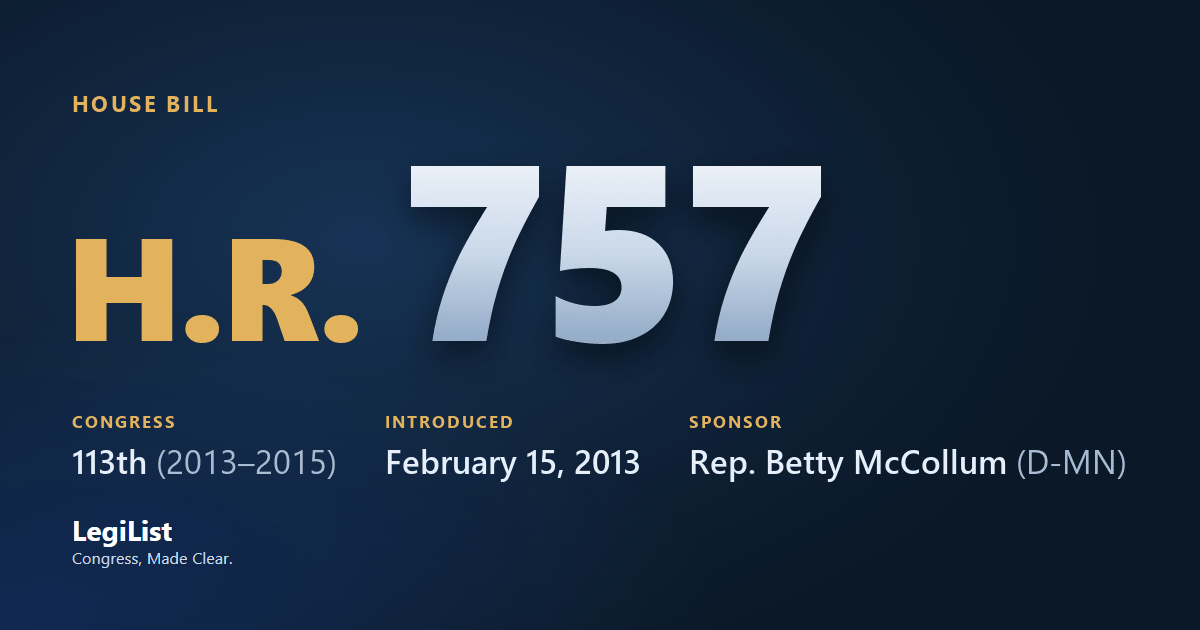
SAVE Native Women Act
Latest action · Apr 8, 2013 Referred to the Subcommittee on Crime, Terrorism, Homeland Security, And Investigations.
Progress
Where this bill reached, and when. A stage with no date was not reached; one that failed a vote and later carried shows the date it carried.
- IntroducedFeb 15, 2013
- Passed HouseNot reached
- Passed SenateNot reached
- To the PresidentNot reached
- Became lawNot reached
Summary
Stand Against Violence and Empower Native Women Act or SAVE Native Women Act - Amends the Omnibus Crime Control and Safe Streets Act of 1968 to include sex trafficking as a target of the grants to Indian tribal governments to combat violent crime against Indian women.
Allows those grants to be used to: (1) address the needs of youth who are victims of, or exposed to, domestic violence, dating violence, sexual assault, sex trafficking, or stalking; and (2) develop and promote best practices for responding to domestic violence, dating violence, sexual assault, sex trafficking, and stalking.
Allows tribal coalition grants to be used to develop and promote state, local, and tribal legislation and policies that enhance best practices for responding to violent crimes against Indian women.
Requires the Attorney General to award such grants annually to each tribal coalition that meets certain criteria under the Violence Against Women Act of 1994, is recognized by the Office on Violence Against Women, serves Indian tribes, and meets any additional criteria the Attorney General requires.
Requires that tribal coalition grants also be provided to organizations that propose to incorporate and operate a tribal coalition in areas where Indian tribes are located but no tribal coalition exists.
Amends the Violence Against Women and Department of Justice Reauthorization Act of 2005 to include the Secretary of the Interior, in addition to the Secretary of Health and Human Services (HHS) and the Attorney General, as a participant in consultations with Indian tribes regarding the administration of tribal funds and programs, enhancement of Indian women's safety, and federal response to violent crimes against Indian women.
Amends the Indian Civil Rights Act of 1968 to give Indian tribes criminal jurisdiction over domestic violence, dating violence, and violations of protective orders that occur on their lands. Makes that jurisdiction concurrent with federal and state jurisdiction.
Authorizes the Attorney General to award grants to assist Indian tribes in exercising such jurisdiction, providing indigent defendants with free legal counsel, and securing the rights of victims of such crimes.
Amends the federal criminal code to give Indian courts civil jurisdiction to issue and enforce protection orders. Excludes Indian courts in Alaska from that jurisdiction, except with respect to the Metlakatla Indian Community, Annette Islands Reserve.
Increases the maximum federal penalties for assault convictions.
Subjects to specified criminal penalties any individuals who: (1) commit an assault resulting in substantial bodily injury to a spouse, intimate partner, or a dating partner; or (2) assault a spouse, intimate partner, or dating partner by strangling, suffocating, or attempting to strangle or suffocate.
Makes federal felony assault penalties applicable to Indians.
Subjects individuals convicted under tribal law of repeat domestic violence or stalking offenses to maximum federal penalty provisions for repeat offenders.
Amends the Violence Against Women and Department of Justice Reauthorization Act of 2005 to require the National Institute of Justice to include women in Alaska Native Villages, Native Hawaiian women, and sex trafficking in its study of violence against Indian women.
Reauthorizes appropriations for the national tribal sex offender registry and the tribal protection order registry.
Directs the Attorney General to report to Congress on whether the Alaska Rural Justice and Law Enforcement Commission should be continued.
Amends the Omnibus Crime Control and Safe Streets Act of 1968 to expand the grant program to encourage governmental entities to treat domestic violence, dating violence, sexual assault, and stalking as serious violations of criminal law.
Allows those grants to be used to: (1) enforce protection orders across state and tribal lines; (2) develop training programs and best practices for responding to domestic violence, dating violence, sexual assault, and stalking; (3) develop, implement, or enhance sexual assault nurse or forensic examiner programs and Sexual Assault Response Teams; (4) implement human immunodeficiency virus testing programs; (5) address backlogs of sexual assault evidence collection kits; and (6) develop multidisciplinary high-risk teams focused on preventing domestic or dating violence homicides. Requires at least 25% of the grant funds to be used for projects that address sexual assault.
Cosponsors 5
Members who signed on, in the order they did. All signed on Feb 15, 2013.
| Seat | Cosponsor | Signed on | |
|---|---|---|---|
| D-DC | Eleanor Holmes Norton | Original | Feb 15, 2013 |
| D-WI | Gwen Moore | Original | Feb 15, 2013 |
| R-ID | Michael K. Simpson | Original | Feb 15, 2013 |
| D-AZ | Raúl M. Grijalva | Original | Feb 15, 2013 |
| R-OK | Tom Cole | Original | Feb 15, 2013 |
Committees 2
Where it was sent and what each committee and subcommittee did with it, in order.
| Chamber | Committee | What it did |
|---|---|---|
| House | Judiciary Committee | Referred Feb 15, 2013 |
| Constitution and Limited Government Subcommittee | Referred Apr 8, 2013 | |
| Crime and Federal Government Surveillance Subcommittee | Referred Apr 8, 2013 | |
| House | Natural Resources Committee | Referred Feb 15, 2013 |
| Indian and Insular Affairs Subcommittee | Referred Mar 1, 2013 |
Actions 5
Everything that happened, newest first.
- Apr 8, 2013Referred to the Subcommittee on the Constitution And Civil Justice.
- Apr 8, 2013Referred to the Subcommittee on Crime, Terrorism, Homeland Security, And Investigations.
- Mar 1, 2013Referred to the Subcommittee Indian and Alaska Native Affairs.
- Feb 15, 2013Introduced in House
- Feb 15, 2013Referred to the Committee on the Judiciary, and in addition to the Committee on Natural Resources, for a period to be subsequently determined by the Speaker, in each case for consideration of such provisions as fall within the jurisdiction of the committee concerned.
Research
What has been written about this bill: committee reports, cost estimates, the sponsor’s authority statement, printed hearings and the Congressional Research Service’s work.
Constitutional authority
The sponsor’s statement, as printed in the page H597.
Titles 3
Every title it has carried, official and short, at each stage.
- Official Title as Introduced
- To decrease the incidence of violent crimes against Indian women, to strengthen the capacity of Indian tribes to exercise the sovereign authority of Indian tribes to respond to violent crimes committed against Indian women, and to ensure that perpetrators of violent crimes committed against Indian women are held accountable for that criminal behavior, and for other purposes.
- Short Titles as Introduced
- SAVE Native Women Act
- Stand Against Violence and Empower Native Women Act
Subjects
Assigned by the Library of Congress. Policy area: Native Americans.
- Alaska
- Alaska Natives and Hawaiians
- Assault and harassment offenses
- Child safety and welfare
- Crime victims
- Crimes against children
- Crimes against women
- Criminal investigation, prosecution, interrogation
- Criminal justice information and records
- Criminal procedure and sentencing
- Domestic violence and child abuse
- Evidence and witnesses
- HIV/AIDS
- Human trafficking
- Indian social and development programs
- Jurisdiction and venue
- Law enforcement administration and funding
- Lawyers and legal services
- Medical tests and diagnostic methods
- Native Americans
- Sex offenses
- Violent crime
Text 1
Each version as it was printed, newest first.
- Feb 15, 2013Introduced in House
Everything here is as published by Congress: the summary is the Congressional Research Service's, the action wording is the clerks', and the subjects are the Library of Congress's. How far it got is read from the actions themselves, taking the most recent one of each kind, so a bill that failed a vote and later passed is shown as having passed. Records come from this bill on Congress.gov and govinfo.gov; cost estimates are the Congressional Budget Office's, and the hearings are the printed hearings GovInfo publishes, which can appear months after the hearing.