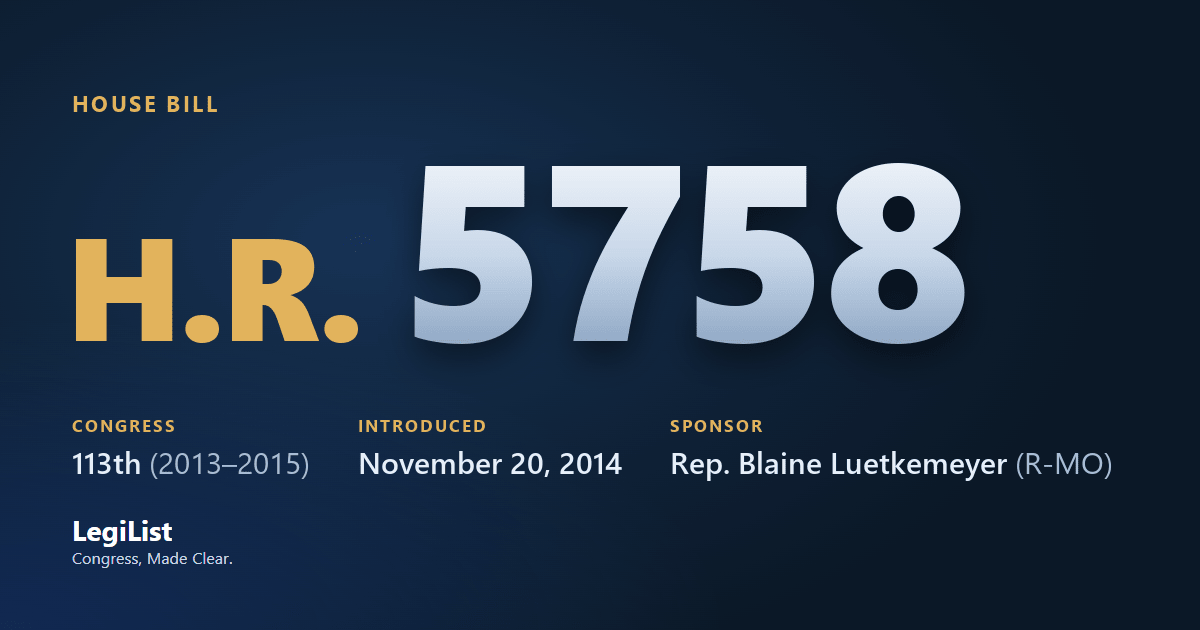
Financial Institution Customer Protection Act of 2014
Latest action · Nov 20, 2014 Referred to the House Committee on Financial Services.
Progress
Where this bill reached, and when. A stage with no date was not reached; one that failed a vote and later carried shows the date it carried.
- IntroducedNov 20, 2014
- Passed HouseNot reached
- Passed SenateNot reached
- To the PresidentNot reached
- Became lawNot reached
Summary
Financial Institution Customer Protection Act of 2014 - Prohibits a federal banking agency from suggesting, requesting, or ordering a depository institution to terminate a specific customer account, or otherwise restrict or discourage it from entering into or maintaining a banking relationship with a specific customer, unless: (1) the agency has a material reason to do so, and (2) the reason is not based solely on reputation risk.
Prescribes requirements for notice from the federal banking agency to the depository institution about such a customer account restriction or termination; but states that notice to the customer is not required.
Amends the Financial Institutions Reform, Recovery, and Enforcement Act of 1989 to revise requirements for summoning witnesses and requiring production of books or other records the Attorney General deems relevant or material to a civil investigation in contemplation of a civil proceeding which may result in civil penalties for specified violations.
Cosponsors 3
Members who signed on, in the order they did. All signed on Nov 20, 2014.
| Seat | Cosponsor | Signed on | |
|---|---|---|---|
| D-FL | Alcee L. Hastings | Original | Nov 20, 2014 |
| D-FL | Patrick Murphy | Original | Nov 20, 2014 |
| R-OH | Steve Stivers | Original | Nov 20, 2014 |
Committees 1
Where it was sent and what each committee and subcommittee did with it, in order.
| Chamber | Committee | What it did |
|---|---|---|
| House | Financial Services Committee | Referred Nov 20, 2014 |
Actions 2
Everything that happened, newest first.
- Nov 20, 2014Introduced in House
- Nov 20, 2014Referred to the House Committee on Financial Services.
Research
What has been written about this bill: committee reports, cost estimates, the sponsor’s authority statement, printed hearings and the Congressional Research Service’s work.
Constitutional authority
The sponsor’s statement, as printed in the page H8170.
Titles 2
Every title it has carried, official and short, at each stage.
- Official Title as Introduced
- To provide requirements for the appropriate Federal banking agencies when requesting or ordering a depository institution to terminate a specific customer account, to provide for additional requirements related to subpoenas issued under the Financial Institutions Reform, Recovery, and Enforcement Act of 1989, and for other purposes.
- Short Titles as Introduced
- Financial Institution Customer Protection Act of 2014
Subjects
Assigned by the Library of Congress. Policy area: Finance and Financial Sector.
- Administrative law and regulatory procedures
- Bank accounts, deposits, capital
- Banking and financial institutions regulation
- Business records
- Congressional oversight
- Consumer affairs
- Department of the Treasury
- Evidence and witnesses
- Federal Deposit Insurance Corporation (FDIC)
- Federal Reserve System
- Finance and Financial Sector
- Government information and archives
- Judicial procedure and administration
- Terrorism
Text 1
Each version as it was printed, newest first.
- Nov 20, 2014Introduced in House
Support LegiList
This page is free, carries no paywall, and is built and maintained by one person. If the record here is useful to you, a few dollars keeps it going.
Everything here is as published by Congress: the summary is the Congressional Research Service's, the action wording is the clerks', and the subjects are the Library of Congress's. How far it got is read from the actions themselves, taking the most recent one of each kind, so a bill that failed a vote and later passed is shown as having passed. Records come from this bill on Congress.gov and govinfo.gov; cost estimates are the Congressional Budget Office's, and the hearings are the printed hearings GovInfo publishes, which can appear months after the hearing.