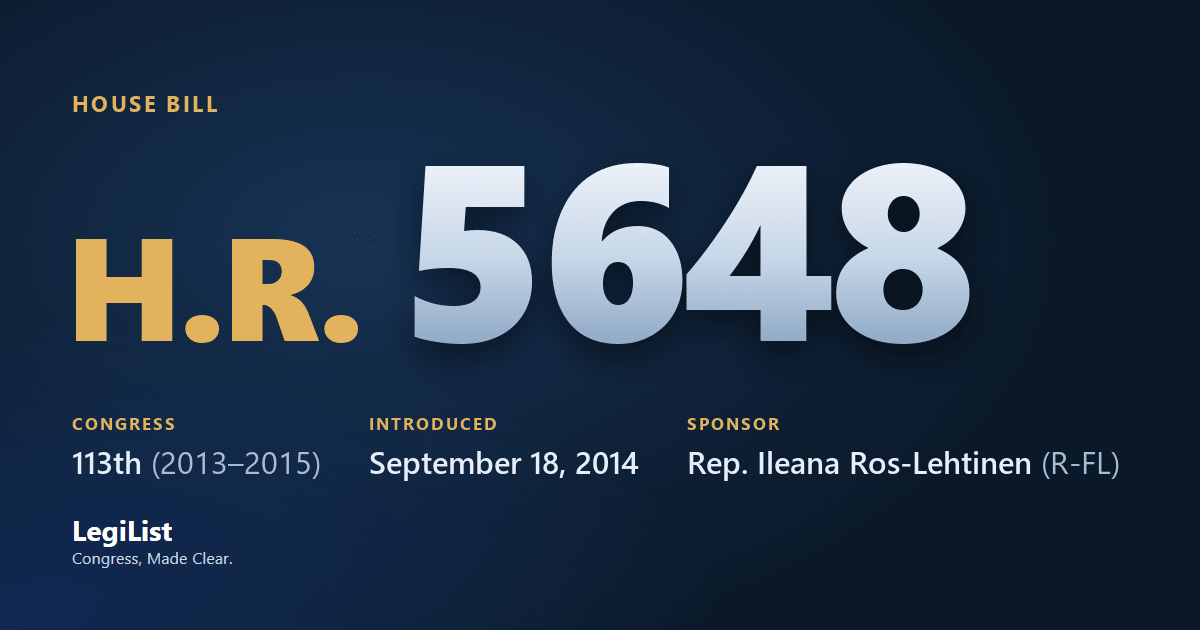
United States-Jordan Defense Cooperation Act of 2014
Latest action · Sep 18, 2014 Referred to the House Committee on Foreign Affairs.
Progress
Where this bill reached, and when. A stage with no date was not reached; one that failed a vote and later carried shows the date it carried.
- IntroducedSep 18, 2014
- Passed HouseNot reached
- Passed SenateNot reached
- To the PresidentNot reached
- Became lawNot reached
Summary
United States-Jordan Defense Cooperation Act of 2014 - Expresses the sense of Congress that expeditious consideration of certifications of letters of offer to sell defense articles, defense services, design and construction services, and major defense equipment to the Hashemite Kingdom of Jordan is fully consistent with U. S. security and foreign policy interests and the objectives of world peace and security.
Amends the Arms Export Control Act to include Jordan among the countries eligible for certain streamlined defense sales.
Amends the Foreign Assistance Act of 1961 to include Jordan among the countries not required to be included in the annual foreign military training report submitted by the Department of Defense (DOD) and the Department of State to Congress.
Authorizes the Secretary of State to enter into a Memorandum of Understanding with Jordan to increase military cooperation, including joint military exercises, personnel exchanges, support for international peacekeeping missions, and enhanced strategic dialogue.
Makes specified funds for the foreign military financing funds program available for Jordan, subject to certain requirements.
Cosponsors 4
Members who signed on, in the order they did. Signatures ran from Nov 14, 2014 to Nov 20, 2014.
| Seat | Cosponsor | Signed on | |
|---|---|---|---|
| R-IL | Adam Kinzinger | Nov 14, 2014 | |
| R-LA | Charles W. Boustany, Jr. | Nov 14, 2014 | |
| R-MN | Michele Bachmann | Nov 14, 2014 | |
| R-NY | Peter T. King | Nov 20, 2014 |
Committees 1
Where it was sent and what each committee and subcommittee did with it, in order.
| Chamber | Committee | What it did |
|---|---|---|
| House | Foreign Affairs Committee | Referred Sep 18, 2014 |
Actions 2
Everything that happened, newest first.
- Sep 18, 2014Introduced in House
- Sep 18, 2014Referred to the House Committee on Foreign Affairs.
Research
What has been written about this bill: committee reports, cost estimates, the sponsor’s authority statement, printed hearings and the Congressional Research Service’s work.
Constitutional authority
The sponsor’s statement, as printed in the page H7891.
Printed hearings 1
Hearings whose printed record names this bill, newest first: hearings on it, and wider hearings where it came up.
| Number | Hearing | Committee | Held |
|---|---|---|---|
| Serial No. 113-222 | UNITED STATES-JORDAN DEFENSE COOPERATION ACT OF 201421 pages | Foreign Affairs Committee | Nov 19, 2014 |
CRS reports 1
Congressional Research Service work that CRS links to this bill or the law it became, newest first.
Cite it 1
Products on other subjects that cite it, usually among other measures.
| Product | Title | Kind | Published |
|---|---|---|---|
| R46796 | Congress and the Middle East, 2011-2020: Selected Case Studies Archived | Report | May 21, 2021 |
Titles 2
Every title it has carried, official and short, at each stage.
- Official Title as Introduced
- To improve defense cooperation between the United States and the Hashemite Kingdom of Jordan.
- Short Titles as Introduced
- United States-Jordan Defense Cooperation Act of 2014
Subjects
Assigned by the Library of Congress. Policy area: International Affairs.
Text 1
Each version as it was printed, newest first.
- Sep 18, 2014Introduced in House
Support LegiList
This page is free, carries no paywall, and is built and maintained by one person. If the record here is useful to you, a few dollars keeps it going.
Everything here is as published by Congress: the summary is the Congressional Research Service's, the action wording is the clerks', and the subjects are the Library of Congress's. How far it got is read from the actions themselves, taking the most recent one of each kind, so a bill that failed a vote and later passed is shown as having passed. Records come from this bill on Congress.gov and govinfo.gov; cost estimates are the Congressional Budget Office's, and the hearings are the printed hearings GovInfo publishes, which can appear months after the hearing.