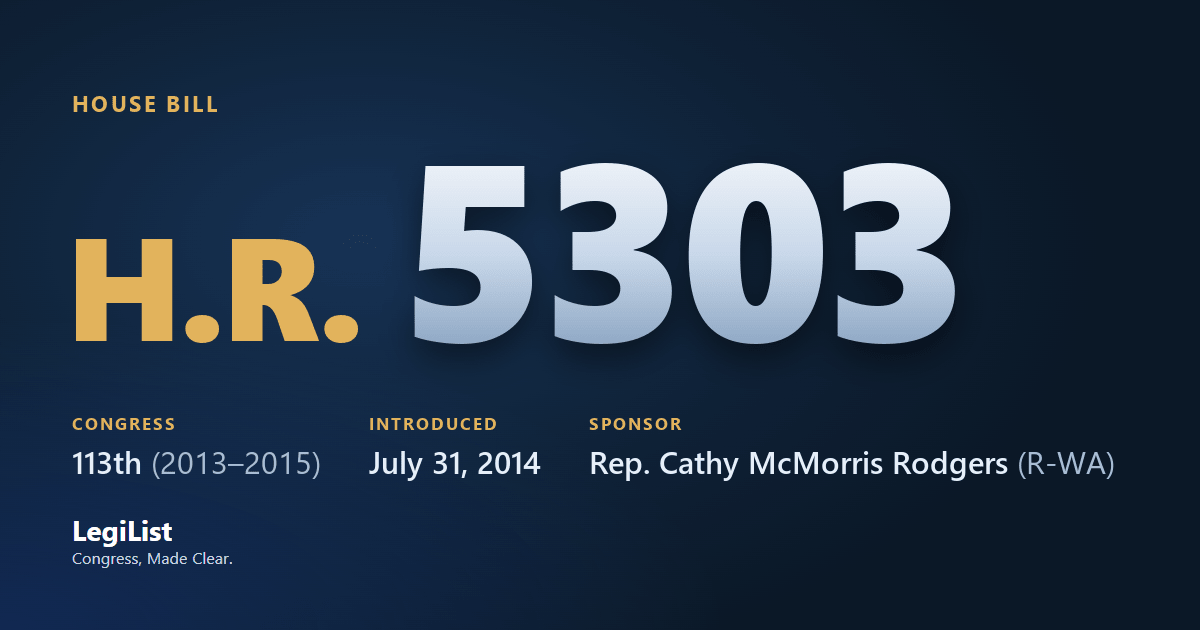
21st Century Classroom Innovation Act
Latest action · Nov 17, 2014 Referred to the Subcommittee on Early Childhood, Elementary, and Secondary Education.
Progress
Where this bill reached, and when. A stage with no date was not reached; one that failed a vote and later carried shows the date it carried.
- IntroducedJul 31, 2014
- Passed HouseNot reached
- Passed SenateNot reached
- To the PresidentNot reached
- Became lawNot reached
Summary
21st Century Classroom Innovation Act - Amends part A (Teacher and Principal Training and Recruiting Fund) of title II of the Elementary and Secondary Education Act of 1965 to allow states to use that portion of their part A grant funds reserved for state activities to award competitive grants to local educational agencies (LEAs), charter schools, or consortia of such entities to carry out blended learning projects.
Defines a "blended learning project" as a formal education program that: (1) includes an element of online learning and instructional time in a supervised location away from home; (2) includes an element of student control over time, place, path, or pace; and (3) connects the modalities along each student's learning path within a course or subject to provide an integrated learning experience.
Requires the competitive grant funds to be used for: (1) planning activities, the purchase of digital instructional resources, initial professional development activities, and one-time information technology purchases; or (2) ongoing professional development for teachers, school leaders, or other personnel involved in the project.
Requires each state making such a grant to contribute non-federal funds equal to at least 10% of the grant.
Reduces, from 2.5% to 1.5%, that portion of part A grant funds that states must reserve for subgrants to local partnerships between institutions of higher education and high-need LEAs. (This increases the amount reserved for state activities.)
Cosponsors
Members who signed on, in the order they did.
Committees 1
Where it was sent and what each committee and subcommittee did with it, in order.
| Chamber | Committee | What it did |
|---|---|---|
| House | Education and Workforce Committee | Referred Jul 31, 2014 |
| Early Childhood, Elementary, and Secondary Education Subcommittee | Referred Nov 17, 2014 |
Actions 3
Everything that happened, newest first.
- Nov 17, 2014Referred to the Subcommittee on Early Childhood, Elementary, and Secondary Education.
- Jul 31, 2014Introduced in House
- Jul 31, 2014Referred to the House Committee on Education and the Workforce.
In the Congressional Record 1
Days the Record’s own index lists this bill, newest first, with the pages and the members it names. Pages starting H are the House, S the Senate, E Extensions of Remarks.
| Where | In the Record | Members | Date |
|---|---|---|---|
| House | Lists H7185–H7188H.R. 5303–5389 | — | Jul 31, 2014 |
Research
What has been written about this bill: committee reports, cost estimates, the sponsor’s authority statement, printed hearings and the Congressional Research Service’s work.
Constitutional authority
The sponsor’s statement, as printed in the page H7185.
Titles 2
Every title it has carried, official and short, at each stage.
- Official Title as Introduced
- To promote the use of blended learning in classrooms across America.
- Short Titles as Introduced
- 21st Century Classroom Innovation Act
Subjects
Assigned by the Library of Congress. Policy area: Education.
Text 1
Each version as it was printed, newest first.
- Jul 31, 2014Introduced in House
Support LegiList
This page is free, carries no paywall, and is built and maintained by one person. If the record here is useful to you, a few dollars keeps it going.
Everything here is as published by Congress: the summary is the Congressional Research Service's, the action wording is the clerks', and the subjects are the Library of Congress's. How far it got is read from the actions themselves, taking the most recent one of each kind, so a bill that failed a vote and later passed is shown as having passed. Records come from this bill on Congress.gov and govinfo.gov; cost estimates are the Congressional Budget Office's, and the hearings are the printed hearings GovInfo publishes, which can appear months after the hearing.