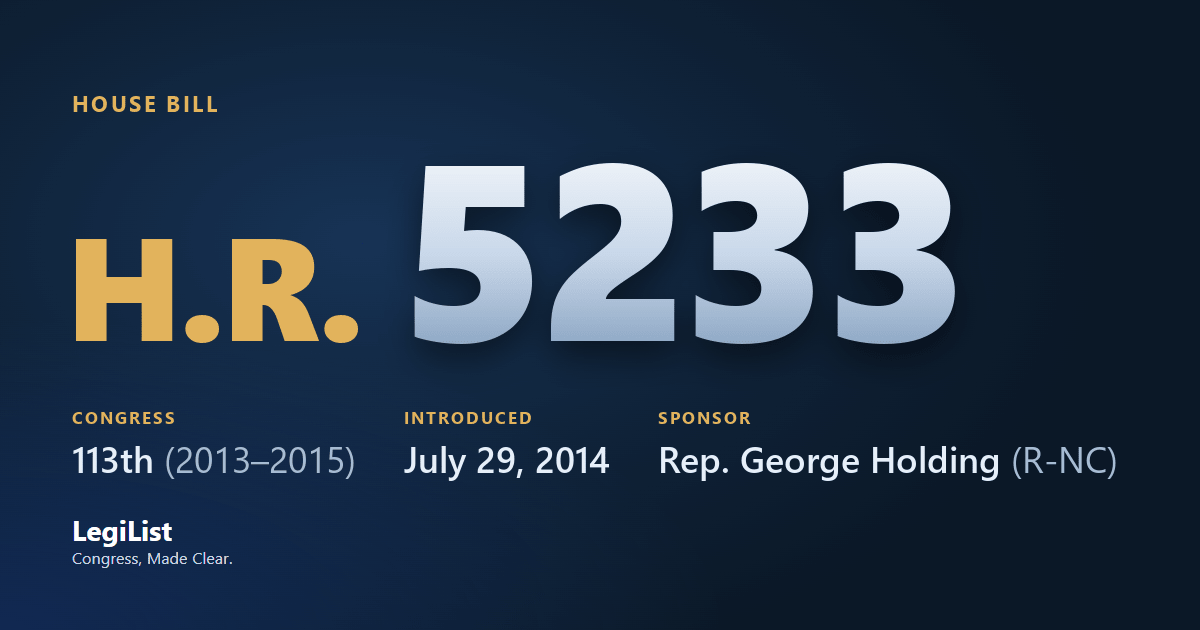
Trade Secrets Protection Act of 2014
Latest action · Dec 11, 2014 Placed on the Union Calendar, Calendar No. 494.
Progress
Where this bill reached, and when. A stage with no date was not reached; one that failed a vote and later carried shows the date it carried.
- IntroducedJul 29, 2014
- Passed HouseNot reached
- Passed SenateNot reached
- To the PresidentNot reached
- Became lawNot reached
Summary
Trade Secrets Protection Act of 2014 - (Sec. 2) Amends the federal criminal code to authorize an owner of a trade secret related to a product or service used in interstate or foreign commerce, who is aggrieved by a misappropriation of such trade secret, to bring a civil action to obtain appropriate relief. Grants U.S. district courts original jurisdiction of such actions, subject to a five-year statute of limitations beginning when the misappropriation is or should have been discovered.
Authorizes the court, upon ex parte application, to issue an order providing for the seizure of property necessary to preserve evidence in such civil action or to prevent the propagation or dissemination of the trade secret, if it finds that:
- a temporary restraining order would be inadequate because the restrained party would evade or otherwise not comply with it;
- immediate and irreparable injury will occur if such seizure is not ordered;
- the harm to the applicant of denying the application outweighs the harm to the legitimate interests of the person against whom seizure would be ordered and the harm to any third parties who may be harmed by such seizure;
- the applicant is likely to succeed in showing that the person against whom seizure would be ordered misappropriated the trade secret by improper means, or conspired to use improper means to misappropriate it, and is in possession of the trade secret;
- the application reasonably describes the matter to be seized and its location;
- the person against whom seizure would be ordered would destroy or otherwise make such matter inaccessible to the court if the applicant were to proceed on notice to such person; and
- the applicant has not publicized the requested seizure.
Sets forth required elements of such an order, including providing for: (1) seizure in a manner that minimizes any interruption of the business operations of third parties; and (2) protection of the property from disclosure. Directs the court to take seized material into its custody. Grants a person who suffers damage by reason of a wrongful or excessive seizure under this Act a cause of action against the applicant for the order and entitles such person to appropriate relief.
Sets forth remedies that a court may grant for such misappropriation, including granting injunctive relief, awarding damages for losses or unjust enrichment caused, and awarding exemplary damages and attorney fees for willful and malicious misappropriation.
Defines "misappropriation" to mean: (1) acquisition of a trade secret of another by a person who knows or has reason to know that the trade secret was acquired by improper means (including theft, bribery, misrepresentation, breach of a duty to maintain secrecy, or espionage); or (2) disclosure or use of a trade secret of another without consent.
(Sec. 3) Directs the Attorney General, one year after this Act's enactment and biannually thereafter, to submit to the House and Senate Judiciary Committees and make publicly available on the Department of Justice (DOJ) website a report on:
- the scope of the theft of trade secrets of U.S. companies occurring outside of the United States;
- the extent to which such theft is sponsored by foreign governments, instrumentalities, or agents;
- the threat posed by such theft;
- the ability and limitations of trade secret owners to prevent such theft, to enforce any judgment after foreign entities for such theft, and to prevent imports based on such theft;
- a breakdown of the trade secret protections afforded U.S. companies by each country that is a U.S. trading partner and enforcement efforts available and undertaken in each such country;
- instances of the federal government working with foreign countries to investigate, arrest, and prosecute entities and individuals involved in such theft;
- specific progress made under trade agreements and treaties to protect against such theft; and
- recommended legislative and executive actions to reduce the threat of and economic impact caused by such theft, to educate U.S. companies regarding the threats to their trade secrets when taken outside of the United States, to provide assistance to U.S. companies to reduce the risk of such theft, and to provide a mechanism for U.S. companies to confidentially or anonymously report such theft.
Cosponsors 23
Members who signed on, in the order they did. Signatures ran from Jul 29, 2014 to Nov 12, 2014; 7 are original cosponsors, there from the day it was introduced.
| Seat | Cosponsor | Signed on | |
|---|---|---|---|
| D-LA | Cedric L. Richmond | Original | Jul 29, 2014 |
| D-NY | Hakeem S. Jeffries | Original | Jul 29, 2014 |
| R-NC | Howard Coble | Original | Jul 29, 2014 |
| D-NY | Jerrold Nadler | Original | Jul 29, 2014 |
| D-MI | John Conyers, Jr. | Original | Jul 29, 2014 |
| R-OH | Steve Chabot | Original | Jul 29, 2014 |
| D-WA | Suzan K. DelBene | Original | Jul 29, 2014 |
| R-GA | Doug Collins | Jul 31, 2014 | |
| R-WI | F. James Sensenbrenner, Jr. | Jul 31, 2014 | |
| R-TX | Lamar Smith | Jul 31, 2014 | |
| R-NY | Richard L. Hanna | Jul 31, 2014 | |
| R-NY | Tom Reed | Jul 31, 2014 | |
| R-MO | Jason Smith | Aug 1, 2014 | |
| R-NC | Patrick T. McHenry | Aug 1, 2014 | |
| D-FL | Theodore E. Deutch | Aug 1, 2014 |
Committees 1
Where it was sent and what each committee and subcommittee did with it, in order.
| Chamber | Committee | What it did |
|---|---|---|
| House | Judiciary Committee | Referred Jul 29, 2014Markup Sep 17, 2014Reported Dec 11, 2014 |
| Courts, Intellectual Property, Artificial Intelligence, and the Internet Subcommittee | Referred Jul 30, 2014Discharged Sep 9, 2014 |
Actions 8
Everything that happened, newest first.
- Dec 11, 2014Reported (Amended) by the Committee on Judiciary. H. Rept. 113-657.
- Dec 11, 2014Placed on the Union Calendar, Calendar No. 494.
- Sep 17, 2014Committee Consideration and Mark-up Session Held.
- Sep 17, 2014Ordered to be Reported (Amended) by Voice Vote.
- Sep 9, 2014Subcommittee on Courts, Intellectual Property, and the Internet Discharged.
- Jul 30, 2014Referred to the Subcommittee on Courts, Intellectual Property, and the Internet.
- Jul 29, 2014Introduced in House
- Jul 29, 2014Referred to the House Committee on the Judiciary.
Research
What has been written about this bill: committee reports, cost estimates, the sponsor’s authority statement, printed hearings and the Congressional Research Service’s work.
Committee report
Congressional Budget Office cost estimate
- Nov 26, 2014H.R. 5233, Trade Secrets Protection Act of 2014As ordered reported by the House Committee on the Judiciary on September 17, 2014
Constitutional authority
The sponsor’s statement, as printed in the page H7040.
Related bills 1
Companion bills and other measures the record links to this one.
| Bill | Title | Relationship | Latest action |
|---|---|---|---|
| S 2267 | Defend Trade Secrets Act of 2014 | Related bill | Apr 29, 2014 |
Titles 3
Every title it has carried, official and short, at each stage.
- Official Title as Introduced
- To amend chapter 90 of title 18, United States Code, to provide Federal jurisdiction for the theft of trade secrets, and for other purposes.
- Short Titles as Introduced
- Trade Secrets Protection Act of 2014
- Short Titles as Reported to House
- Trade Secrets Protection Act of 2014
Subjects
Assigned by the Library of Congress. Policy area: Crime and Law Enforcement.
Text 2
Each version as it was printed, newest first.
- Dec 11, 2014Reported in House
- Jul 29, 2014Introduced in House
Everything here is as published by Congress: the summary is the Congressional Research Service's, the action wording is the clerks', and the subjects are the Library of Congress's. How far it got is read from the actions themselves, taking the most recent one of each kind, so a bill that failed a vote and later passed is shown as having passed. Records come from this bill on Congress.gov and govinfo.gov; cost estimates are the Congressional Budget Office's, and the hearings are the printed hearings GovInfo publishes, which can appear months after the hearing.