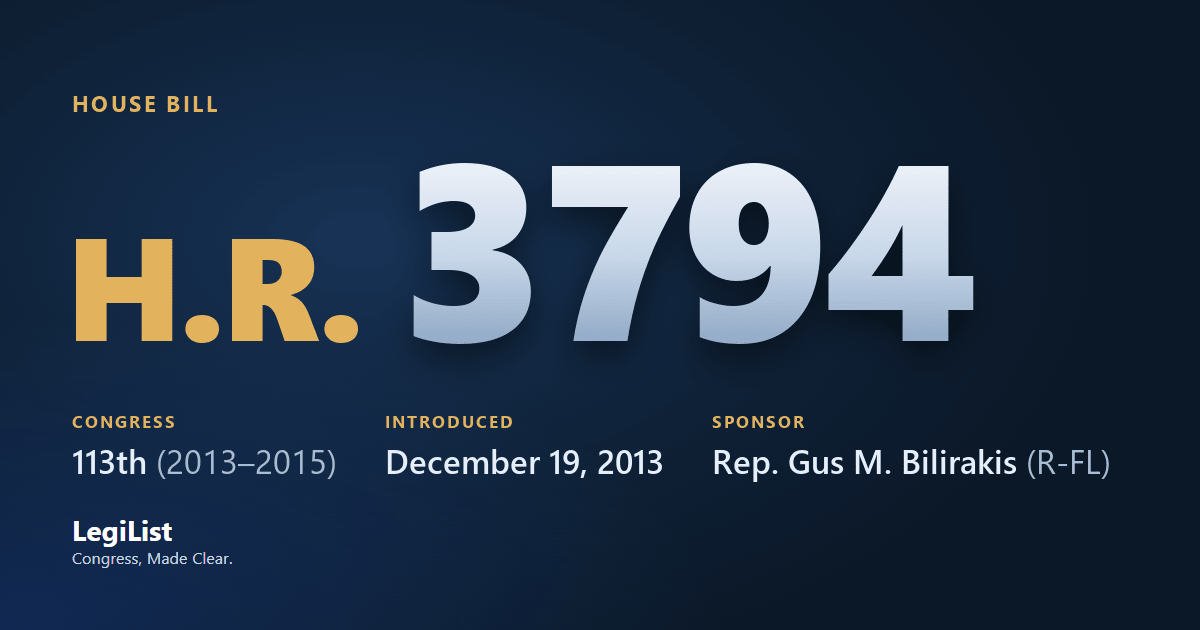
Latest action · Jan 24, 2014Referred to the Subcommittee on Military Personnel.
Progress
Where this bill reached, and when. A stage with no date
was not reached; one that failed a vote and later carried shows the
date it carried.
IntroducedDec 19, 2013
Passed HouseNot reached
Passed SenateNot reached
To the PresidentNot reached
Became lawNot reached
Summary
Repeals a provision of the Bipartisan Budget Act of 2013 that reduces the cost-of-living adjustment to the retirement pay of members of the Armed Forces under age 62.
Requires a reduction in the unobligated balances of the Department of Defense (DOD) to offset the costs incurred by such repeal.
Cosponsors 1
Members who signed on, in the order they did.
All signed on Feb 3, 2014.
Jan 24, 2014Referred to the Subcommittee on Military Personnel.
Dec 19, 2013Introduced in House
Dec 19, 2013Referred to the Committee on Armed Services, and in addition to the Committee on Appropriations, for a period to be subsequently determined by the Speaker, in each case for consideration of such provisions as fall within the jurisdiction of the committee concerned.
Research
What has been written about this bill: committee reports, cost estimates,
the sponsor’s authority statement, printed hearings and the Congressional Research Service’s work.
Constitutional authority
Congress has the power to enact this legislation pursuant to the following: This bill is enacted pursuant to Article I, Section 8 of the United States Constitution (Clauses 12, 13, 14, 16, and 17) which grants Congress the power to raise and support an Army; to provide and maintain a Navy; to make rules for the government and regulation of the land and naval forces; to provide for organizing, arming, and disciplining the militia; and to exercise authority over all places purchased for the erection of forts, magazines, dock-yards, and other needful buildings.
The sponsor’s statement, as printed in the page H8126.
Related bills 20
Companion bills and other measures the record links to this one.
Processed by Stripe in a separate window. LegiList never sees card details.
Everything here is as published by Congress: the summary is the
Congressional Research Service's, the action wording is the clerks',
and the subjects are the Library of Congress's. How far it got is read
from the actions themselves, taking the most recent one of each kind,
so a bill that failed a vote and later passed is shown as having passed.
Records come from
this bill on Congress.gov
and govinfo.gov; cost estimates
are the Congressional Budget Office's, and the hearings are the printed
hearings GovInfo publishes, which can appear months after the hearing.