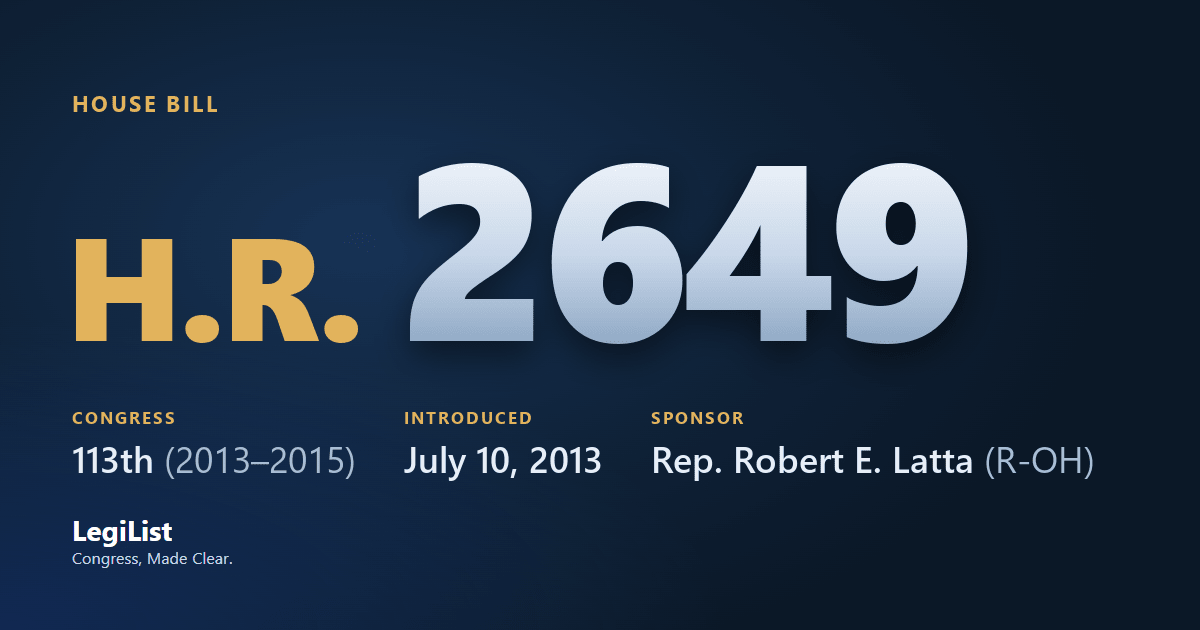
FCC `ABCs' Act of 2013
Latest action · Jul 12, 2013 Referred to the Subcommittee on Communications and Technology.
Progress
Where this bill reached, and when. A stage with no date was not reached; one that failed a vote and later carried shows the date it carried.
- IntroducedJul 10, 2013
- Passed HouseNot reached
- Passed SenateNot reached
- To the PresidentNot reached
- Became lawNot reached
Summary
FCC "ABCs" Act of 2013 - Amends the Communications Act of 1934 to direct the Federal Communications Commission (FCC), in the case of a proposed or final rule (including a proposed or final amendment to an existing rule) that may have an economically significant impact, to include in the notice a cost-benefit analysis demonstrating that the benefits outweigh the costs, recognizing that some benefits and costs are difficult to quantify.
Defines "economically significant impact" as an effect on the economy of at least $100 million annually or a material adverse effect on the economy, a sector of the economy, productivity, competition, jobs, the environment, public health or safety, or state, local, or tribal governments or communities.
Prohibits any appropriations for the express purpose of carrying out such analysis and notice requirements.
Directs the FCC to presume, absent clear and convincing evidence to the contrary, that: (1) forbearance requirements are met when determining whether to forbear from applying any regulation or provision under such Act to a telecommunications carrier, service, or class; and (2) regulations considered in each biennial regulatory review are no longer necessary in the public interest as the result of meaningful economic competition between providers of telecommunications service.
Cosponsors
Members who signed on, in the order they did.
Committees 1
Where it was sent and what each committee and subcommittee did with it, in order.
| Chamber | Committee | What it did |
|---|---|---|
| House | Energy and Commerce Committee | Referred Jul 10, 2013 |
| Communications and Technology Subcommittee | Referred Jul 12, 2013 |
Actions 3
Everything that happened, newest first.
- Jul 12, 2013Referred to the Subcommittee on Communications and Technology.
- Jul 10, 2013Introduced in House
- Jul 10, 2013Referred to the House Committee on Energy and Commerce.
Research
What has been written about this bill: committee reports, cost estimates, the sponsor’s authority statement, printed hearings and the Congressional Research Service’s work.
Constitutional authority
The sponsor’s statement, as printed in the page H4370.
Printed hearings 1
Hearings whose printed record names this bill, newest first: hearings on it, and wider hearings where it came up.
| Number | Hearing | Committee | Held |
|---|---|---|---|
| Serial No. 113-86 | THE EVOLUTION OF WIRED COMMUNICATIONS NETWORKS257 pages | Energy and Commerce Committee | Oct 23, 2013 |
Titles 2
Every title it has carried, official and short, at each stage.
- Official Title as Introduced
- To amend the Communications Act of 1934 to reform the Federal Communications Commission by requiring an analysis of benefits and costs during the rule making process and creating certain presumptions regarding regulatory forbearance and biennial regulatory review determinations.
- Short Titles as Introduced
- FCC `ABCs' Act of 2013
Subjects
Assigned by the Library of Congress. Policy area: Science, Technology, Communications.
Text 1
Each version as it was printed, newest first.
- Jul 10, 2013Introduced in House
Everything here is as published by Congress: the summary is the Congressional Research Service's, the action wording is the clerks', and the subjects are the Library of Congress's. How far it got is read from the actions themselves, taking the most recent one of each kind, so a bill that failed a vote and later passed is shown as having passed. Records come from this bill on Congress.gov and govinfo.gov; cost estimates are the Congressional Budget Office's, and the hearings are the printed hearings GovInfo publishes, which can appear months after the hearing.