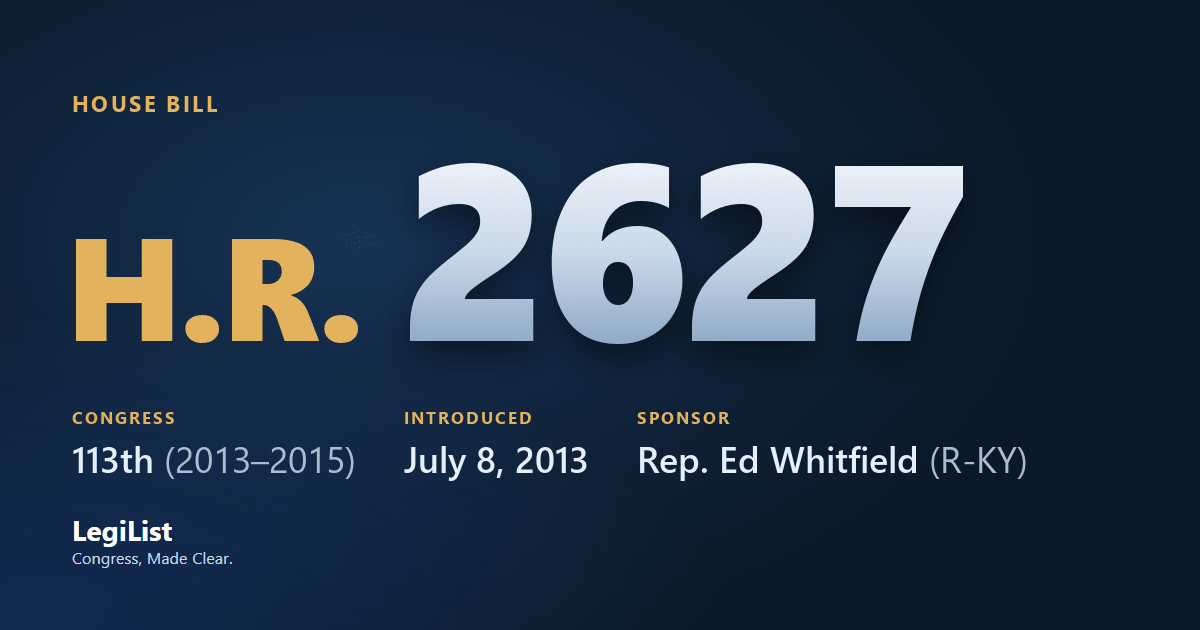
Caring for Coal Miners Act
Latest action · Jul 10, 2013 Referred to the Subcommittee on Energy and Mineral Resources.
Progress
Where this bill reached, and when. A stage with no date was not reached; one that failed a vote and later carried shows the date it carried.
- IntroducedJul 8, 2013
- Passed HouseNot reached
- Passed SenateNot reached
- To the PresidentNot reached
- Became lawNot reached
Summary
Caring for Coal Miners Act - Amends the Surface Mining Control and Reclamation Act of 1977 to revise the formula for determining transfers from the Abandoned Mine Reclamation Fund to the Multiemployer Health Benefit Plan.
Requires the formula to be calculated by taking into account only: (1) those beneficiaries actually enrolled in the Plan as of the enactment of this Act (currently, enrolled as of December 31, 2006), who are eligible to receive health benefits on the first day of the calendar year for which the transfer is made; and in addition to these beneficiaries (2) those who would be denied health benefits payable directly by an employer in the bituminous coal industry under a coal wage agreement as a result of a bankruptcy proceeding commenced in 2012.
Considers the latter beneficiaries to be eligible to receive such health benefits under the Plan.
Requires reduction of the amount made available to a beneficiary as a result of this Act, however, by the amount of any benefits actually paid by a Voluntary Employees' Beneficiary Association (VEBA) to or on behalf of a covered beneficiary, so that no covered beneficiary receives a greater benefit than would have been payable before the VEBA was established.
Defines "Voluntary Employees' Beneficiary Association" as one established pursuant to the order entered May 29, 2013, by the Court in the case In re: Patriot Coal Corporation (Case No. 12-51502, Bankruptcy Court for the Eastern District of Missouri).
Cosponsors 3
Members who signed on, in the order they did. Signatures ran from Jul 8, 2013 to Jul 22, 2013; 2 are original cosponsors, there from the day it was introduced.
| Seat | Cosponsor | Signed on | |
|---|---|---|---|
| R-WV | David B. McKinley | Original | Jul 8, 2013 |
| R-WV | Shelley Moore Capito | Original | Jul 8, 2013 |
| R-IL | Rodney Davis | Jul 22, 2013 |
Committees 1
Where it was sent and what each committee and subcommittee did with it, in order.
| Chamber | Committee | What it did |
|---|---|---|
| House | Natural Resources Committee | Referred Jul 8, 2013 |
| Energy and Mineral Resources Subcommittee | Referred Jul 10, 2013 |
Actions 3
Everything that happened, newest first.
- Jul 10, 2013Referred to the Subcommittee on Energy and Mineral Resources.
- Jul 8, 2013Introduced in House
- Jul 8, 2013Referred to the House Committee on Natural Resources.
Research
What has been written about this bill: committee reports, cost estimates, the sponsor’s authority statement, printed hearings and the Congressional Research Service’s work.
Constitutional authority
The sponsor’s statement, as printed in the page H4214.
Titles 2
Every title it has carried, official and short, at each stage.
- Official Title as Introduced
- To amend the Surface Mining Control and Reclamation Act of 1977 to protect the health care benefits of our Nation's miners.
- Short Titles as Introduced
- Caring for Coal Miners Act
Subjects
Assigned by the Library of Congress. Policy area: Energy.
Text 1
Each version as it was printed, newest first.
- Jul 8, 2013Introduced in House
Support LegiList
This page is free, carries no paywall, and is built and maintained by one person. If the record here is useful to you, a few dollars keeps it going.
Everything here is as published by Congress: the summary is the Congressional Research Service's, the action wording is the clerks', and the subjects are the Library of Congress's. How far it got is read from the actions themselves, taking the most recent one of each kind, so a bill that failed a vote and later passed is shown as having passed. Records come from this bill on Congress.gov and govinfo.gov; cost estimates are the Congressional Budget Office's, and the hearings are the printed hearings GovInfo publishes, which can appear months after the hearing.