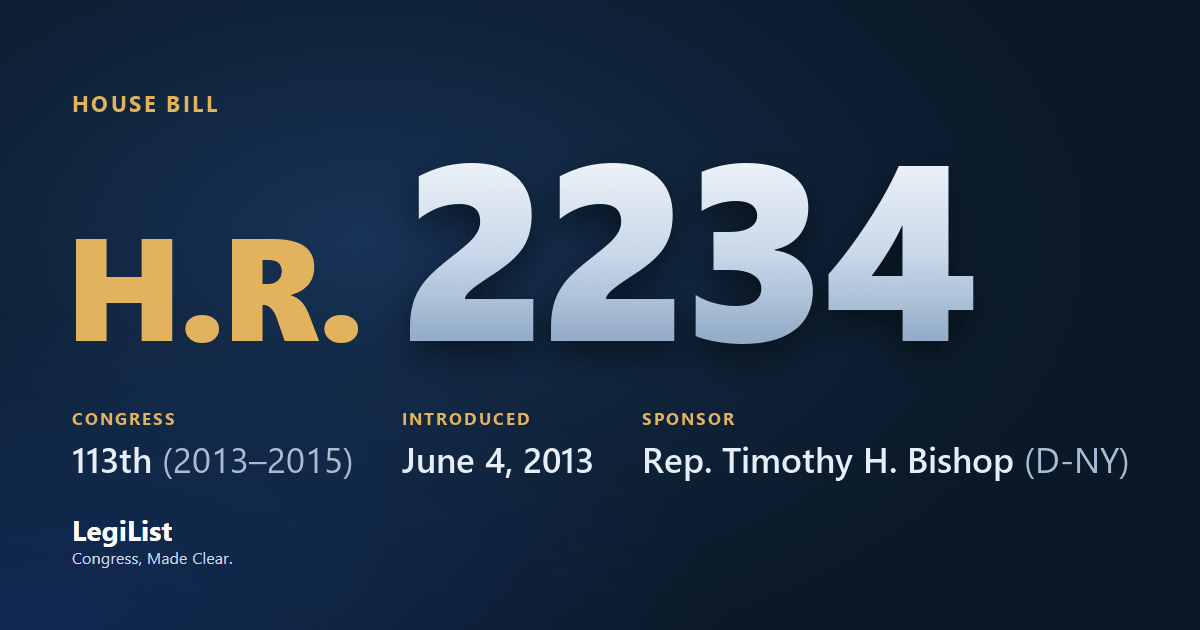
Diploma and Accreditation Integrity Protection Act
Latest action · Jul 15, 2013 Referred to the Subcommittee on Regulatory Reform, Commercial And Antitrust Law.
Progress
Where this bill reached, and when. A stage with no date was not reached; one that failed a vote and later carried shows the date it carried.
- IntroducedJun 4, 2013
- Passed HouseNot reached
- Passed SenateNot reached
- To the PresidentNot reached
- Became lawNot reached
Summary
Diploma and Accreditation Integrity Protection Act - Prohibits any accreditor from being considered a reliable authority as to the quality of education or training offered by degree-granting institutions for any purpose related to immigration, federal employment, or any other federal activity, unless the accreditor is recognized by the Secretary of Education.
Considers only a degree from a degree-granting institution that is accredited by such an accreditor to be acceptable in situations when a degree from an institution of higher education (IHE) is required or taken into consideration for the purpose of appointing, promoting, or improving the pay of a federal employee.
Directs the Federal Trade Commission (FTC) to define as an unfair and deceptive act or practice: (1) certain offerings of academic, professional, or occupational degrees by entities that are not IHEs or are not accredited by an accreditor recognized by the Secretary, any other appropriate federal agency, or the Council for Higher Education Accreditation; or (2) the issuing of any accreditation to a degree-granting institution by an accreditor that lacks such recognition.
Cosponsors
Members who signed on, in the order they did.
Committees 4
Where it was sent and what each committee and subcommittee did with it, in order.
| Chamber | Committee | What it did |
|---|---|---|
| House | Education and Workforce Committee | Referred Jun 4, 2013 |
| Higher Education and Workforce Development Subcommittee | Referred Jul 8, 2013 | |
| House | Oversight and Government Reform Committee | Referred Jun 4, 2013 |
| House | Energy and Commerce Committee | Referred Jun 4, 2013 |
| Commerce, Manufacturing, and Trade Subcommittee | Referred Jun 7, 2013 | |
| House | Judiciary Committee | Referred Jun 4, 2013 |
| Administrative State, Regulatory Reform, and Antitrust Subcommittee | Referred Jul 15, 2013 |
Actions 5
Everything that happened, newest first.
- Jul 15, 2013Referred to the Subcommittee on Regulatory Reform, Commercial And Antitrust Law.
- Jul 8, 2013Referred to the Subcommittee on Higher Education and Workforce Training.
- Jun 7, 2013Referred to the Subcommittee on Commerce, Manufacturing, and Trade.
- Jun 4, 2013Introduced in House
- Jun 4, 2013Referred to the Committee on Education and the Workforce, and in addition to the Committees on Oversight and Government Reform, Energy and Commerce, and the Judiciary, for a period to be subsequently determined by the Speaker, in each case for consideration of such provisions as fall within the jurisdiction of the committee concerned.
Research
What has been written about this bill: committee reports, cost estimates, the sponsor’s authority statement, printed hearings and the Congressional Research Service’s work.
Constitutional authority
The sponsor’s statement, as printed in the page H3095.
Titles 2
Every title it has carried, official and short, at each stage.
- Official Title as Introduced
- To reduce and prevent the sale and use of fraudulent degrees in order to protect the integrity of valid higher education degrees that are used for Federal employment purposes.
- Short Titles as Introduced
- Diploma and Accreditation Integrity Protection Act
Subjects
Assigned by the Library of Congress. Policy area: Education.
- Administrative law and regulatory procedures
- Competition and antitrust
- Consumer affairs
- Education
- Educational facilities and institutions
- Federal Trade Commission (FTC)
- Government employee pay, benefits, personnel management
- Higher education
- Immigration status and procedures
- Licensing and registrations
- Marketing and advertising
Text 1
Each version as it was printed, newest first.
- Jun 4, 2013Introduced in House
Everything here is as published by Congress: the summary is the Congressional Research Service's, the action wording is the clerks', and the subjects are the Library of Congress's. How far it got is read from the actions themselves, taking the most recent one of each kind, so a bill that failed a vote and later passed is shown as having passed. Records come from this bill on Congress.gov and govinfo.gov; cost estimates are the Congressional Budget Office's, and the hearings are the printed hearings GovInfo publishes, which can appear months after the hearing.