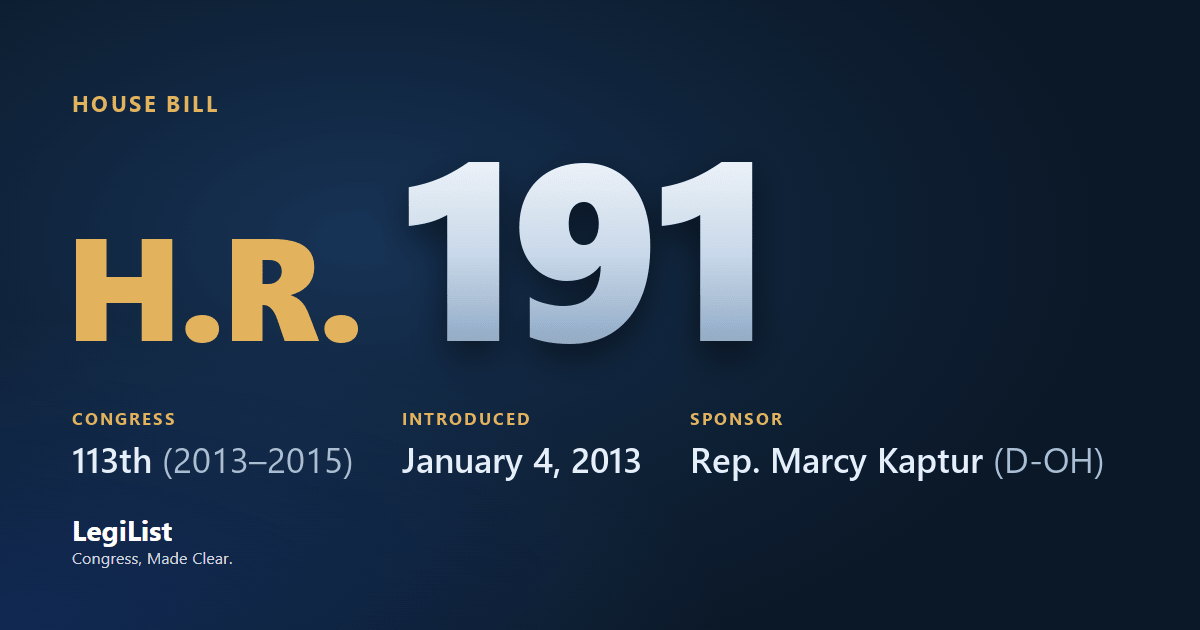
NAFTA Accountability Act
Latest action · Jan 15, 2013 Referred to the Subcommittee on Trade.
Progress
Where this bill reached, and when. A stage with no date was not reached; one that failed a vote and later carried shows the date it carried.
- IntroducedJan 4, 2013
- Passed HouseNot reached
- Passed SenateNot reached
- To the PresidentNot reached
- Became lawNot reached
Summary
NAFTA Accountability Act - Provides that unless the specified conditions set forth in this Act are met: (1) Congress withdraws its approval of the North American Free Trade Agreement (NAFTA) effective one year after enactment of this Act; and (2) the President, not later than 200 days after enactment of such Act, shall provide written notice of withdrawal to the governments of Canada and Mexico.
Specifies among such conditions that the President confers with the governments of Canada and Mexico and renegotiates NAFTA to correct: (1) trade deficits, (2) currency distortions, and (3) the impact of agricultural imports on U.S. production. Prescribes requirements also for: (1) gains in U.S. jobs and living standards, (2) increased domestic manufacturing, (3) health and environmental standards, (4) a non-increase in crime with illegal drugs, and (5) democracy and human freedoms.
Expresses the sense of Congress that until such conditions are met: (1) the President should not engage in negotiations to expand NAFTA to include other countries, and (2) trade promotion authority should not be renewed with respect to approval of any such NAFTA expansion.
Cosponsors 1
Members who signed on, in the order they did. All signed on Feb 12, 2013.
| Seat | Cosponsor | Signed on | |
|---|---|---|---|
| R-NC | Walter B. Jones | Feb 12, 2013 |
Committees 1
Where it was sent and what each committee and subcommittee did with it, in order.
| Chamber | Committee | What it did |
|---|---|---|
| House | Ways and Means Committee | Referred Jan 4, 2013 |
| Trade Subcommittee | Referred Jan 15, 2013 |
Actions 3
Everything that happened, newest first.
- Jan 15, 2013Referred to the Subcommittee on Trade.
- Jan 4, 2013Introduced in House
- Jan 4, 2013Referred to the House Committee on Ways and Means.
In the Congressional Record 1
Days the Record’s own index lists this bill, newest first, with the pages and the members it names. Pages starting H are the House, S the Senate, E Extensions of Remarks.
| Where | In the Record | Members | Date |
|---|---|---|---|
| House | Debate and remarks H82 | Marcy Kaptur D-OH | Jan 9, 2014 |
Research
What has been written about this bill: committee reports, cost estimates, the sponsor’s authority statement, printed hearings and the Congressional Research Service’s work.
Constitutional authority
The sponsor’s statement, as printed in the page H54.
Related bills 1
Companion bills and other measures the record links to this one.
| Bill | Title | Relationship | Latest action |
|---|---|---|---|
| HR 156 | To provide for the withdrawal of the United States from the North American Free Trade Agreement. | Related bill | Jan 15, 2013 |
Titles 2
Every title it has carried, official and short, at each stage.
- Official Title as Introduced
- To assess the impact of the North American Free Trade Agreement (NAFTA), to require further negotiation of certain provisions of the NAFTA, and to provide for the withdrawal from the NAFTA unless certain conditions are met.
- Short Titles as Introduced
- NAFTA Accountability Act
Subjects
Assigned by the Library of Congress. Policy area: Foreign Trade and International Finance.
- Agricultural trade
- Air quality
- Arizona
- California
- Canada
- Competitiveness, trade promotion, trade deficits
- Congressional oversight
- Elections, voting, political campaign regulation
- Environmental assessment, monitoring, research
- Food supply, safety, and labeling
- Foreign Trade and International Finance
- Free trade and trade barriers
- Human rights
- International monetary system and foreign exchange
- Latin America
- Mexico
- New Mexico
- News media and reporting
- Rule of law and government transparency
- Tariffs
- Texas
- Trade agreements and negotiations
- Trade restrictions
- Unemployment
- Water quality
Text 1
Each version as it was printed, newest first.
- Jan 4, 2013Introduced in House
Support LegiList
This page is free, carries no paywall, and is built and maintained by one person. If the record here is useful to you, a few dollars keeps it going.
Everything here is as published by Congress: the summary is the Congressional Research Service's, the action wording is the clerks', and the subjects are the Library of Congress's. How far it got is read from the actions themselves, taking the most recent one of each kind, so a bill that failed a vote and later passed is shown as having passed. Records come from this bill on Congress.gov and govinfo.gov; cost estimates are the Congressional Budget Office's, and the hearings are the printed hearings GovInfo publishes, which can appear months after the hearing.