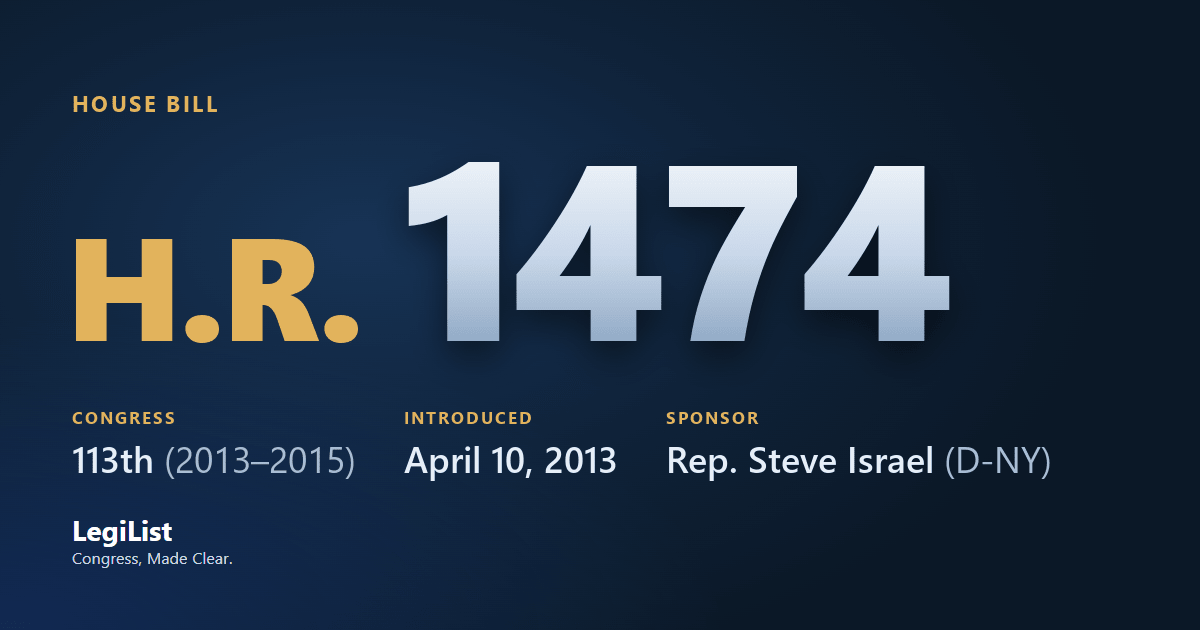
Undetectable Firearms Modernization Act
Latest action · Apr 30, 2013 Referred to the Subcommittee on Crime, Terrorism, Homeland Security, and Investigations.
Progress
Where this bill reached, and when. A stage with no date was not reached; one that failed a vote and later carried shows the date it carried.
- IntroducedApr 10, 2013
- Passed HouseNot reached
- Passed SenateNot reached
- To the PresidentNot reached
- Became lawNot reached
Summary
Undetectable Firearms Modernization Act - Amends the Undetectable Firearms Act of 1988 to: (1) delay the repeal date for 10 years; and (2) extend coverage of, and exemptions under, the Act to undetectable firearm receivers and ammunition magazines.
Prohibits the manufacture, importation, sale, shipment, delivery, possession, transfer, or receipt of any receiver for a rifle or handgun, or of any ammunition magazine, that: (1) is manufactured by a person who is not a licensed manufacturer; (2) is not as detectable as the Receiver Security Exemplar or the Magazine Security Exemplar by walk-through metal detectors; or (3) does not generate an image that accurately depicts the shape of a receiver or a magazine when subjected to inspection by airport x-ray machines.
Allows barium sulfate or other compounds to be used in the fabrication of a firearm receiver.
Defines a "Receiver Security Exemplar" and a "Magazine Security Exemplar" as objects fabricated at the direction of the Attorney General that are: (1) constructed, respectively, of 3.7 ounces of material type 17-4 PH stainless steel in a shape resembling the lower receiver for a rifle or handgun or of 1 ounce of material type 17-4 PH stainless steel in a shape resembling an ammunition magazine; and (2) suitable for testing and calibrating metal detectors.
Directs the Attorney General to promulgate regulations to permit receivers or magazines that were previously prohibited but that become as detectable as the respective Exemplar in view of advances in weapons detection technology.
Cosponsors 7
Members who signed on, in the order they did. Signatures ran from Apr 18, 2013 to Nov 20, 2013.
| Seat | Cosponsor | Signed on | |
|---|---|---|---|
| D-NY | Charles B. Rangel | Apr 18, 2013 | |
| D-IL | Janice D. Schakowsky | Apr 18, 2013 | |
| D-RI | David N. Cicilline | May 8, 2013 | |
| R-NY | Peter T. King | May 8, 2013 | |
| D-AZ | Raúl M. Grijalva | May 8, 2013 | |
| D-PA | Matt Cartwright | Jun 18, 2013 | |
| D-MI | John Conyers, Jr. | Nov 20, 2013 |
Committees 1
Where it was sent and what each committee and subcommittee did with it, in order.
| Chamber | Committee | What it did |
|---|---|---|
| House | Judiciary Committee | Referred Apr 10, 2013 |
| Crime and Federal Government Surveillance Subcommittee | Referred Apr 30, 2013 |
Actions 3
Everything that happened, newest first.
- Apr 30, 2013Referred to the Subcommittee on Crime, Terrorism, Homeland Security, and Investigations.
- Apr 10, 2013Introduced in House
- Apr 10, 2013Referred to the House Committee on the Judiciary.
Research
What has been written about this bill: committee reports, cost estimates, the sponsor’s authority statement, printed hearings and the Congressional Research Service’s work.
Constitutional authority
The sponsor’s statement, as printed in the page H1910.
Related bills 1
Companion bills and other measures the record links to this one.
| Bill | Title | Relationship | Latest action |
|---|---|---|---|
| S 1149 | Undetectable Firearms Modernization Act | Related bill | Jun 12, 2013 |
Titles 2
Every title it has carried, official and short, at each stage.
- Official Title as Introduced
- To reauthorize the ban on undetectable firearms, and to extend the ban to undetectable firearm receivers and undetectable ammunition magazines.
- Short Titles as Introduced
- Undetectable Firearms Modernization Act
Subjects
Assigned by the Library of Congress. Policy area: Crime and Law Enforcement.
Text 1
Each version as it was printed, newest first.
- Apr 10, 2013Introduced in House
Everything here is as published by Congress: the summary is the Congressional Research Service's, the action wording is the clerks', and the subjects are the Library of Congress's. How far it got is read from the actions themselves, taking the most recent one of each kind, so a bill that failed a vote and later passed is shown as having passed. Records come from this bill on Congress.gov and govinfo.gov; cost estimates are the Congressional Budget Office's, and the hearings are the printed hearings GovInfo publishes, which can appear months after the hearing.