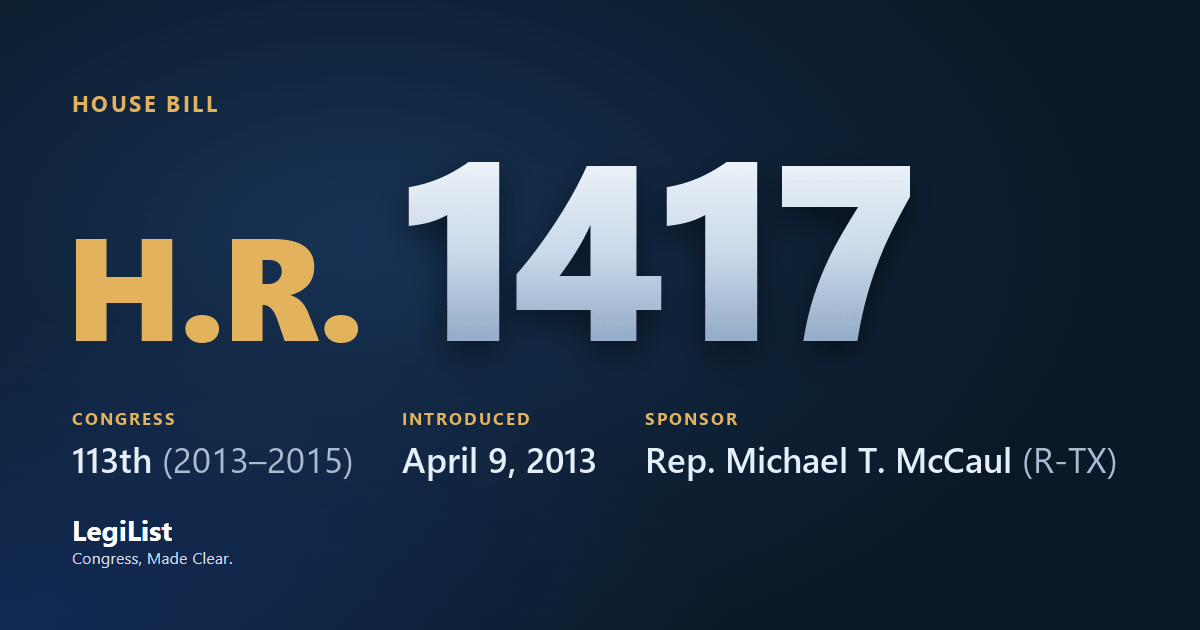
Border Security Results Act of 2013
Latest action · May 20, 2013 Placed on the Union Calendar, Calendar No. 62.
Progress
Where this bill reached, and when. A stage with no date was not reached; one that failed a vote and later carried shows the date it carried.
- IntroducedApr 9, 2013
- Passed HouseNot reached
- Passed SenateNot reached
- To the PresidentNot reached
- Became lawNot reached
Summary
Border Security Results Act of 2013 - (Sec. 2) Directs the Secretary of Homeland Security (DHS) to report to the appropriate congressional committees and the Government Accountability Office (GAO) at specified intervals on the state of situational awareness and operational control of U.S. borders, including an identification of the high traffic areas and the illegal border crossing effectiveness rate for each sector along the northern and southern borders that are within the responsibility of the Border Patrol. Requires the Comptroller General to report on the verification of the data and methodology used to determine such areas and rate.
Defines: (1) "operational control" as a condition in which there is a not lower than 90% illegal border crossing effectiveness rate, informed by situational awareness, and in which a significant reduction in the movement of illicit drugs and other contraband through such areas is being achieved; and (2) "situational awareness" as knowledge and an understanding of current illicit cross-border activity, including cross-border threats and trends concerning illicit trafficking and unlawful crossings along the borders and in the maritime environment, and the ability to forecast future shifts in such threats and trends.
(Sec. 3) Directs the Secretary to submit to such committees a comprehensive strategy for gaining and maintaining: (1) situational awareness and operational control of high traffic areas within two years, and (2) operational control along the southwest border of the United States within five years. Requires such strategy to include a consideration of:
- an assessment of principal border security threats;
- efforts to analyze and disseminate border security and threat information between DHS border security components and with other federal agencies with missions associated with the border;
- efforts to increase situational awareness, in accordance with privacy, civil liberties, and civil rights protections;
- efforts to detect and prevent terrorists and instruments of terrorism from entering the United States;
- efforts to ensure that any new border security technology can be operationally integrated with existing technologies in use by DHS;
- an assessment of existing efforts and technologies used for border security and the effect on civil rights, private property rights, privacy rights, and civil liberties;
- technology required to maintain, support, and enhance security and facilitate trade at ports of entry;
- operational coordination of DHS border security components;
- lessons learned from Operation Jumpstart and Operation Phalanx;
- cooperative agreements and information sharing with state, local, tribal, territorial, and other federal law enforcement agencies that have jurisdiction on the northern or southern borders or in the maritime environment;
- border security information received from consultation with such law enforcement agencies and from border community stakeholders;
- agreements with foreign governments that support U.S. border security efforts;
- staffing requirements for all border security functions;
- a prioritized list of research and development objectives to enhance the security of U.S. land and maritime borders;
- an assessment of training programs;
- local crime indices of municipalities and counties along the southern border;
- an assessment of how border security operations affect crossing times; and
- metrics required for measuring the effectiveness of efforts to secure the borders.
Directs the Secretary to submit to such committees and GAO an implementation plan for each DHS border security component to carry out such strategy, which: (1) specifies what protections will be put in place to ensure that staffing and resources necessary for the maintenance of operations at ports of entry are not diverted to operations between ports of entry, and (2) includes an integrated master schedule and cost estimate for activities and a comprehensive border security technology plan to improve surveillance capabilities. Requires the Comptroller General to report to such committees on such plan.
Requires the Secretary, not later than 180 days after the submission of each Quadrennial Homeland Security Review, to submit an updated strategy and implementation plan.
Directs the Secretary to implement specified metrics, informed by situational awareness, to measure the effectiveness of security: (1) between ports of entry, including an illegal border crossing effectiveness rate, an illicit drugs seizure rate, a cocaine seizure effectiveness rate, and estimates of total attempted illegal border crossings and of the impact of the Border Patrol's Consequence Delivery System on the rate of recidivism; (2) at ports of entry, including an inadmissible border crossing rate, illicit drugs and cocaine seizure rates, estimates of total attempted inadmissible border crossers and of infractions related to personnel and cargo committed by major violators, and a measurement of how border security operations affect crossing times; and (3) in the maritime environment, including an undocumented migrant interdiction rate and an estimate of the total number of undocumented migrants DHS's maritime security components fail to interdict, illicit drugs and cocaine removal rates inside out outside transit zones, and a rate that measures DHS's ability to respond to and resolve known maritime threats by placing assets on-scene. Requires the Secretary to make the data and methodology used to develop such metrics available to GAO for a report to Congress.
Directs the Secretary to submit to such committees and the Comptroller General: (1) a certification if the Secretary determines that situational awareness and operational control of high traffic areas have been achieved by not later than two years after the date of submission of the implementation plan and that operational control along the southwest border has been achieved by not later than five years after such submission date (with annual recertifications); or (2) a report that describes why situational awareness or operational control, or both, were not achieved, including impediments incurred, potential remedies, and recommendations.
Directs the Comptroller General to report to such committees on: (1) such certifications; (2) areas of overlap in responsibilities within the border security functions of DHS; and (3) the relative cost effectiveness of border security strategies, including deployment of additional personnel and technology and construction of virtual and physical barriers.
Requires the Secretary to submit annual reports to such committees on: (1) a resource allocation model for current and future year staffing requirements; (2) the level of manpower available at all land, air, and sea ports of entry and between ports of entry; (3) the difference between the staffing the model suggests and the actual staffing at and between the ports of entry; and (4) the security and competitive impacts of entering into a reimbursement agreement with foreign governments for CBP preclearance facilities.
(Sec. 4) Directs the Secretary to submit to such committees: (1) a plan to implement immediately a biometric exit capability at ports of entry under the US-VISIT program; or (2) upon determining that development of such a system is not feasible, an alternative program to provide the same level of security.
(Sec. 5) Prohibits the Secretary from conducting any study relating to the imposition of a border crossing fee for pedestrians or passenger vehicles at land ports of entry along the southern border or the northern border of the United States.
Cosponsors 20
Members who signed on, in the order they did. Signatures ran from Apr 9, 2013 to May 14, 2013; 3 are original cosponsors, there from the day it was introduced.
| Seat | Cosponsor | Signed on | |
|---|---|---|---|
| D-MS | Bennie G. Thompson | Original | Apr 9, 2013 |
| R-MI | Candice S. Miller | Original | Apr 9, 2013 |
| D-TX | Sheila Jackson Lee | Original | Apr 9, 2013 |
| D-TX | Henry Cuellar | Apr 11, 2013 | |
| R-SC | Jeff Duncan | Apr 11, 2013 | |
| R-NY | Peter T. King | Apr 11, 2013 | |
| R-TX | Ted Poe | Apr 11, 2013 | |
| R-PA | Patrick Meehan | Apr 12, 2013 | |
| R-TX | Pete Olson | Apr 12, 2013 | |
| R-UT | Chris Stewart | Apr 15, 2013 | |
| R-NC | Richard Hudson | Apr 15, 2013 | |
| D-AZ | Ron Barber | Apr 18, 2013 | |
| R-AZ | Trent Franks | Apr 18, 2013 | |
| R-IL | Adam Kinzinger | Apr 24, 2013 | |
| R-TX | Blake Farenthold | Apr 24, 2013 |
Committees 1
Where it was sent and what each committee and subcommittee did with it, in order.
| Chamber | Committee | What it did |
|---|---|---|
| House | Homeland Security Committee | Referred Apr 9, 2013Markup May 15, 2013Reported May 20, 2013 |
| Border Security and Enforcement Subcommittee | Referred Apr 15, 2013Markup Apr 24, 2013Reported Apr 24, 2013 |
Actions 9
Everything that happened, newest first.
- May 20, 2013Reported (Amended) by the Committee on Homeland Security. H. Rept. 113-87.
- May 20, 2013Placed on the Union Calendar, Calendar No. 62.
- May 15, 2013Committee Consideration and Mark-up Session Held.
- May 15, 2013Ordered to be Reported (Amended) by Voice Vote.
- Apr 24, 2013Subcommittee Consideration and Mark-up Session Held.
In the Congressional Record 7
Days the Record’s own index lists this bill, newest first, with the pages and the members it names. Pages starting H are the House, S the Senate, E Extensions of Remarks.
| Where | In the Record | Members | Date |
|---|---|---|---|
| House | Debate and remarks H6223 | Sheila Jackson Lee D-TX | Jul 15, 2014 |
| House | Debate and remarks H129 | Sheila Jackson Lee D-TX | Jan 9, 2014 |
| House | Debate and remarks H8102 | Sheila Jackson Lee D-TX | Dec 12, 2013 |
| House | Debate and remarks H7387 | Sheila Jackson Lee D-TX | Dec 2, 2013 |
| House | Debate and remarks H6468 | Sheila Jackson Lee D-TX | Oct 10, 2013 |
Research
What has been written about this bill: committee reports, cost estimates, the sponsor’s authority statement, printed hearings and the Congressional Research Service’s work.
Committee report
Constitutional authority
The sponsor’s statement, as printed in the page H1858.
Printed hearings 13
Hearings whose printed record names this bill, newest first: hearings on it, and wider hearings where it came up.
| Number | Hearing | Committee | Held |
|---|---|---|---|
| Serial No. 113-91 | OPEN BORDERS: THE IMPACT OF PRESIDENTIAL AMNESTY ON BORDER SECURITY63 pages | Homeland Security Committee | Dec 2, 2014 |
| Serial No. 113-78 | PORT OF ENTRY INFRASTRUCTURE: HOW DOES THE FEDERAL GOVERNMENT PRIORITIZE INVESTMENTS?49 pages | Homeland Security Committee | Jul 16, 2014 |
| Serial No. 113-53 | THE SECRETARY'S VISION FOR THE FUTURE--CHALLENGES AND PRIORITIES65 pages | Homeland Security Committee | Feb 26, 2014 |
| Serial No. 113-50 | EXAMINING CHALLENGES AND WASTED TAXPAYER DOLLARS IN MODERNIZING BORDER SECURITY IT SYSTEMS48 pages | Homeland Security Committee | Feb 6, 2014 |
| Serial No. 113-47 | A FALSE NARRATIVE ENDANGERS THE HOMELAND73 pages | Homeland Security Committee | Jan 15, 2014 |
CRS reports 3
Congressional Research Service work that CRS links to this bill or the law it became, newest first.
Cite it 3
Products on other subjects that cite it, usually among other measures.
| Product | Title | Kind | Published |
|---|---|---|---|
| R43852 | The President’s Immigration Accountability Executive Action of November 20, 2014: Overview and Issues Archived | Report | Feb 24, 2015 |
| R43356 | Border Security: Immigration Inspections at Ports of Entry Archived | Report | Jan 26, 2015 |
| R42985 | Issues in Homeland Security Policy for the 113th Congress Archived | Report | Sep 23, 2013 |
Related bills 1
Companion bills and other measures the record links to this one.
| Bill | Title | Relationship | Latest action |
|---|---|---|---|
| S 683 | Border Security Results Act of 2013 | Related bill | Apr 9, 2013 |
Titles 3
Every title it has carried, official and short, at each stage.
- Official Title as Introduced
- To require the Secretary of Homeland Security to develop a comprehensive strategy to gain and maintain operational control of the international borders of the United States, and for other purposes.
- Short Titles as Introduced
- Border Security Results Act of 2013
- Short Titles as Reported to House
- Border Security Results Act of 2013
Subjects
Assigned by the Library of Congress. Policy area: Immigration.
Text 2
Each version as it was printed, newest first.
- May 20, 2013Reported in House
- Apr 9, 2013Introduced in House
Everything here is as published by Congress: the summary is the Congressional Research Service's, the action wording is the clerks', and the subjects are the Library of Congress's. How far it got is read from the actions themselves, taking the most recent one of each kind, so a bill that failed a vote and later passed is shown as having passed. Records come from this bill on Congress.gov and govinfo.gov; cost estimates are the Congressional Budget Office's, and the hearings are the printed hearings GovInfo publishes, which can appear months after the hearing.