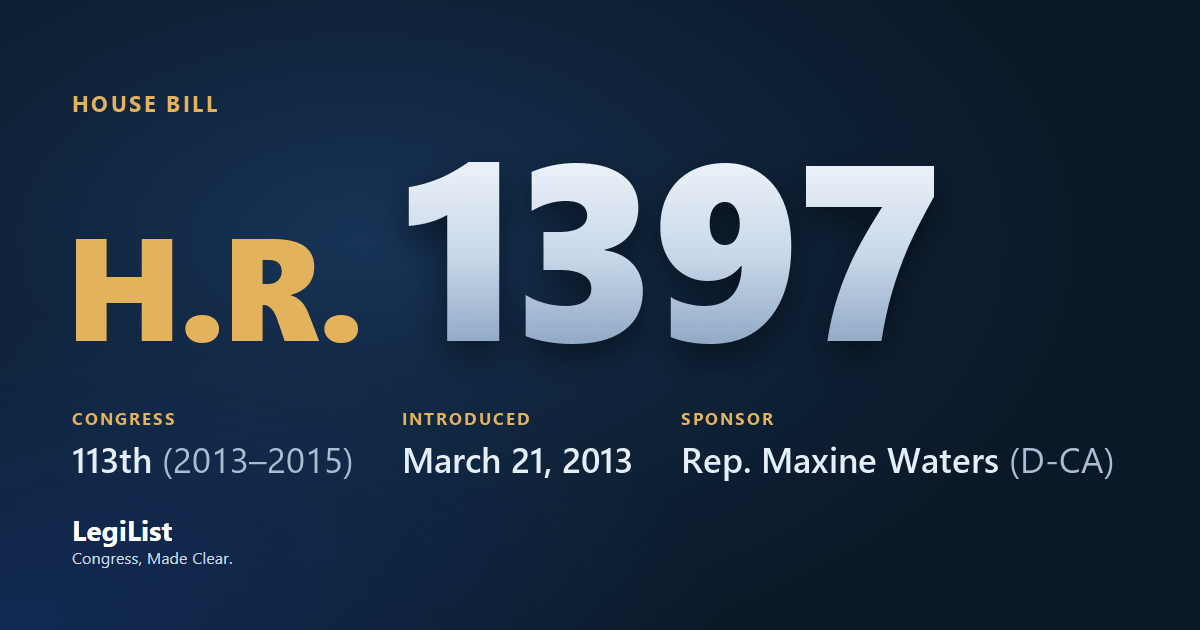
Project Rebuild Act of 2013
Latest action · Mar 21, 2013 Referred to the House Committee on Financial Services.
Progress
Where this bill reached, and when. A stage with no date was not reached; one that failed a vote and later carried shows the date it carried.
- IntroducedMar 21, 2013
- Passed HouseNot reached
- Passed SenateNot reached
- To the PresidentNot reached
- Became lawNot reached
Summary
Project Rebuild Act of 2013 - Appropriates funds for assistance to eligible entities including state and local governments, and qualified nonprofit organizations, businesses or eligible consortia for the redevelopment of abandoned and foreclosed-upon properties and for stabilization of affected neighborhoods (Project Rebuild).
Allows the use of funds to: (1) establish financing mechanisms for the purchase and redevelopment of abandoned and foreclosed-upon properties; (2) purchase and rehabilitate such properties; (3) establish and operate land banks for them; (4) demolish blighted structures (except public housing); and (5) redevelop abandoned, foreclosed, demolished, or vacant properties.
Requires each state to receive at least $20 million of formula funds, all of which shall be used with respect to low and moderate-income individuals and families.
Requires each state and local government grantee to establish procedures to create preferences for development of affordable rental housing.
Allows a grantee to use up to 10% to create jobs by establishing and operating a program to maintain eligible neighborhood properties.
Sets forth Buy American requirements.
Requires all laborers and mechanics employed by contractors and subcontractors on federally-assisted projects to be paid wages at the locally prevailing rates (Davis-Bacon Act).
Cosponsors 31
Members who signed on, in the order they did. Signatures ran from Mar 21, 2013 to Jan 29, 2014; 19 are original cosponsors, there from the day it was introduced.
| Seat | Cosponsor | Signed on | |
|---|---|---|---|
| D-FL | Alcee L. Hastings | Original | Mar 21, 2013 |
| D-MS | Bennie G. Thompson | Original | Mar 21, 2013 |
| D-LA | Cedric L. Richmond | Original | Mar 21, 2013 |
| D-RI | David N. Cicilline | Original | Mar 21, 2013 |
| D-GA | David Scott | Original | Mar 21, 2013 |
| D-NJ | Donald M. Payne, Jr. | Original | Mar 21, 2013 |
| D-MD | Donna F. Edwards | Original | Mar 21, 2013 |
| D-VI | Donna M. Christensen | Original | Mar 21, 2013 |
| D-TX | Eddie Bernice Johnson | Original | Mar 21, 2013 |
| D-MO | Emanuel Cleaver | Original | Mar 21, 2013 |
| D-FL | Frederica S. Wilson | Original | Mar 21, 2013 |
| D-GA | Henry C. "Hank" Johnson, Jr. | Original | Mar 21, 2013 |
| D-SC | James E. Clyburn | Original | Mar 21, 2013 |
| D-OH | Joyce Beatty | Original | Mar 21, 2013 |
| D-CA | Karen Bass | Original | Mar 21, 2013 |
Committees 1
Where it was sent and what each committee and subcommittee did with it, in order.
| Chamber | Committee | What it did |
|---|---|---|
| House | Financial Services Committee | Referred Mar 21, 2013 |
Actions 2
Everything that happened, newest first.
- Mar 21, 2013Introduced in House
- Mar 21, 2013Referred to the House Committee on Financial Services.
Research
What has been written about this bill: committee reports, cost estimates, the sponsor’s authority statement, printed hearings and the Congressional Research Service’s work.
Constitutional authority
The sponsor’s statement, as printed in the page H1828.
Titles 2
Every title it has carried, official and short, at each stage.
- Official Title as Introduced
- To create jobs and reinvest in communities through the rehabilitation of abandoned and foreclosed residential and commercial properties, and for other purposes.
- Short Titles as Introduced
- Project Rebuild Act of 2013
Subjects
Assigned by the Library of Congress. Policy area: Housing and Community Development.
- Appropriations
- Buy American requirements
- Employee hiring
- Fraud offenses and financial crimes
- Housing and Community Development
- Housing and community development funding
- Housing finance and home ownership
- Housing supply and affordability
- Labor standards
- Low- and moderate-income housing
- Property rights
- Public contracts and procurement
- Residential rehabilitation and home repair
- Rural conditions and development
- Urban and suburban affairs and development
- Wages and earnings
Text 1
Each version as it was printed, newest first.
- Mar 21, 2013Introduced in House
Support LegiList
This page is free, carries no paywall, and is built and maintained by one person. If the record here is useful to you, a few dollars keeps it going.
Everything here is as published by Congress: the summary is the Congressional Research Service's, the action wording is the clerks', and the subjects are the Library of Congress's. How far it got is read from the actions themselves, taking the most recent one of each kind, so a bill that failed a vote and later passed is shown as having passed. Records come from this bill on Congress.gov and govinfo.gov; cost estimates are the Congressional Budget Office's, and the hearings are the printed hearings GovInfo publishes, which can appear months after the hearing.