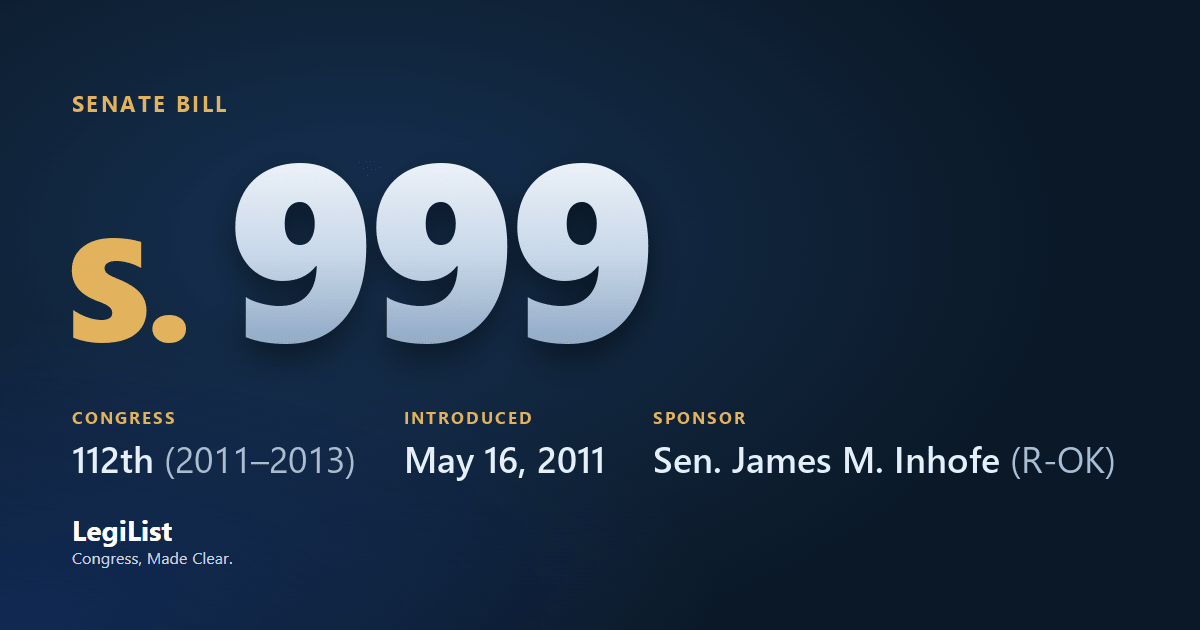
Small System Safe Drinking Water Act of 2011
Latest action · May 16, 2011 Read twice and referred to the Committee on Environment and Public Works.
Progress
Where this bill reached, and when. A stage with no date was not reached; one that failed a vote and later carried shows the date it carried.
- IntroducedMay 16, 2011
- Passed SenateNot reached
- Passed HouseNot reached
- To the PresidentNot reached
- Became lawNot reached
Summary
Small System Safe Drinking Water Act of 2011 - Amends the Safe Drinking Water Act to require the Administrator of the Environmental Protection Agency (EPA): (1) to convene a working group to study barriers to using specified treatments; (2) to develop model guidance to assist states in regulating and promoting such treatment options; and (3) when establishing affordability criteria for variance technology, to consider specified cost factors, to give extra weight to households below the poverty level and to communities that meet state affordability criteria, and to ensure that the criteria are not more costly, on a per-capita basis, to a small public water system than the per capita cost to a large water system of acquiring feasible technology.
Requires the Administrator or a state, before initiating any enforcement action, to ensure that sufficient funds have been made available to assist each public water system that serves fewer than 10,000 individuals in meeting regulation requirements.
Revises provisions allowing an exemption of a system from maximum containment level and treatment technique requirements to: (1) increase the population threshold; and (2) allow state determinations of a renewal period.
Revises technical assistance provisions to require water systems serving fewer than 10,000 individuals to receive adequate technical assistance and training to meet requirements of final rules. Gives priority to systems not in compliance with specified rules concerning disinfectants and disinfection byproducts, arsenic and compliance and new source monitoring, or groundwater or any other final rule promulgated by the Administrator after this Act's enactment.
Establishes pilot programs to: (1) explore new technologies or approaches to comply with a drinking water standard; and (2) research technology transfer issues and disinfection strategies relating to drinking water.
Cosponsors 5
Members who signed on, in the order they did. All signed on May 16, 2011.
| Seat | Cosponsor | Signed on | |
|---|---|---|---|
| R-LA | David Vitter | Original | May 16, 2011 |
| R-ID | James E. Risch | Original | May 16, 2011 |
| R-AR | John Boozman | Original | May 16, 2011 |
| R-ID | Mike Crapo | Original | May 16, 2011 |
| R-MS | Thad Cochran | Original | May 16, 2011 |
Committees 1
Where it was sent and what each committee and subcommittee did with it, in order.
| Chamber | Committee | What it did |
|---|---|---|
| Senate | Environment and Public Works Committee | Referred May 16, 2011 |
Actions 3
Everything that happened, newest first.
- May 16, 2011Introduced in Senate
- May 16, 2011Sponsor introductory remarks on measure. (CR S2993-2994)
- May 16, 2011Read twice and referred to the Committee on Environment and Public Works.
In the Congressional Record 1
Days the Record’s own index lists this bill, newest first, with the pages and the members it names. Pages starting H are the House, S the Senate, E Extensions of Remarks.
| Where | In the Record | Members | Date |
|---|---|---|---|
| Senate | Debate and remarks S2993 | James M. Inhofe R-OK | May 16, 2011 |
Titles 2
Every title it has carried, official and short, at each stage.
- Official Title as Introduced
- A bill to amend the Safe Drinking Water Act to prevent the enforcement of certain national primary drinking water regulations unless sufficient funding is available.
- Short Titles as Introduced
- Small System Safe Drinking Water Act of 2011
Subjects
Assigned by the Library of Congress. Policy area: Environmental Protection.
- Administrative law and regulatory procedures
- Environmental assessment, monitoring, research
- Environmental Protection
- Environmental Protection Agency (EPA)
- Environmental regulatory procedures
- Environmental technology
- Government lending and loan guarantees
- Hazardous wastes and toxic substances
- State and local finance
- Technology transfer and commercialization
- Water quality
- Water use and supply
Text 1
Each version as it was printed, newest first.
- May 16, 2011Introduced in Senate
Support LegiList
This page is free, carries no paywall, and is built and maintained by one person. If the record here is useful to you, a few dollars keeps it going.
Everything here is as published by Congress: the summary is the Congressional Research Service's, the action wording is the clerks', and the subjects are the Library of Congress's. How far it got is read from the actions themselves, taking the most recent one of each kind, so a bill that failed a vote and later passed is shown as having passed. Records come from this bill on Congress.gov and govinfo.gov; cost estimates are the Congressional Budget Office's, and the hearings are the printed hearings GovInfo publishes, which can appear months after the hearing.