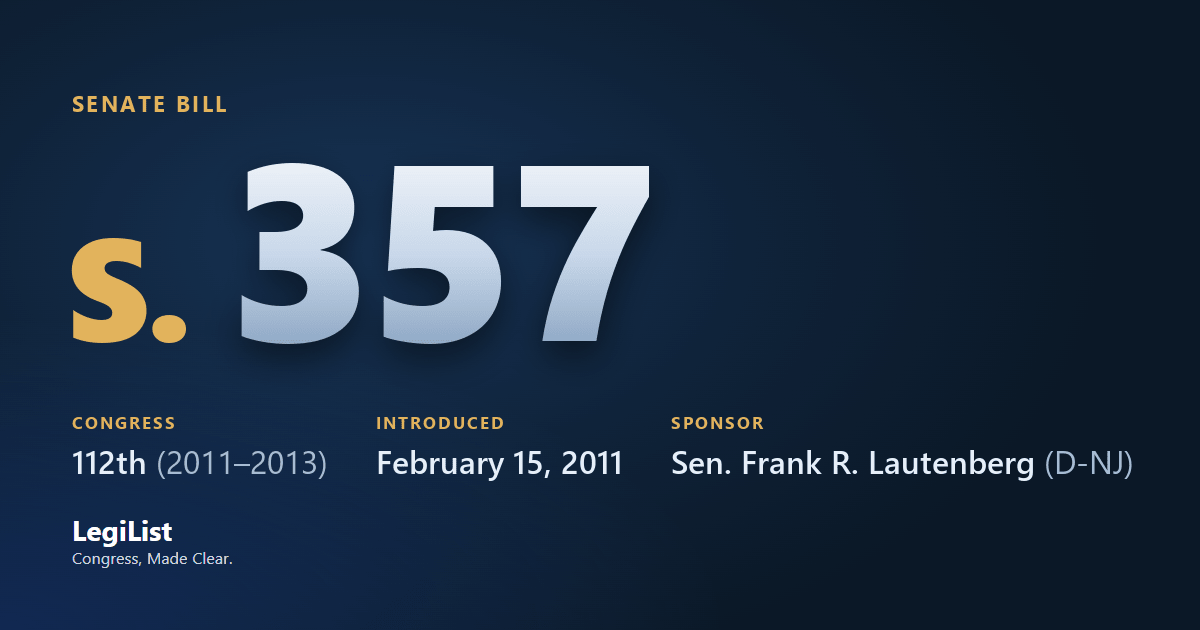
Wildlife Disease Emergency Act of 2011
Latest action · Sep 19, 2012 Placed on Senate Legislative Calendar under General Orders. Calendar No. 515.
Progress
Where this bill reached, and when. A stage with no date was not reached; one that failed a vote and later carried shows the date it carried.
- IntroducedFeb 15, 2011
- Passed SenateNot reached
- Passed HouseNot reached
- To the PresidentNot reached
- Became lawNot reached
Summary
Wildlife Disease Emergency Act of 2011 - (Sec. 4) Authorizes the Secretary of the Interior, in consultation with the governor of a potentially affected state, to declare in such state a wildlife disease emergency for a disease that affects wildlife: (1) within the United States; or (2) outside the United States, but with the potential to enter the United States.
Requires the Secretary, in making such a declaration, to consider: (1) the level of threat the disease poses to affected wildlife populations; (2) the sufficiency of resources available in the fund established by this Act; (3) the ability of the Department of the Interior and other agencies, tribal governments, and other stakeholders to address and coordinate a response to the disease through other means; and (4) the request of any state governor to make such a declaration.
Directs the Secretary, upon making such a declaration, to lead a coordinated response to the emergency.
Authorizes the Secretary to implement a grant program to provide grants to state wildlife agencies and Indian tribes to coordinate the response to, and address, such declared emergencies.
(Sec. 5) Establishes in the Treasury a Wildlife Disease Emergency Fund, to be administered by the Secretary.
Requires the Fund to consist of such amounts as are appropriated to the Fund and that are received as donations, gifts, or contributions.
Prohibits amounts in the Fund from being made available for any purpose other than to respond to a declared emergency.
Requires the Secretary to report annually to Congress on the operation of the Fund.
Requires a separate statement concerning the Fund in the President's annual budget submission to Congress.
Authorizes appropriations.
(Sec. 6) Directs the Secretary to establish a Wildlife Disease Committee to assist the Secretary in increasing the level of preparedness needed to address emerging wildlife diseases.
Requires the Committee to: (1) advise the Secretary on risk assessment, preparation, monitoring, research, and response to wildlife diseases that may significantly impact the health and sustainability of wildlife populations; and (2) as appropriate, draft documents related to such activities.
(Sec. 7) Authorizes the Secretary to convene rapid response teams to address any wildlife disease emergency.
(Sec. 8) Prohibits anything in this Act from: (1) limiting the Secretary's authority to respond to wildlife disease events that are not declared emergencies; (2) affecting the authority, jurisdiction, or responsibility of the states to manage, control, or regulate fish and resident wildlife under any state law; (3) granting authority to any public agency to acquire private property or conservation easements or otherwise infringe any use of private property; or (4) limiting, repealing, superseding, or modifying any provision of law.
Cosponsors 5
Members who signed on, in the order they did. Signatures ran from Feb 15, 2011 to May 5, 2011; 3 are original cosponsors, there from the day it was introduced.
| Seat | Cosponsor | Signed on | |
|---|---|---|---|
| I-VT | Bernard Sanders | Original | Feb 15, 2011 |
| D-NM | Jeff Bingaman | Original | Feb 15, 2011 |
| D-VT | Patrick J. Leahy | Original | Feb 15, 2011 |
| D-NJ | Robert Menendez | Apr 12, 2011 | |
| D-MD | Benjamin L. Cardin | May 5, 2011 |
Committees 1
Where it was sent and what each committee and subcommittee did with it, in order.
| Chamber | Committee | What it did |
|---|---|---|
| Senate | Environment and Public Works Committee | Referred Feb 15, 2011Markup Jul 25, 2012Reported Sep 19, 2012 |
| Fisheries, Water, and Wildlife Subcommittee | Hearings Apr 24, 2012 |
Actions 6
Everything that happened, newest first.
- Sep 19, 2012Committee on Environment and Public Works. Reported by Senator Boxer with amendments. With written report No. 112-214.
- Sep 19, 2012Placed on Senate Legislative Calendar under General Orders. Calendar No. 515.
- Jul 25, 2012Committee on Environment and Public Works. Ordered to be reported with an amendment favorably.
- Apr 24, 2012Committee on Environment and Public Works Senate Subcommittee on Water and Wildlife. Hearings held. With printed Hearing: S.Hrg. 112-968.
- Feb 15, 2011Introduced in Senate
- Feb 15, 2011Read twice and referred to the Committee on Environment and Public Works.
Research
What has been written about this bill: committee reports, cost estimates, the sponsor’s authority statement, printed hearings and the Congressional Research Service’s work.
Committee report
Congressional Budget Office cost estimate
- Aug 14, 2012S. 357, the Wildlife Disease Emergency Act of 2011As ordered reported by the Senate Committee on Environment and Public Works on July 25, 2012
Printed hearings 1
Hearings whose printed record names this bill, newest first: hearings on it, and wider hearings where it came up.
Titles 3
Every title it has carried, official and short, at each stage.
- Official Title as Introduced
- A bill to authorize the Secretary of the Interior to identify and declare wildlife disease emergencies and to coordinate rapid response to those emergencies, and for other purposes.
- Short Titles as Introduced
- Wildlife Disease Emergency Act of 2011
- Short Titles as Reported to Senate
- Wildlife Disease Emergency Act of 2011
Subjects
Assigned by the Library of Congress. Policy area: Animals.
Text 2
Each version as it was printed, newest first.
- Sep 19, 2012Reported to Senate
- Feb 15, 2011Introduced in Senate
Everything here is as published by Congress: the summary is the Congressional Research Service's, the action wording is the clerks', and the subjects are the Library of Congress's. How far it got is read from the actions themselves, taking the most recent one of each kind, so a bill that failed a vote and later passed is shown as having passed. Records come from this bill on Congress.gov and govinfo.gov; cost estimates are the Congressional Budget Office's, and the hearings are the printed hearings GovInfo publishes, which can appear months after the hearing.