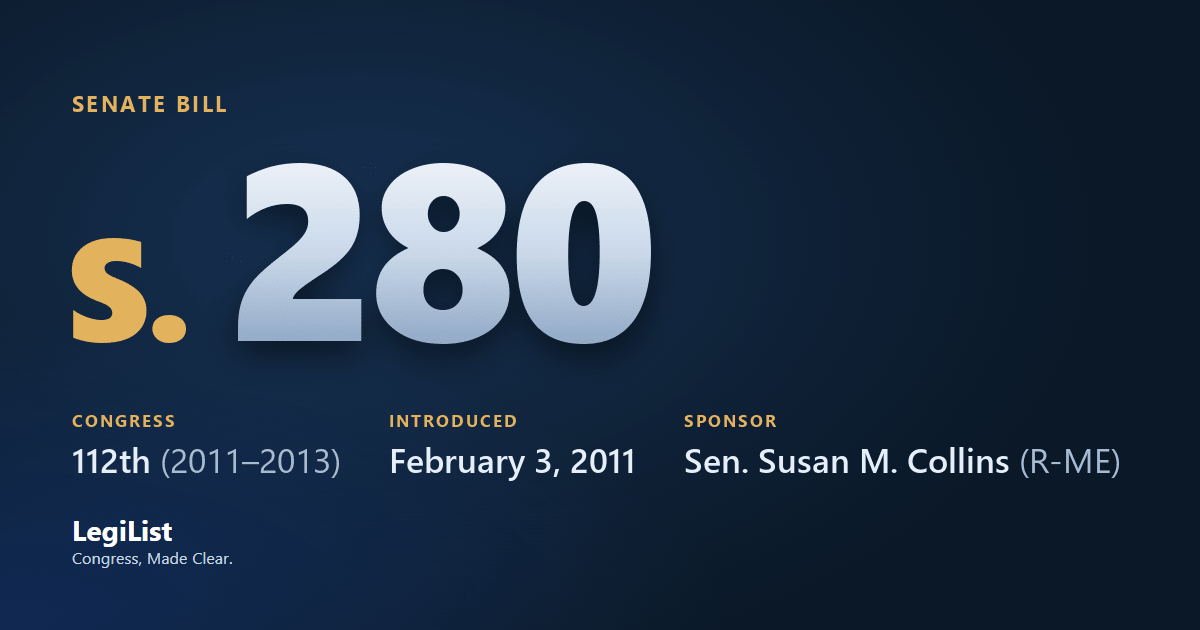
No Child Left Behind Flexibility and Improvements Act
Latest action · Feb 3, 2011 Read twice and referred to the Committee on Health, Education, Labor, and Pensions.
Progress
Where this bill reached, and when. A stage with no date was not reached; one that failed a vote and later carried shows the date it carried.
- IntroducedFeb 3, 2011
- Passed SenateNot reached
- Passed HouseNot reached
- To the PresidentNot reached
- Became lawNot reached
Summary
No Child Left Behind Flexibility and Improvements Act - Amends the Elementary and Secondary Education Act of 1965 (ESEA) to revise requirements relating to annual yearly progress (AYP) of students and schools, statewide and local accountability systems, special education, limited English proficiency students, funding levels and academic assessment deferrals, highly qualified teachers, and reading activities.
Authorizes the Secretary of Education to modify an AYP timeline.
Allows states to use: (1) additional types of statewide models and systems for measuring all students' progress; and (2) alternative assessments, designated by their individualized education program plan teams, for students with disabilities.
Gives states an option to include as limited English proficiency students, until they complete secondary school, those formerly in such subgroup who have subsequently acquired English proficiency.
Permits use of local assessments in measuring AYP.
Increases the levels of ESEA funding which must be reached before states are not allowed certain deferrals of academic assessments.
Revises requirements relating to AYP by group and subgroup.
Adds options for deeming teachers of multiple academic subjects as highly qualified, and for general social studies certification.
Reauthorizes the Reading First and Early Reading First programs through FY2017.
Authorizes use of reading activities subgrants for individual or small-group instruction, as well as for class-wide instruction.
Cosponsors 1
Members who signed on, in the order they did. All signed on Feb 3, 2011.
| Seat | Cosponsor | Signed on | |
|---|---|---|---|
| R-ME | Olympia J. Snowe | Original | Feb 3, 2011 |
Committees 1
Where it was sent and what each committee and subcommittee did with it, in order.
| Chamber | Committee | What it did |
|---|---|---|
| Senate | Health, Education, Labor, and Pensions Committee | Referred Feb 3, 2011 |
Actions 3
Everything that happened, newest first.
- Feb 3, 2011Introduced in Senate
- Feb 3, 2011Sponsor introductory remarks on measure. (CR S549)
- Feb 3, 2011Read twice and referred to the Committee on Health, Education, Labor, and Pensions.
In the Congressional Record 1
Days the Record’s own index lists this bill, newest first, with the pages and the members it names. Pages starting H are the House, S the Senate, E Extensions of Remarks.
| Where | In the Record | Members | Date |
|---|---|---|---|
| Senate | Debate and remarks S549 | Susan M. Collins R-ME | Feb 3, 2011 |
Titles 2
Every title it has carried, official and short, at each stage.
- Official Title as Introduced
- A bill to provide for flexibility and improvements in elementary and secondary education, and for other purposes.
- Short Titles as Introduced
- No Child Left Behind Flexibility and Improvements Act
Subjects
Assigned by the Library of Congress. Policy area: Education.
Text 1
Each version as it was printed, newest first.
- Feb 3, 2011Introduced in Senate
Everything here is as published by Congress: the summary is the Congressional Research Service's, the action wording is the clerks', and the subjects are the Library of Congress's. How far it got is read from the actions themselves, taking the most recent one of each kind, so a bill that failed a vote and later passed is shown as having passed. Records come from this bill on Congress.gov and govinfo.gov; cost estimates are the Congressional Budget Office's, and the hearings are the printed hearings GovInfo publishes, which can appear months after the hearing.