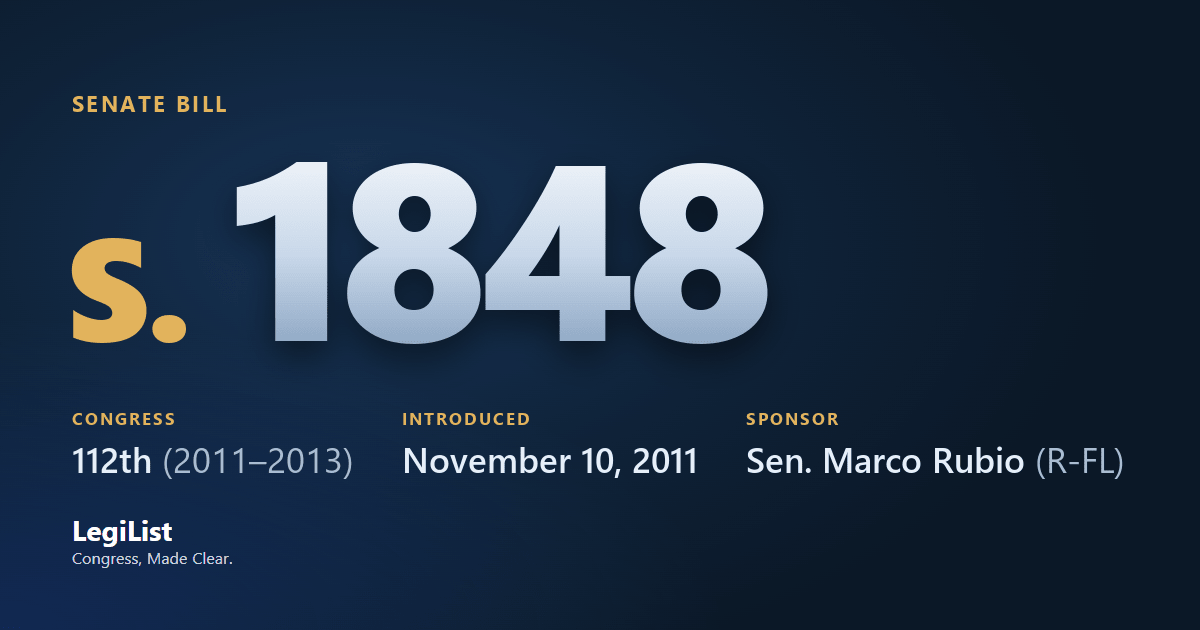
United Nations Transparency, Accountability, and Reform Act of 2011
Latest action · Nov 10, 2011 Read twice and referred to the Committee on Foreign Relations.
Progress
Where this bill reached, and when. A stage with no date was not reached; one that failed a vote and later carried shows the date it carried.
- IntroducedNov 10, 2011
- Passed SenateNot reached
- Passed HouseNot reached
- To the PresidentNot reached
- Became lawNot reached
Summary
United Nations Transparency, Accountability, and Reform Act of 2011 - Directs the President to use U.S. influence at the United Nations (U.N.) on a variety of issues, including to shift the funding mechanism for the regular budget of the U.N. from an assessed to a voluntary basis.
Withholds up to 50% of nonvoluntary U.S. contributions to the regular budget of the U.N. unless the Secretary of State certifies to Congress that 80% of the total regular budget of the U.N. is apportioned on a voluntary basis.
Requires the annual congressional budget justification to include a detailed itemized request in support of the U.S. contribution of the regular budget of the U.N.
Sets forth requirements for the Comptroller General (GAO) with respect to audits and investigations of U.S. contributions to the U.N. and such contributions' use by U.N. entities.
Prohibits the obligation or expenditure of a U.S. contribution to any U.N. entity unless the entity has provided the Comptroller General with a transparency certification and is in compliance with such certification.
Prohibits making funds available: (1) to international organizations for any purpose other than an assessed U.S. contribution to a U.N. entity or other international organization; (2) to international organizations and programs for any purpose other than a voluntary U.S. contribution to a U.N. entity or other international organization; and (3) for international peacekeeping activities for any purpose other than a U.S. contribution to U.N. peacekeeping activities, to the International Criminal Tribunal for the former Yugoslavia (ICTY), or to the International Criminal Tribunal for Rwanda (ICTR).
Directs the Secretary to withhold from the regular budget of the U.N. an amount equal to the amount of U.S. overpayments to the U.N.
States that is U.S. policy to oppose any proposals on expansion of the Security Council that would: (1) diminish U.S. influence on the Security Council, or (2) include veto rights for new Security Council members.
Withholds from U.S. contributions to the regular budget of the United Nations amounts that are proportional to the percentage of such budget that are expended for a U.N. human rights treaty monitoring body or committee that was established by a convention or an international covenant to which the United States is not party.
Directs the Secretary to withhold U.S. contributions from any U.N. entity that recognizes a Palestinian state or upgrades the status of the Palestinian observer mission at the U.N., the Palestine Liberation Organization (PLO), the Palestinian Authority (PA), or any other Palestinian administrative organization or governing entity prior to the achievement of a final peace agreement with Israel.
Provides that until the Secretary makes a specified certification to Congress: (1) the Secretary shall withhold from a U.S. contribution to a regular budget of the U.N. an amount equal to the amount that would be allocated for the United Nations Human Rights Council (UNHRC), (2) the Secretary shall not make a voluntary contribution to UNHRC, and (3) the United States shall not run for a UNHRC seat.
Directs the Secretary to withhold from a U.S. contribution to a regular budget of the U.N. an amount equal to the amount that would be allocated for: (1) the U.N. Special Rapporteur on the situation of human rights in Palestinian territories occupied since 1967; and (2) any other U.N. Special Procedures used to display bias against the United States or Israel or to provide support for any member state which is subject to Security Council sanctions, under a Security Council-mandated human rights investigation, has repeatedly supported acts of international terrorism, or is a country of particular concern for religious freedom.
States that it is U.S. policy to oppose any legitimization of the Goldstone Report and to lead a diplomatic campaign supporting its revocation.
Prohibits funds from being used for U.S. participation in the Durban III meeting or any part of the Durban process.
Withholds U.S. contributions to the United Nations Relief and Works Agency for Palestine Refugees in the Near East (UNRWA) or to any successor or related entity unless the Secretary makes specified certifications to Congress.
Prohibits any U.S. contribution to the International Atomic Energy Agency (IAEA) from being used to support Technical Cooperation program assistance to any country, including North Korea, that: (1) has repeatedly supported acts of international terrorism; or (2) is in breach of, or under investigation for breach of, obligations regarding its safeguards agreement with the IAEA, the Nuclear Non-Proliferation Treaty, or any relevant Security Council resolution.
Directs the Secretary to withhold from the U.S. voluntary contribution to the IAEA an amount proportional to that spent by the IAEA in 2007-2008 on Technical Cooperation program assistance to such countries.
Sets forth U.S. policy regarding reform of U.N. peacekeeping operations.
Directs the President to use U.S. influence at the U.N. to oppose the creation of new, or expansion of existing, U.N. peacekeeping operations until the Secretary certifies to Congress that specified peacekeeping reforms have been adopted by the U.N. Department of Peacekeeping Operations or the General Assembly.
Cosponsors 3
Members who signed on, in the order they did. Signatures ran from Nov 10, 2011 to Nov 14, 2011; 2 are original cosponsors, there from the day it was introduced.
| Seat | Cosponsor | Signed on | |
|---|---|---|---|
| R-OK | James M. Inhofe | Original | Nov 10, 2011 |
| R-ID | Mike Crapo | Original | Nov 10, 2011 |
| R-ID | James E. Risch | Nov 14, 2011 |
Committees 1
Where it was sent and what each committee and subcommittee did with it, in order.
| Chamber | Committee | What it did |
|---|---|---|
| Senate | Foreign Relations Committee | Referred Nov 10, 2011 |
Actions 3
Everything that happened, newest first.
- Nov 10, 2011Introduced in Senate
- Nov 10, 2011Sponsor introductory remarks on measure. (CR S7373)
- Nov 10, 2011Read twice and referred to the Committee on Foreign Relations.
In the Congressional Record 1
Days the Record’s own index lists this bill, newest first, with the pages and the members it names. Pages starting H are the House, S the Senate, E Extensions of Remarks.
| Where | In the Record | Members | Date |
|---|---|---|---|
| Senate | Debate and remarks S7373 | Marco Rubio R-FL | Nov 10, 2011 |
Research
What has been written about this bill: committee reports, cost estimates, the sponsor’s authority statement, printed hearings and the Congressional Research Service’s work.
Printed hearings 1
Hearings whose printed record names this bill, newest first: hearings on it, and wider hearings where it came up.
| Number | Hearing | Committee | Held |
|---|---|---|---|
| Serial No. 112-51 | ABANDONED MINED LANDS: INNOVATIVE SOLUTIONS FOR RESTORING THE ENVIRONMENT, IMPROVING SAFETY AND CREATING JOBS77 pages | Natural Resources Committee | Jul 14, 2011 |
Related bills 1
Companion bills and other measures the record links to this one.
| Bill | Title | Relationship | Latest action |
|---|---|---|---|
| HR 2829 | United Nations Transparency, Accountability, and Reform Act of 2011 | Related bill | Dec 8, 2011 |
Titles 2
Every title it has carried, official and short, at each stage.
- Official Title as Introduced
- A bill to promote transparency, accountability, and reform within the United Nations system, and for other purposes.
- Short Titles as Introduced
- United Nations Transparency, Accountability, and Reform Act of 2011
Subjects
Assigned by the Library of Congress. Policy area: International Affairs.
- Accounting and auditing
- Appropriations
- Arab-Israeli relations
- Arms control and nonproliferation
- Asia
- Australia
- Canada
- Conflicts and wars
- Congressional oversight
- Congressional tributes
- Crime victims
- Crimes against women
- Criminal investigation, prosecution, interrogation
- Czech Republic
- Diplomacy, foreign officials, Americans abroad
- Europe
- Foreign aid and international relief
- Germany
- Government ethics and transparency, public corruption
- Government liability
- Government studies and investigations
- Human rights
- Human trafficking
- International Affairs
- International law and treaties
- International organizations and cooperation
- Iran
- Israel
- Italy
- Middle East
- Military command and structure
- Military law
- Military personnel and dependents
- Netherlands
- New Zealand
- North Korea
- Nuclear power
- Nuclear weapons
- Oceania
- Palestinians
- Poland
- Racial and ethnic relations
- Refugees, asylum, displaced persons
- Religion
- Sanctions
- Sex offenses
- Terrorism
- United Nations
Text 1
Each version as it was printed, newest first.
- Nov 10, 2011Introduced in Senate
Everything here is as published by Congress: the summary is the Congressional Research Service's, the action wording is the clerks', and the subjects are the Library of Congress's. How far it got is read from the actions themselves, taking the most recent one of each kind, so a bill that failed a vote and later passed is shown as having passed. Records come from this bill on Congress.gov and govinfo.gov; cost estimates are the Congressional Budget Office's, and the hearings are the printed hearings GovInfo publishes, which can appear months after the hearing.