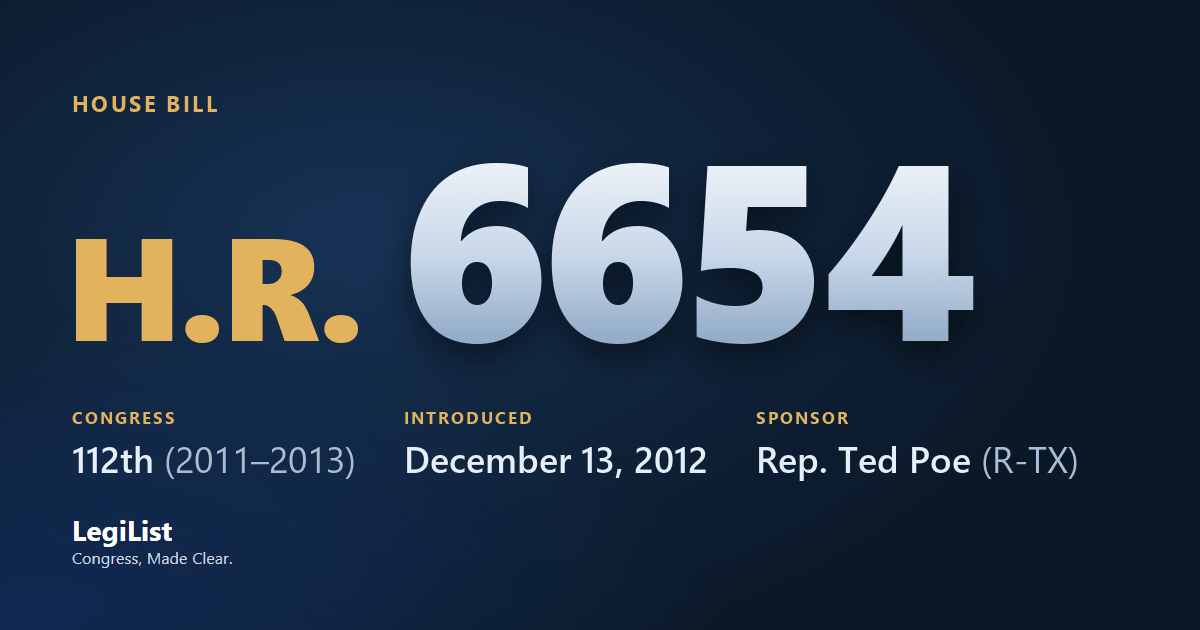
Foreign Counterfeit Merchandise Prevention Act
Latest action · Dec 13, 2012 Referred to the House Committee on the Judiciary.
Progress
Where this bill reached, and when. A stage with no date was not reached; one that failed a vote and later carried shows the date it carried.
- IntroducedDec 13, 2012
- Passed HouseNot reached
- Passed SenateNot reached
- To the PresidentNot reached
- Became lawNot reached
Summary
Foreign Counterfeit Merchandise Prevention Act - Amends the federal criminal code to provide that it shall not be a violation of the prohibition against a federal employee disclosing trade secrets or other confidential or proprietary information for an officer or employee of U.S. Customs and Border Protection (CBP): (1) at the time that merchandise is presented for examination and thereafter, to provide the owner of a copyright or a registered mark or any person who may be injured by a circumvention of copyright protection systems with any information appearing on the merchandise, including its retail packaging, or a sample or image of such merchandise and its retail packaging, for the purposes of determining whether the merchandise or its packaging infringes the copyright, bears or consists of a counterfeit mark of the registered mark, or is a violation of copyright protection systems; or (2) after seizing merchandise determined to be in violation of copyright protection systems, to provide certain information to persons injured by such violation, including the date of importation, the port of entry, a description of the merchandise, the country of origin of the merchandise, the names and addresses of the foreign manufacturer, the exporter, and the importer, and a photographic or digital image of the merchandise.
Applies such exemption only with respect to tangible goods presented to the CBP for importation into, or exportation from, the United States.
Amends the Lanham Act to direct the Secretary of Homeland Security (DHS) (the Secretary) to record and transmit to customs officers any contact information, documentation of the locality in which goods were manufactured, and copies of trademark registrations furnished by domestic or eligible foreign manufacturers or traders for the purpose of aiding the enforcement of a prohibition on the importation of goods bearing infringing marks or names. (Currently, such activities are performed by the Secretary of the Treasury.)
Requires the Secretary, if the CBP detains critical merchandise bearing a DHS-recorded registered trademark, to provide the trademark owner any information on such critical merchandise and its packaging and labels, including, without redaction, photographs or digital images, packaging, and labels. Permits the Secretary, subject to any bonding and return requirements, to provide the owner samples of the critical merchandise without redaction.
Defines "critical merchandise" to include: (1) aircraft engines, appliances, propellers, and spare parts; (2) children's sleepwear, cosmetics, devices, drugs, food, motor vehicle equipment, pesticide chemicals, semiconductors, and tobacco products; (3) items on the U.S. Munitions List established under specified provisions of the Arms Export Control Act; and (4) any other article of manufacture that the Secretary determines could, if permitted entry into the United States in violation of the U.S. laws, pose a danger to the health, safety, or welfare of consumers, or to the national security of the United States.
Applies such Lanham Act amendments only with respect to tangible goods presented to the CBP for importation into the United States.
Cosponsors 6
Members who signed on, in the order they did. Signatures ran from Dec 13, 2012 to Dec 18, 2012; 3 are original cosponsors, there from the day it was introduced.
| Seat | Cosponsor | Signed on | |
|---|---|---|---|
| D-CA | Linda T. Sánchez | Original | Dec 13, 2012 |
| R-OH | Steve Chabot | Original | Dec 13, 2012 |
| D-CA | Zoe Lofgren | Original | Dec 13, 2012 |
| R-CA | Howard P. "Buck" McKeon | Dec 18, 2012 | |
| R-TX | Michael T. McCaul | Dec 18, 2012 | |
| D-MA | William R. Keating | Dec 18, 2012 |
Committees 1
Where it was sent and what each committee and subcommittee did with it, in order.
| Chamber | Committee | What it did |
|---|---|---|
| House | Judiciary Committee | Referred Dec 13, 2012 |
Actions 2
Everything that happened, newest first.
- Dec 13, 2012Introduced in House
- Dec 13, 2012Referred to the House Committee on the Judiciary.
In the Congressional Record 1
Days the Record’s own index lists this bill, newest first, with the pages and the members it names. Pages starting H are the House, S the Senate, E Extensions of Remarks.
| Where | In the Record | Members | Date |
|---|---|---|---|
| House | Lists H6807H.R. 6654–6670 | — | Dec 13, 2012 |
Research
What has been written about this bill: committee reports, cost estimates, the sponsor’s authority statement, printed hearings and the Congressional Research Service’s work.
Constitutional authority
The sponsor’s statement, as printed in the page H6807.
Related bills 1
Companion bills and other measures the record links to this one.
| Bill | Title | Relationship | Latest action |
|---|---|---|---|
| HR 4216 | Foreign Counterfeit Prevention Act | Related bill | Mar 28, 2012 |
Titles 2
Every title it has carried, official and short, at each stage.
- Official Title as Introduced
- To provide for the exchange of information related to trade enforcement, and for other purposes.
- Short Titles as Introduced
- Foreign Counterfeit Merchandise Prevention Act
Subjects
Assigned by the Library of Congress. Policy area: Crime and Law Enforcement.
Text 1
Each version as it was printed, newest first.
- Dec 13, 2012Introduced in House
Everything here is as published by Congress: the summary is the Congressional Research Service's, the action wording is the clerks', and the subjects are the Library of Congress's. How far it got is read from the actions themselves, taking the most recent one of each kind, so a bill that failed a vote and later passed is shown as having passed. Records come from this bill on Congress.gov and govinfo.gov; cost estimates are the Congressional Budget Office's, and the hearings are the printed hearings GovInfo publishes, which can appear months after the hearing.