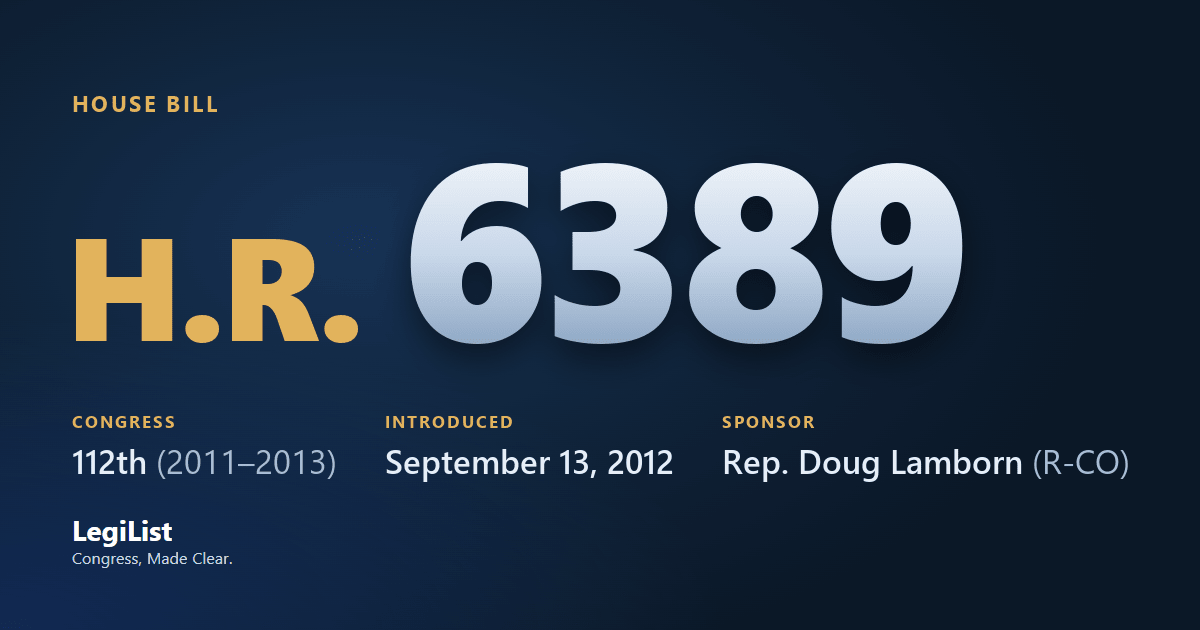
Sequestration Prevention Act of 2012
Latest action · Sep 19, 2012 Referred to the Subcommittee on the Constitution.
Progress
Where this bill reached, and when. A stage with no date was not reached; one that failed a vote and later carried shows the date it carried.
- IntroducedSep 13, 2012
- Passed HouseNot reached
- Passed SenateNot reached
- To the PresidentNot reached
- Became lawNot reached
Summary
Sequestration Prevention Act of 2012 - Title I: Fully Repeal the Sequestration Provision of Round 2 of the Budget Control Act - Amends the Balanced Budget and Emergency Deficit Control Act of 1985 (Gramm--Rudman-Hollings Act), as amended by the Budget Control Act of 2011, to repeal its budget goal enforcement requirements (sequestration mandate).
Title II: Repeal of Health Care Law - Repealing the Job-Killing Health Care Law Act - Repeals the Patient Protection and Affordable Care Act (PPACA), and restores or revives any provisions of law amended or repealed by it as if PPACA had not been enacted.
Repeals title I (Coverage, Medicare, Medicaid, and Revenues) and subtitle B (Health) of title II of the Health Care and Education Reconciliation Act of 2010, and restores or revives any provisions of law amended or repealed by them as if such title and subtitle had not been enacted.
Repeals the Food and Nutrition Act of 2008, including the supplemental nutrition assistance program.
Title III: Nutrition Assistance Block Grant Program - Directs the Secretary of Agriculture (USDA) to establish a nutrition assistance block grant program of annual grants to each participating state that establishes a nutrition assistance program including work requirements, mandatory drug testing, and benefit use limitations at least as restrictive as those for the supplemental nutrition assistance program.
Title IV: Block Grant the Medicaid Program - Directs the Secretary of Health and Human Services (HHS) to establish a Medicaid block grant program of annual grants to each participating state that establishes a medical assistance program for individuals.
Repeals title XIX (Medicaid) of the Social Security Act, and eliminates mandatory direct funding for the existing Medicaid program.
Title V: Reduction of Federal Workforce - Requires the Director of the Office of Management and Budget (OMB) to determine the number of full-time employees employed in each federal agency.
Prohibits the head of each federal agency from hiring more than 2 employees for every 3 employees who leave employment in the agency until the number of full-time employees in the agency is 10% less than the number determined by the OMB Director under this title.
Title VI: Prohibition on Climate Change and Global Warming Funding - Prohibits the expenditure of federal funds for any activity relating to climate change or global warming.
Title VII: Protecting Access to Health Care - Protecting Access to Healthcare Act - Title I: HEALTH Act - Help Efficient, Accessible, Low Cost, Timely Healthcare (HEALTH) Act of 2012 - Prescribes requirements for lawsuits for health care goods and services liability claims.
Sets a three-year statute of limitations after the manifestation of injury or one year after the claimant discovers the injury, with certain exceptions.
Limits noneconomic damages to $250,000. Makes each party liable only for the amount of damages directly proportional to such party's percentage of responsibility.
Allows the court to restrict the payment of attorney contingency fees.
Authorizes the award of punitive damages only where: (1) it is proven by clear and convincing evidence that a person acted with malicious intent to injure the claimant or deliberately failed to avoid unnecessary injury the claimant was substantially certain to suffer, and (2) compensatory damages are awarded. Limits punitive damages to the greater of two times the amount of economic damages or $250,000.
Limits the liability of manufacturers, distributors, suppliers, and providers of medical products that comply with Food and Drug Administration (FDA) standards.
Provides for periodic payments of future damage awards.
Health Care Safety Net Enhancement Act of 2012 - Amends the Public Health Service Act (PHSA) to deem a hospital or an emergency department and a physician or physician group of that hospital or emergency department to be an employee of the Public Health Service for purposes of any civil action that may arise from providing emergency and post-stabilization services on or after January 1, 2012.
Health Insurance Industry Fair Competition Act of 2012 - Declares that nothing in the McCarran-Ferguson Act (which exempts the insurance business generally from federal regulation) shall modify, impair, or supersede the operation of any of the antitrust laws with respect to the business of health insurance. Applies prohibitions against using unfair methods of competition to the business of health insurance without regard to whether such business is carried on for profit.
Good Samaritan Health Professionals Act of 2012 - Amends the PHSA to declare that a health care professional shall not be liable under federal or state law, with certain exceptions, for harm caused by any act or omission if: (1) the professional is serving as a volunteer for purposes of responding to a disaster; and (2) the act or omission occurs during the period of the disaster, in the professional's capacity as such a volunteer, and in a good faith belief that the individual being treated is in need of health care services.
Places on the plaintiff in any civil action or proceeding against a health care professional the burden of proving by clear and convincing evidence that the limitation of liability under this Act does not apply.
Title VIII: Budget Control Act Spending Cap Adjustments - Amends the Gramm-Rudman-Hollings Act to reenact the requirements for enforcement of discretionary spending limits as they were in effect on January 15, 2012.
Specifies discretionary spending caps for the security category (Budget Function 050, largely Department of Defense [DOD]) and the non-security category for FY2013-FY2022.
Cosponsors
Members who signed on, in the order they did.
Committees 11
Where it was sent and what each committee and subcommittee did with it, in order.
| Chamber | Committee | What it did |
|---|---|---|
| House | Budget Committee | Referred Sep 13, 2012 |
| House | Ways and Means Committee | Referred Sep 13, 2012 |
| House | Energy and Commerce Committee | Referred Sep 13, 2012 |
| Health Subcommittee | Referred Sep 14, 2012 | |
| House | Education and Workforce Committee | Referred Sep 13, 2012 |
| House | Judiciary Committee | Referred Sep 13, 2012 |
| Constitution and Limited Government Subcommittee | Referred Sep 19, 2012 | |
| House | Committee on House Administration | Referred Sep 13, 2012 |
| House | Natural Resources Committee | Referred Sep 13, 2012 |
| Indian and Insular Affairs Subcommittee | Referred Sep 18, 2012 | |
| House | Rules Committee | Referred Sep 13, 2012 |
| House | Appropriations Committee | Referred Sep 13, 2012 |
| House | Agriculture Committee | Referred Sep 13, 2012 |
| House | Oversight and Government Reform Committee | Referred Sep 13, 2012 |
Actions 5
Everything that happened, newest first.
- Sep 19, 2012Referred to the Subcommittee on the Constitution.
- Sep 18, 2012Referred to the Subcommittee Indian and Alaska Native Affairs.
- Sep 14, 2012Referred to the Subcommittee on Health.
- Sep 13, 2012Introduced in House
- Sep 13, 2012Referred to the Committee on the Budget, and in addition to the Committees on Ways and Means, Energy and Commerce, Education and the Workforce, the Judiciary, House Administration, Natural Resources, Rules, Appropriations, Agriculture, and Oversight and Government Reform, for a period to be subsequently determined by the Speaker, in each case for consideration of such provisions as fall within the jurisdiction of the committee concerned.
Research
What has been written about this bill: committee reports, cost estimates, the sponsor’s authority statement, printed hearings and the Congressional Research Service’s work.
Constitutional authority
The sponsor’s statement, as printed in the page H6000.
Related bills 9
Companion bills and other measures the record links to this one.
| Bill | Title | Relationship | Latest action |
|---|---|---|---|
| HR 5 | Protecting Access to Healthcare Act | Related bill | Apr 16, 2012 |
| HR 157 | Health Care Safety Net Enhancement Act of 2011 | Related bill | Feb 1, 2011 |
| S 192 | Repealing the Job-Killing Health Care Law Act | Related bill | Jan 27, 2011 |
| S 218 | Help Efficient, Accessible, Low-cost, Timely Healthcare (HEALTH) Act of 2011 | Related bill | Jan 27, 2011 |
| HR 1099 | Taxpayers' Freedom of Conscience Act of 2011 | Related bill | Mar 29, 2011 |
| HR 1943 | Health Insurance Industry Fair Competition Act | Related bill | Jul 11, 2011 |
| S 3473 | Sequestration Prevention Act of 2012 | Identical bill | Aug 1, 2012 |
| HR 3586 | Good Samaritan Health Professionals Act of 2011 | Related bill | Dec 14, 2011 |
| HR 5838 | Health Insurance Industry Antitrust Enforcement Act of 2012 | Related bill | Jun 5, 2012 |
Titles 8
Every title it has carried, official and short, at each stage.
- Official Title as Introduced
- To replace automatic spending cuts with targeted reforms, and for other purposes.
- Short Titles as Introduced
- Sequestration Prevention Act of 2012
- Short Titles as Introduced for portions of this bill
- Health Insurance Industry Fair Competition Act of 2012
- Health Care Safety Net Enhancement Act of 2012
- Help Efficient, Accessible, Low-cost, Timely Healthcare (HEALTH) Act of 2012
- Protecting Access to Health Care Act
- Repealing the Job-Killing Health Care Law Act
- Good Samaritan Health Professionals Act of 2012
Subjects
Assigned by the Library of Congress. Policy area: Health.
- Advisory bodies
- Alternative dispute resolution, mediation, arbitration
- Budget process
- Civil actions and liability
- Climate change and greenhouse gases
- Competition and antitrust
- Disaster relief and insurance
- Drug safety, medical device, and laboratory regulation
- Emergency medical services and trauma care
- Environmental regulatory procedures
- Evidence and witnesses
- Federal preemption
- Food assistance and relief
- Government employee pay, benefits, personnel management
- Health
- Health care costs and insurance
- Health care coverage and access
- Health care quality
- Health facilities and institutions
- Health personnel
- Health promotion and preventive care
- Health technology, devices, supplies
- Insurance industry and regulation
- Intergovernmental relations
- Judicial procedure and administration
- Lawyers and legal services
- Medicaid
- Medicare
- Prescription drugs
- Product safety and quality
- Social work, volunteer service, charitable organizations
- State and local finance
Text 1
Each version as it was printed, newest first.
- Sep 13, 2012Introduced in House
Support LegiList
This page is free, carries no paywall, and is built and maintained by one person. If the record here is useful to you, a few dollars keeps it going.
Everything here is as published by Congress: the summary is the Congressional Research Service's, the action wording is the clerks', and the subjects are the Library of Congress's. How far it got is read from the actions themselves, taking the most recent one of each kind, so a bill that failed a vote and later passed is shown as having passed. Records come from this bill on Congress.gov and govinfo.gov; cost estimates are the Congressional Budget Office's, and the hearings are the printed hearings GovInfo publishes, which can appear months after the hearing.