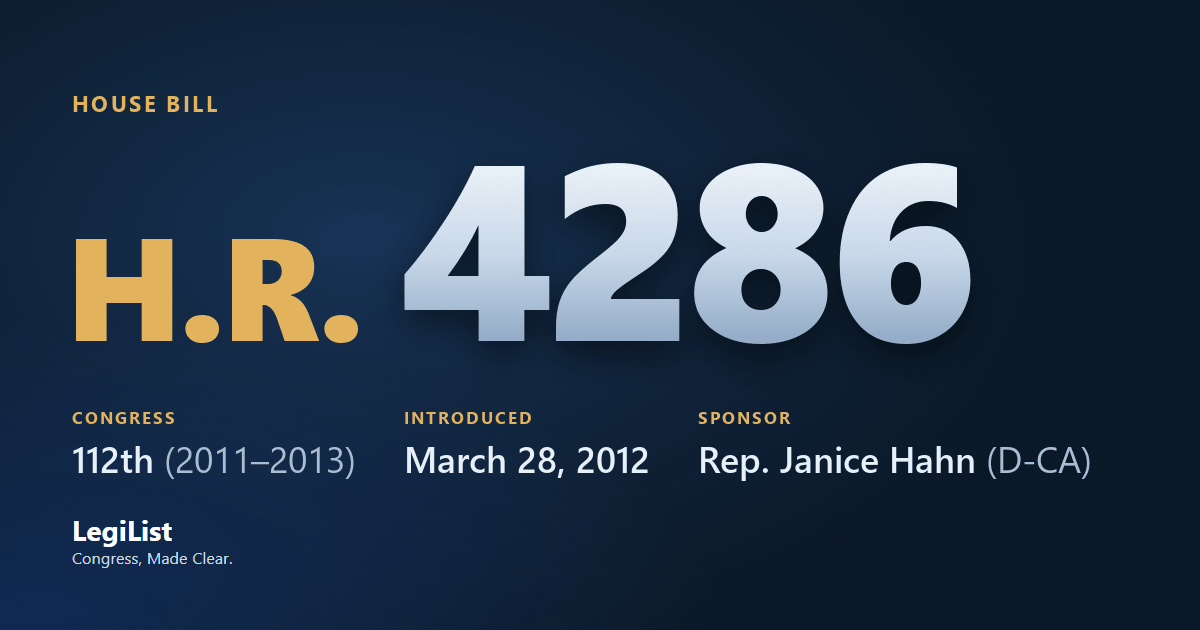
Student Loan Grace Period Extension Act
Latest action · Sep 26, 2012 Referred to the Subcommittee on Higher Education and Workforce Training.
Progress
Where this bill reached, and when. A stage with no date was not reached; one that failed a vote and later carried shows the date it carried.
- IntroducedMar 28, 2012
- Passed HouseNot reached
- Passed SenateNot reached
- To the PresidentNot reached
- Became lawNot reached
Summary
Student Loan Grace Period Extension Act - Amends title IV (Student Assistance) of the Higher Education Act of 1965 to extend the grace period before payment must begin on Direct Stafford Loans from 6 months to 12 months after borrowers cease to carry at least one-half the normal full-time academic workload.
Extends the federal interest subsidy on Direct Stafford Loans to all of the interest accrued on such loans before the loan repayment period begins. (Currently, the subsidy applies to all of the interest accrued before a borrower ceases to carry at least one-half the normal full-time academic workload.)
Cosponsors 23
Members who signed on, in the order they did. Signatures ran from Apr 26, 2012 to Jun 26, 2012.
| Seat | Cosponsor | Signed on | |
|---|---|---|---|
| D-MI | Hansen Clarke | Apr 26, 2012 | |
| D-NY | Yvette D. Clarke | Apr 26, 2012 | |
| D-OH | Dennis J. Kucinich | May 7, 2012 | |
| D-NY | Edolphus Towns | May 7, 2012 | |
| D-DC | Eleanor Holmes Norton | May 7, 2012 | |
| D-MP | Gregorio Kilili Camacho Sablan | May 7, 2012 | |
| D-MN | Keith Ellison | May 7, 2012 | |
| D-GU | Madeleine Z. Bordallo | May 7, 2012 | |
| D-VT | Peter Welch | May 7, 2012 | |
| D-MO | Russ Carnahan | May 7, 2012 | |
| D-NY | Charles B. Rangel | May 10, 2012 | |
| D-MA | John W. Olver | May 10, 2012 | |
| D-IA | Leonard L. Boswell | May 10, 2012 | |
| D-CA | Bob Filner | Jun 8, 2012 | |
| D-IL | Bobby L. Rush | Jun 8, 2012 | |
| D-WI | Gwen Moore | Jun 8, 2012 | |
| D-GA | John Lewis | Jun 8, 2012 | |
| D-TX | Sheila Jackson Lee | Jun 8, 2012 | |
| D-MI | Gary C. Peters | Jun 18, 2012 | |
| D-ME | Michael H. Michaud | Jun 18, 2012 | |
| D-WA | Rick Larsen | Jun 18, 2012 | |
| D-AL | Terri A. Sewell | Jun 18, 2012 | |
| D-TX | Silvestre Reyes | Jun 26, 2012 |
Committees 1
Where it was sent and what each committee and subcommittee did with it, in order.
| Chamber | Committee | What it did |
|---|---|---|
| House | Education and Workforce Committee | Referred Mar 28, 2012 |
| Higher Education and Workforce Development Subcommittee | Referred Sep 26, 2012 |
Actions 4
Everything that happened, newest first.
- Sep 26, 2012Referred to the Subcommittee on Higher Education and Workforce Training.
- Mar 28, 2012Introduced in House
- Mar 28, 2012Sponsor introductory remarks on measure. (CR E465-466)
- Mar 28, 2012Referred to the House Committee on Education and the Workforce.
In the Congressional Record 2
Days the Record’s own index lists this bill, newest first, with the pages and the members it names. Pages starting H are the House, S the Senate, E Extensions of Remarks.
| Where | In the Record | Members | Date |
|---|---|---|---|
| House | Debate and remarks H2081 | Janice Hahn D-CA | Apr 25, 2012 |
| Extensions | Debate and remarks E465 | Janice Hahn D-CA | Mar 28, 2012 |
Research
What has been written about this bill: committee reports, cost estimates, the sponsor’s authority statement, printed hearings and the Congressional Research Service’s work.
Constitutional authority
The sponsor’s statement, as printed in the page H1740.
Titles 2
Every title it has carried, official and short, at each stage.
- Official Title as Introduced
- To restore and extend the grace period before repayment begins on Federal Direct Stafford loans and Federal Direct Unsubsidized Stafford Loans.
- Short Titles as Introduced
- Student Loan Grace Period Extension Act
Subjects
Assigned by the Library of Congress. Policy area: Education.
Text 1
Each version as it was printed, newest first.
- Mar 28, 2012Introduced in House
Everything here is as published by Congress: the summary is the Congressional Research Service's, the action wording is the clerks', and the subjects are the Library of Congress's. How far it got is read from the actions themselves, taking the most recent one of each kind, so a bill that failed a vote and later passed is shown as having passed. Records come from this bill on Congress.gov and govinfo.gov; cost estimates are the Congressional Budget Office's, and the hearings are the printed hearings GovInfo publishes, which can appear months after the hearing.