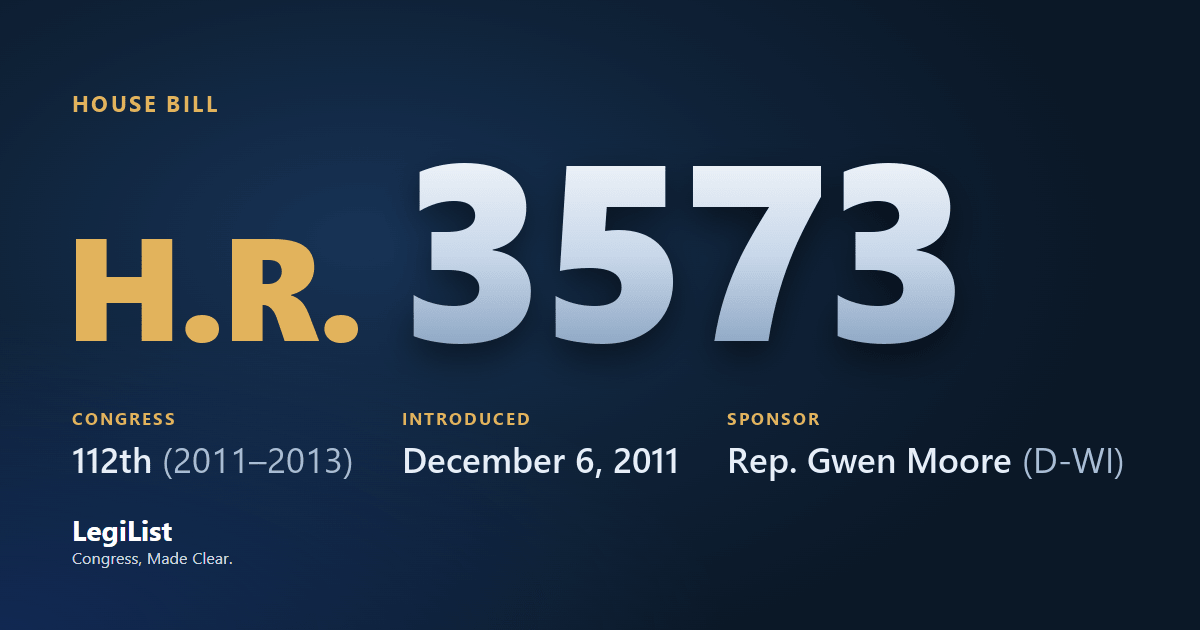
RISE Out of Poverty Act
Latest action · Dec 13, 2011 Referred to the Subcommittee on Human Resources.
Progress
Where this bill reached, and when. A stage with no date was not reached; one that failed a vote and later carried shows the date it carried.
- IntroducedDec 6, 2011
- Passed HouseNot reached
- Passed SenateNot reached
- To the PresidentNot reached
- Became lawNot reached
Summary
Rewriting to Improve and Secure an Exit Out of Poverty Act or RISE Out of Poverty Act - Amends part A (Temporary Assistance for Needy Families Act) (TANF) of title IV of the Social Security Act to require state TANF plans to address whether and how states will give priority to providing assistance in areas with the greatest need.
Extends the TANF program.
Establishes matching grants to the states for subsidized employment.
Sets a flat minimum participation rate of 50% with respect to all families residing in a state that include a work-eligible individual.
Revises participation requirements.
Gives TANF recipients the option to have trained personnel assess certain barriers to employment.
Revises the contents of individual responsibility plans.
Authorizes a state to develop a modified employability plan for a TANF recipient with, or caring for a family member with, a disability.
Prohibits a state from imposing a lifetime sanction or full-family sanction on assistance to any individual or family on the basis of a family member's failure to comply with a program requirement.
Prohibits sanctioning individuals for failure to engage in work if the failure results from the inability to secure child care or after-school arrangements for a child under age 13.
Prohibits imposing a limit of less than 60 months on duration of TANF assistance. Makes the durational limit inapplicable during a recession.
Requires that states establish personnel standards through a merit-based system in the administration of TANF programs.
Bans state use of federal TANF funds to replace state or local spending for non-qualified state expenditures.
Requires TANF assistance to meet basic family economic needs.
Makes reducing child poverty a purpose of the TANF program.
Requires that states adopt standards and procedures to address domestic and sexual violence suffered by TANF recipients.
Requires a state to guarantee child care services to TANF recipients employed or participating in a work activity.
Eliminates the ban on providing assistance to families not assigning certain support rights to the state.
Gives states the option to extend TANF eligibility to children through age 21.
Prohibits considering financial aid tied to education of a child in determining eligibility for or the amount of TANF.
Eliminates bars to TANF assistance for persons convicted of drug felonies, unwed teen parents not in school, and teens not in an adult-supervised living arrangement.
Cosponsors 23
Members who signed on, in the order they did. Signatures ran from Dec 6, 2011 to Feb 29, 2012; 10 are original cosponsors, there from the day it was introduced.
| Seat | Cosponsor | Signed on | |
|---|---|---|---|
| D-MS | Bennie G. Thompson | Original | Dec 6, 2011 |
| D-IL | Danny K. Davis | Original | Dec 6, 2011 |
| D-VI | Donna M. Christensen | Original | Dec 6, 2011 |
| D-NY | Edolphus Towns | Original | Dec 6, 2011 |
| D-DC | Eleanor Holmes Norton | Original | Dec 6, 2011 |
| D-MO | Emanuel Cleaver | Original | Dec 6, 2011 |
| D-CA | Fortney Pete Stark | Original | Dec 6, 2011 |
| D-IL | Jesse L. Jackson, Jr. | Original | Dec 6, 2011 |
| D-MI | John Conyers, Jr. | Original | Dec 6, 2011 |
| D-CA | Maxine Waters | Original | Dec 6, 2011 |
| D-FL | Corrine Brown | Dec 12, 2011 | |
| D-CA | Bob Filner | Dec 13, 2011 | |
| D-CA | Barbara Lee | Dec 15, 2011 | |
| D-CA | Lynn C. Woolsey | Dec 15, 2011 | |
| D-AZ | Raúl M. Grijalva | Dec 15, 2011 | |
| D-IN | André Carson | Dec 16, 2011 | |
| D-CT | Rosa L. DeLauro | Dec 20, 2011 | |
| D-NJ | Donald M. Payne | Jan 17, 2012 | |
| D-TN | Steve Cohen | Jan 18, 2012 | |
| D-IL | Janice D. Schakowsky | Jan 27, 2012 | |
| D-OH | Dennis J. Kucinich | Feb 2, 2012 | |
| D-MO | Wm. Lacy Clay | Feb 15, 2012 | |
| D-PA | Robert A. Brady | Feb 29, 2012 |
Committees 2
Where it was sent and what each committee and subcommittee did with it, in order.
| Chamber | Committee | What it did |
|---|---|---|
| House | Ways and Means Committee | Referred Dec 6, 2011 |
| Work and Welfare Subcommittee | Referred Dec 13, 2011 | |
| House | Oversight and Government Reform Committee | Referred Dec 6, 2011 |
Actions 3
Everything that happened, newest first.
- Dec 13, 2011Referred to the Subcommittee on Human Resources.
- Dec 6, 2011Introduced in House
- Dec 6, 2011Referred to the Committee on Ways and Means, and in addition to the Committee on Oversight and Government Reform, for a period to be subsequently determined by the Speaker, in each case for consideration of such provisions as fall within the jurisdiction of the committee concerned.
Research
What has been written about this bill: committee reports, cost estimates, the sponsor’s authority statement, printed hearings and the Congressional Research Service’s work.
Constitutional authority
The sponsor’s statement, as printed in the page H8187.
CRS reports 1
Congressional Research Service work that CRS links to this bill or the law it became, newest first.
Cite it 1
Products on other subjects that cite it, usually among other measures.
| Product | Title | Kind | Published |
|---|---|---|---|
| R41781 | The Temporary Assistance for Needy Families (TANF) Block Grant: Issues for the 112th Congress Archived | Report | Mar 1, 2012 |
Titles 3
Every title it has carried, official and short, at each stage.
- Official Title as Introduced
- To reauthorize and amend the program of block grants to States for temporary assistance for needy families and related programs.
- Short Titles as Introduced
- RISE Out of Poverty Act
- Rewriting to Improve and Secure an Exit Out of Poverty Act
Subjects
Assigned by the Library of Congress. Policy area: Social Welfare.
- Child care and development
- Child safety and welfare
- Crime victims
- Crimes against women
- Disability and paralysis
- Domestic violence and child abuse
- Drug trafficking and controlled substances
- Economic performance and conditions
- Employment and training programs
- Higher education
- Intergovernmental relations
- Performance measurement
- Poverty and welfare assistance
- Separation, divorce, custody, support
- Sex offenses
- Social Welfare
- State and local finance
- State and local government operations
- Student aid and college costs
- Teenage pregnancy
- Unemployment
- Wages and earnings
Text 1
Each version as it was printed, newest first.
- Dec 6, 2011Introduced in House
Everything here is as published by Congress: the summary is the Congressional Research Service's, the action wording is the clerks', and the subjects are the Library of Congress's. How far it got is read from the actions themselves, taking the most recent one of each kind, so a bill that failed a vote and later passed is shown as having passed. Records come from this bill on Congress.gov and govinfo.gov; cost estimates are the Congressional Budget Office's, and the hearings are the printed hearings GovInfo publishes, which can appear months after the hearing.