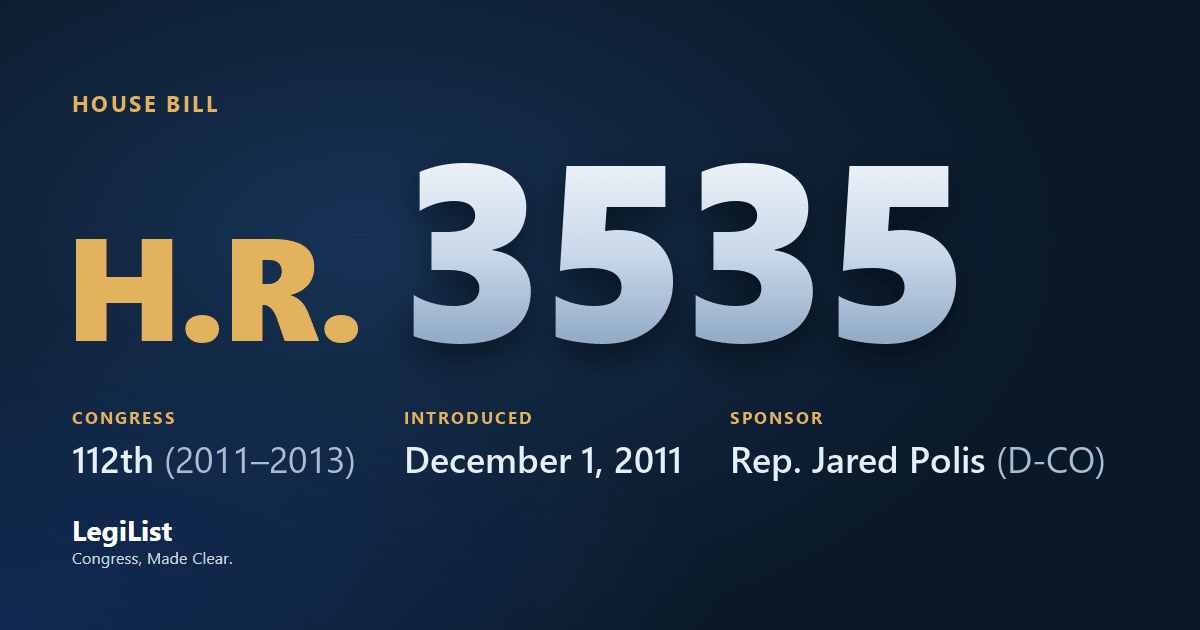
ACE Act
Latest action · Mar 29, 2012 Referred to the Subcommittee on Early Childhood, Elementary, and Secondary Education.
Progress
Where this bill reached, and when. A stage with no date was not reached; one that failed a vote and later carried shows the date it carried.
- IntroducedDec 1, 2011
- Passed HouseNot reached
- Passed SenateNot reached
- To the PresidentNot reached
- Became lawNot reached
Summary
Achieving Change in Education Act or ACE Act - Amends the Elementary and Secondary Education Act of 1965 (ESEA) to require states to identify public elementary or secondary schools as reward schools if they are making significant progress in closing the achievement gap and increasing student academic achievement, growth, and high school graduation rates for students in the aggregate and for the poor, minority, disabled, and limited English proficient student subgroups.
Allows reward schools to use ESEA funds, except those related to serving special populations, in a comprehensive and coordinated manner for innovative programs.
Directs the Secretary of Education to award formula grants to states and, through them, subgrants to local educational agencies (LEAs) to provide: (1) tangible rewards to reward school staff, and (2) reward schools with financial rewards and increased budgeting and staffing flexibility.
Requires states to identify public schools as persistently low-performing schools if they are not making progress in improving the academic performance of their students and are performing in the bottom 5% of the state's elementary and secondary schools or have secondary school graduation rates below 60%.
Requires the Secretary to make formula grants to states and, through them, competitive subgrants to LEAs and LEAs that partner with experienced turnaround partners to: (1) implement one of six intervention models at each persistently low-performing school, and (2) identify and address issues that may contribute to low academic achievement in such schools. Sets forth the intervention actions required under the transformation, restart, school closure, turnaround, school engagement, and expanded school choice models. Makes LEAs eligible for a subgrant extension if they make significant annual progress on certain core academic indicators and leading indicators.
Cosponsors 1
Members who signed on, in the order they did. All signed on Dec 1, 2011.
| Seat | Cosponsor | Signed on | |
|---|---|---|---|
| D-CA | Susan A. Davis | Original | Dec 1, 2011 |
Committees 1
Where it was sent and what each committee and subcommittee did with it, in order.
| Chamber | Committee | What it did |
|---|---|---|
| House | Education and Workforce Committee | Referred Dec 1, 2011 |
| Early Childhood, Elementary, and Secondary Education Subcommittee | Referred Mar 29, 2012 |
Actions 3
Everything that happened, newest first.
- Mar 29, 2012Referred to the Subcommittee on Early Childhood, Elementary, and Secondary Education.
- Dec 1, 2011Introduced in House
- Dec 1, 2011Referred to the House Committee on Education and the Workforce.
Research
What has been written about this bill: committee reports, cost estimates, the sponsor’s authority statement, printed hearings and the Congressional Research Service’s work.
Constitutional authority
The sponsor’s statement, as printed in the page H8076.
Related bills 1
Companion bills and other measures the record links to this one.
| Bill | Title | Relationship | Latest action |
|---|---|---|---|
| S 959 | STAR Act of 2011 | Related bill | May 12, 2011 |
Titles 3
Every title it has carried, official and short, at each stage.
- Official Title as Introduced
- To improve outcomes for students in persistently low-performing schools, to create a culture of recognizing, rewarding, and replicating educational excellence, to authorize school turnaround grants, and for other purposes.
- Short Titles as Introduced
- ACE Act
- Achieving Change in Education Act
Subjects
Assigned by the Library of Congress. Policy area: Education.
Text 1
Each version as it was printed, newest first.
- Dec 1, 2011Introduced in House
Support LegiList
This page is free, carries no paywall, and is built and maintained by one person. If the record here is useful to you, a few dollars keeps it going.
Everything here is as published by Congress: the summary is the Congressional Research Service's, the action wording is the clerks', and the subjects are the Library of Congress's. How far it got is read from the actions themselves, taking the most recent one of each kind, so a bill that failed a vote and later passed is shown as having passed. Records come from this bill on Congress.gov and govinfo.gov; cost estimates are the Congressional Budget Office's, and the hearings are the printed hearings GovInfo publishes, which can appear months after the hearing.