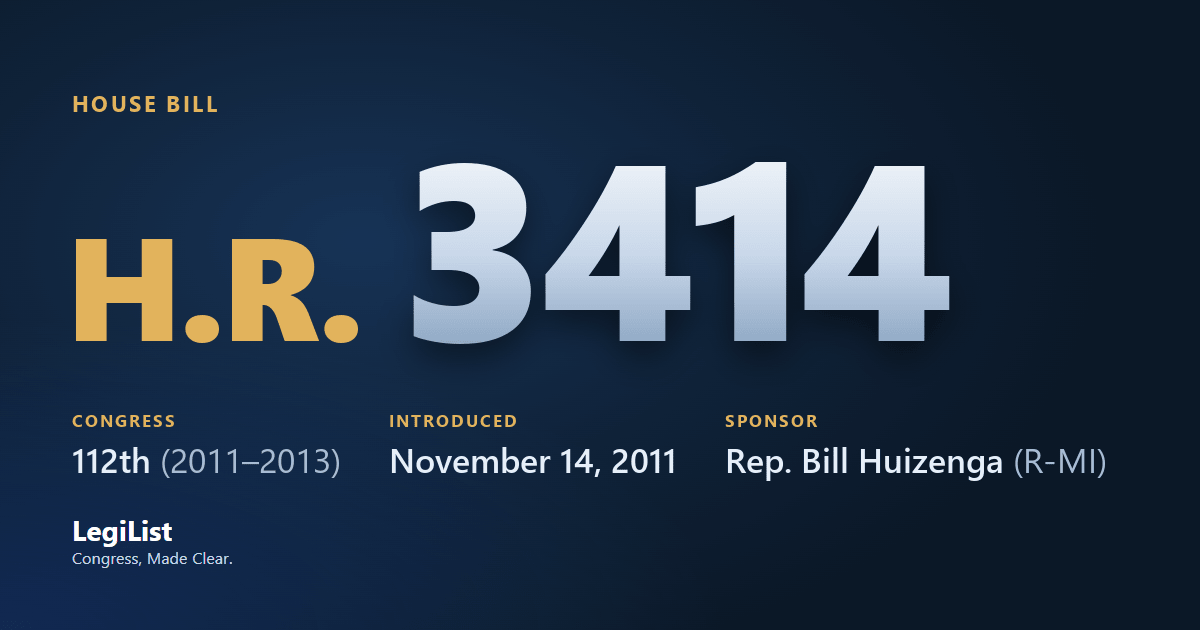
Honest Budget Act
Latest action · Nov 14, 2011 Referred to the Committee on the Budget, and in addition to the Committees on Rules, and Oversight and Government Reform, for a period to be subsequently determined by the Speaker, in each case for consideration of such provisions as fall within the jurisdiction of the committee concerned.
Progress
Where this bill reached, and when. A stage with no date was not reached; one that failed a vote and later carried shows the date it carried.
- IntroducedNov 14, 2011
- Passed HouseNot reached
- Passed SenateNot reached
- To the PresidentNot reached
- Became lawNot reached
Summary
Honest Budget Act - Amends procedures in the Congressional Budget Act of 1974 (CBA) that make it out of order in the Senate to consider appropriations legislation until the Senate agrees to a concurrent resolution on the budget. Permits waivers or suspension of such requirements, or successful appeals from a ruling of the Chair, by an affirmative vote of three-fifths (60) of the Senate.
Declares that it shall not be in order in the House of Representatives to consider certain bills, joint resolutions, or conference reports that designate as an emergency requirement any provision that creates discretionary or direct spending or decreases revenues.
Establishes a procedure for emergency designations by amendment.
Amends the Federal Credit Reform Act of 1990 (FCRA) to revise the budgetary treatment of federal direct loans and loan guarantees to account for them on a fair value basis (currently, a FCRA accrual basis).
Expands such new budgetary treatment to financial investments beginning in FY2015. Defines "financial investment" as a federal government investment in any securities (debt or equity) or futures, swaps, or other derivatives, issued by a non-federal entity, regardless of whether the issuances are federally guaranteed, or issued by a federal entity if the issuance consists of marketable securities.
Requires the President's budget: (1) from FY1992 on to reflect the Treasury discounting component of direct loan and loan guarantee programs; and (2) from FY2015 on to reflect the costs of direct loan, loan guarantee, and financial investment programs.
Defines "Treasury discounting component" as the estimated long-term cost to the federal government of a direct loan, loan guarantee, or financial investment calculated on a net present value basis, excluding administrative costs and any incidental effects on governmental receipts or outlays.
Revises other requirements for the President's budget including conditions for new direct loan obligations incurred and loan guarantee commitments made for FY1992 and thereafter, and new financial investment commitments for FY2015 and thereafter. Requires new budget authority for such loans or loan guarantee or financial investment commitments to be provided in advance in an appropriations Act.
Exempts a direct loan or loan guarantee program that constitutes an entitlement (such as the guaranteed student loan program or the veteran's home loan guaranty program) as well as all existing credit programs of the Commodity Credit Corporation (CCC) from: (1) the above requirement; and (2) the prohibition against modification of an outstanding direct loan, loan guarantee, or financial investment in a manner that increases its costs unless budget authority for the additional cost has been provided in advance in an appropriations Act.
Revises requirements for Treasury transactions with financing accounts (nonbudget accounts associated with each program account which holds balances, receives the cost payment from the program account, and also includes all other cash flows to and from the federal government resulting from such obligations or commitments made on or after October 1, 1991).
Limits the availability of amounts in liquidating accounts to specified payments resulting from direct loan obligations or loan guarantee commitments made before October 1, 1991.
Prescribes requirements for consideration of legislation after agreement on a budget resolution (in effect, extending a point of order against certain changes in mandatory programs to all such programs in appropriations bills).
Prohibits the congressional budget committees from counting rescissions of budget authority that do not result in outlay savings over the period covered by a budget resolution when determining the levels of new budget authority, outlays, direct spending, new entitlement authority, and revenues for a fiscal year.
Suspends within-grade step increases in the compensation of certain federal employees from the date of enactment of this Act until December 31, 2012.
Makes it out of order in the House to consider any legislation that would provide an advance appropriation, except for employment training, education programs, Head Start, rental assistance, the Corporation for Public Broadcasting, and veterans' medical services. Allows waiver of this rule by a vote of three-fifths of the Members.
Prohibits shifts in outlays or revenues from one year to another by a date change to act as an offset for other provisions that increase the deficit for a time period.
Prescribes a budget scoring rule for transfers from the Treasury General Fund to the Highway Trust Fund that increase the level of indebtedness subject to the current applicable statutory public debt limit.
Cosponsors 6
Members who signed on, in the order they did. Signatures ran from Nov 17, 2011 to Feb 1, 2012.
| Seat | Cosponsor | Signed on | |
|---|---|---|---|
| R-TX | Kenny Marchant | Nov 17, 2011 | |
| R-MI | Tim Walberg | Nov 17, 2011 | |
| R-SC | Joe Wilson | Dec 1, 2011 | |
| R-TX | Louie Gohmert | Dec 1, 2011 | |
| R-GA | Austin Scott | Feb 1, 2012 | |
| R-NY | Nan A. S. Hayworth | Feb 1, 2012 |
Committees 3
Where it was sent and what each committee and subcommittee did with it, in order.
| Chamber | Committee | What it did |
|---|---|---|
| House | Budget Committee | Referred Nov 14, 2011 |
| House | Rules Committee | Referred Nov 14, 2011 |
| House | Oversight and Government Reform Committee | Referred Nov 14, 2011 |
Actions 2
Everything that happened, newest first.
- Nov 14, 2011Introduced in House
- Nov 14, 2011Referred to the Committee on the Budget, and in addition to the Committees on Rules, and Oversight and Government Reform, for a period to be subsequently determined by the Speaker, in each case for consideration of such provisions as fall within the jurisdiction of the committee concerned.
Research
What has been written about this bill: committee reports, cost estimates, the sponsor’s authority statement, printed hearings and the Congressional Research Service’s work.
Constitutional authority
The sponsor’s statement, as printed in the page H7578.
Related bills 3
Companion bills and other measures the record links to this one.
| Bill | Title | Relationship | Latest action |
|---|---|---|---|
| S 1651 | Honest Budget Act | Related bill | Oct 4, 2011 |
| HR 3581 | Budget and Accounting Transparency Act of 2012 | Related bill | Feb 9, 2012 |
| HR 3844 | Honest Budget Act of 2012 | Related bill | Feb 2, 2012 |
Titles 2
Every title it has carried, official and short, at each stage.
- Official Title as Introduced
- To provide for greater transparency and honesty in the Federal budget process.
- Short Titles as Introduced
- Honest Budget Act
Subjects
Assigned by the Library of Congress. Policy area: Economics and Public Finance.
- Appropriations
- Budget deficits and national debt
- Budget process
- Economics and Public Finance
- Government employee pay, benefits, personnel management
- Government lending and loan guarantees
- Government trust funds
- Legislative rules and procedure
- Roads and highways
- Senate
- Transportation programs funding
Text 1
Each version as it was printed, newest first.
- Nov 14, 2011Introduced in House
Support LegiList
This page is free, carries no paywall, and is built and maintained by one person. If the record here is useful to you, a few dollars keeps it going.
Everything here is as published by Congress: the summary is the Congressional Research Service's, the action wording is the clerks', and the subjects are the Library of Congress's. How far it got is read from the actions themselves, taking the most recent one of each kind, so a bill that failed a vote and later passed is shown as having passed. Records come from this bill on Congress.gov and govinfo.gov; cost estimates are the Congressional Budget Office's, and the hearings are the printed hearings GovInfo publishes, which can appear months after the hearing.