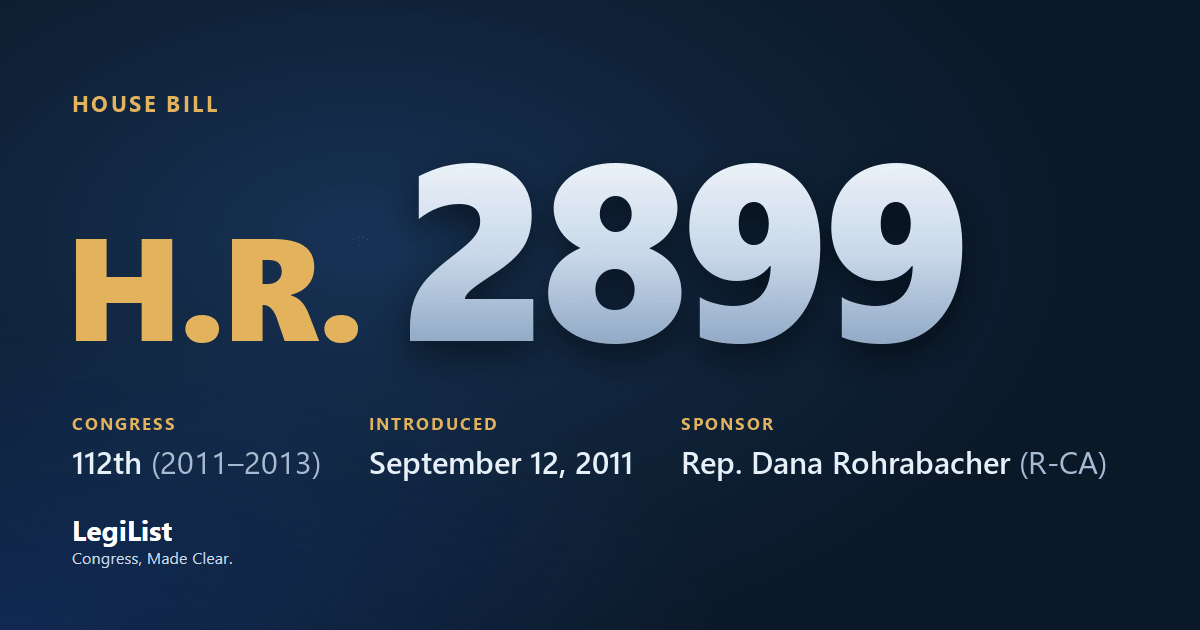
Chinese Media Reciprocity Act of 2011
Latest action · Jun 20, 2012 Subcommittee Hearings Held.
Progress
Where this bill reached, and when. A stage with no date was not reached; one that failed a vote and later carried shows the date it carried.
- IntroducedSep 12, 2011
- Passed HouseNot reached
- Passed SenateNot reached
- To the PresidentNot reached
- Became lawNot reached
Summary
Chinese Media Reciprocity Act of 2011 - Amends the Immigration and Nationality Act to limit the number of I-visas (foreign media) issued to state-controlled media workers from China to the number of visas issued by China to U.S. nationals who are employees of the Broadcasting Board of Governors (BBG) and who seek to enter China solely to engage in such vocation.
Requires revocation of a sufficient number of I-visas issued to Chinese state media workers in order to reach parity with the number of visas issued by China for BBG employees seeking entry to China.
Cosponsors 7
Members who signed on, in the order they did. Signatures ran from Sep 12, 2011 to Jun 26, 2012; 2 are original cosponsors, there from the day it was introduced.
| Seat | Cosponsor | Signed on | |
|---|---|---|---|
| R-VA | J. Randy Forbes | Original | Sep 12, 2011 |
| R-TX | Ted Poe | Original | Sep 12, 2011 |
| R-VA | Frank R. Wolf | Oct 11, 2011 | |
| R-NJ | Christopher H. Smith | Oct 13, 2011 | |
| R-MI | Thaddeus G. McCotter | Oct 13, 2011 | |
| R-SC | Jeff Duncan | Nov 29, 2011 | |
| R-FL | Mario Diaz-Balart | Jun 26, 2012 |
Committees 1
Where it was sent and what each committee and subcommittee did with it, in order.
| Chamber | Committee | What it did |
|---|---|---|
| House | Judiciary Committee | Referred Sep 12, 2011 |
| Immigration Integrity, Security, and Enforcement Subcommittee | Referred Sep 23, 2011Hearings Jun 20, 2012 |
Actions 4
Everything that happened, newest first.
- Jun 20, 2012Subcommittee Hearings Held.
- Sep 23, 2011Referred to the Subcommittee on Immigration Policy and Enforcement.
- Sep 12, 2011Introduced in House
- Sep 12, 2011Referred to the House Committee on the Judiciary.
Research
What has been written about this bill: committee reports, cost estimates, the sponsor’s authority statement, printed hearings and the Congressional Research Service’s work.
Constitutional authority
The sponsor’s statement, as printed in the page H6097.
Printed hearings 2
Hearings whose printed record names this bill, newest first: hearings on it, and wider hearings where it came up.
| Number | Hearing | Committee | Held |
|---|---|---|---|
| Serial No. 112-110 | CHINESE MEDIA RECIPROCITY ACT OF 201151 pages | Judiciary Committee | Jun 20, 2012 |
| Serial No. 112-54 | FOSTERING QUALITY SCIENCE AT EPA: PERSPECTIVES ON COMMON SENSE REFORM (PART I AND PART II)209 pages | Science, Space, and Technology Committee | Nov 30, 2011–Feb 3, 2012 |
CRS reports 2
Congressional Research Service work that CRS links to this bill or the law it became, newest first.
Cite it 2
Products on other subjects that cite it, usually among other measures.
| Product | Title | Kind | Published |
|---|---|---|---|
| LSB10601 | The Law of Foreign Missions and Media in U.S.-China Relations | Insight | May 20, 2021 |
| R44897 | Human Rights in China and U.S. Policy: Issues for the 115th Congress Archived | Report | Jul 17, 2017 |
Titles 2
Every title it has carried, official and short, at each stage.
- Official Title as Introduced
- To amend the Immigration and Nationality Act to ensure open and free journalism access in the People's Republic of China by establishing a reciprocal relationship between the number of visas issued to state-controlled media workers in China and in the United States.
- Short Titles as Introduced
- Chinese Media Reciprocity Act of 2011
Subjects
Assigned by the Library of Congress. Policy area: Immigration.
Text 1
Each version as it was printed, newest first.
- Sep 12, 2011Introduced in House
Support LegiList
This page is free, carries no paywall, and is built and maintained by one person. If the record here is useful to you, a few dollars keeps it going.
Everything here is as published by Congress: the summary is the Congressional Research Service's, the action wording is the clerks', and the subjects are the Library of Congress's. How far it got is read from the actions themselves, taking the most recent one of each kind, so a bill that failed a vote and later passed is shown as having passed. Records come from this bill on Congress.gov and govinfo.gov; cost estimates are the Congressional Budget Office's, and the hearings are the printed hearings GovInfo publishes, which can appear months after the hearing.