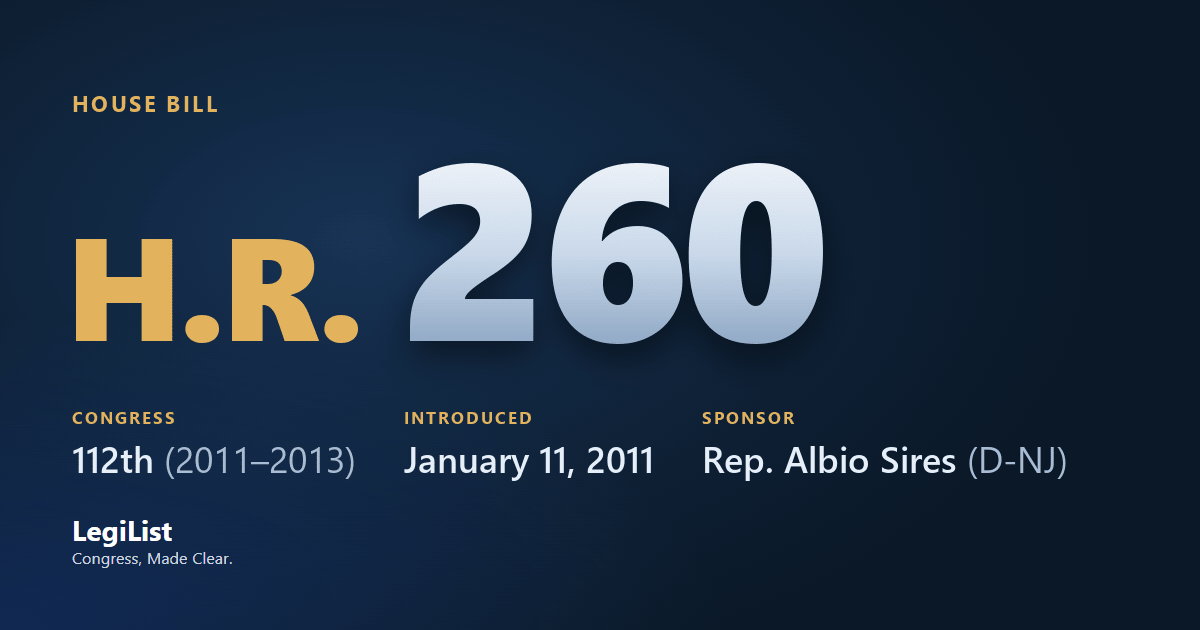
Commute LESS Act of 2011
Latest action · Jan 12, 2011 Referred to the Subcommittee on Highways and Transit.
Progress
Where this bill reached, and when. A stage with no date was not reached; one that failed a vote and later carried shows the date it carried.
- IntroducedJan 11, 2011
- Passed HouseNot reached
- Passed SenateNot reached
- To the PresidentNot reached
- Became lawNot reached
Summary
Commute LESS Act of 2011 or Commute-Leveraging Employer Support and Successes Act of 2011 - Amends the Safe, Accountable, Flexible, Efficient Transportation Equity Act: A Legacy for Users (SAFETEA-LU) to revise the composition of metropolitan planning organizations (MPOs) to include at least one representative designated by an employer advisory council established by this Act.
Revises contents of MPO transportation plans prepared for metropolitan planning areas to include proposed activities and strategies to provide outreach to employers in the region to create and expand alternative commuting and commuter benefit programs (i.e. carpools, transit benefit, and telework programs).
Requires each MPO to establish an employer advisory council consisting of representatives of employers within the MPO's boundaries.
Requires an MPO transportation improvement program (TIP) to be developed in coordination with the advisory council and to include projects identified by it.
Requires the advisory council to: (1) review how long-range transportation plans and TIPs will affect commuting habits; and (2) develop a commuter trip reduction plan.
Directs the Secretary of Transportation (DOT) to create and expand employer investment in transportation and commuter benefit programs. Requires a state receiving funding, in coordination with MPOs, to establish statewide goals for achieving reductions in vehicle miles traveled.
Requires a recipient receiving federal-aid highway funding for a project with a value of $100 million or more or that will reduce traffic flow for more than 120 days to prepare, in coordination with the advisory council, a congestion mitigation plan for the project that includes funding for projects that reduce peak hour vehicle miles traveled along an impacted corridor.
Requires the Secretary, when approving a major capital investment grant of $75 million or more for a major new fixed guideway capital project, to consider, among other things, the ability of the grant recipient to work with employers to get commuters to utilize the project. Directs the Secretary to require the grant applicant to include in its request a plan on how it intends to work with local employers and transportation management organizations to create and expand a commuter benefit program for the project.
Cosponsors 3
Members who signed on, in the order they did. All signed on Jan 11, 2011.
| Seat | Cosponsor | Signed on | |
|---|---|---|---|
| D-CA | Grace F. Napolitano | Original | Jan 11, 2011 |
| D-MA | Michael E. Capuano | Original | Jan 11, 2011 |
| D-MO | Russ Carnahan | Original | Jan 11, 2011 |
Committees 1
Where it was sent and what each committee and subcommittee did with it, in order.
| Chamber | Committee | What it did |
|---|---|---|
| House | Transportation and Infrastructure Committee | Referred Jan 11, 2011 |
| Highways and Transit Subcommittee | Referred Jan 12, 2011 |
Actions 3
Everything that happened, newest first.
- Jan 12, 2011Referred to the Subcommittee on Highways and Transit.
- Jan 11, 2011Introduced in House
- Jan 11, 2011Referred to the House Committee on Transportation and Infrastructure.
In the Congressional Record 1
Days the Record’s own index lists this bill, newest first, with the pages and the members it names. Pages starting H are the House, S the Senate, E Extensions of Remarks.
| Where | In the Record | Members | Date |
|---|---|---|---|
| House | Lists H141H.R. 260-261 | — | Jan 11, 2011 |
Research
What has been written about this bill: committee reports, cost estimates, the sponsor’s authority statement, printed hearings and the Congressional Research Service’s work.
Constitutional authority
The sponsor’s statement, as printed in the page H141.
Printed hearings 2
Hearings whose printed record names this bill, newest first: hearings on it, and wider hearings where it came up.
| Number | Hearing | Committee | Held |
|---|---|---|---|
| Serial No. 112-21 | POLICY PROPOSALS FROM MEMBERS OF CONGRESS TO REFORM THE NATION'S SURFACE TRANSPORTATION PROGRAMS224 pages | Transportation and Infrastructure Committee | Apr 5, 2011 |
| Serial No. 112-19 | IMPROVING AND REFORMING THE NATION'S SURFACE TRANSPORTATION PROGRAMS675 pages | Transportation and Infrastructure Committee | Mar 29, 2011–Mar 30, 2011 |
Titles 3
Every title it has carried, official and short, at each stage.
- Official Title as Introduced
- To amend titles 23 and 49, United States Code, to enhance employer involvement in transportation planning and to create and expand commuter benefit programs, and for other purposes.
- Short Titles as Introduced
- Commute-Leveraging Employer Support and Successes Act of 2011
- Commute LESS Act of 2011
Subjects
Assigned by the Library of Congress. Policy area: Transportation and Public Works.
Text 1
Each version as it was printed, newest first.
- Jan 11, 2011Introduced in House
Everything here is as published by Congress: the summary is the Congressional Research Service's, the action wording is the clerks', and the subjects are the Library of Congress's. How far it got is read from the actions themselves, taking the most recent one of each kind, so a bill that failed a vote and later passed is shown as having passed. Records come from this bill on Congress.gov and govinfo.gov; cost estimates are the Congressional Budget Office's, and the hearings are the printed hearings GovInfo publishes, which can appear months after the hearing.